
Colostrum labels have become surprisingly competitive. One brand leads with grass-fed cattle, another with a big IgG percentage, while another has a proprietary process, a frosted jar, and enough pastoral photography to make the cows appear to have personal publicists.
That can turn a simple purchase into label-decoding, because the biggest claim on the jar isn’t always the one that tells you the most.
A good colostrum supplement starts with good colostrum: healthy cattle, early collection, careful processing, a meaningful serving, and testing that shows the finished product is what the label says it is.
IgG matters, but it’s only one part of colostrum. Whole colostrum also contains naturally occurring fat, lactoferrin, peptides, growth factors, and other immunoglobulins, so we don’t think the entire food should be judged by one percentage.
That’s why our Grass-Fed Colostrum is first-milking, whole and non-defatted, sourced from grass-fed, pasture-raised cattle, and processed at low temperature and pressure. We’d rather preserve the food than strip it down just to make one number look better.
Table of Contents
What Is the Best Colostrum Supplement?
The best colostrum supplement should tell you where it came from, when it was collected, how much you’re getting, how it was processed, and what was tested.
After that, the right product depends on what matters most to you:
- Whole-food approach: Look for whole, non-defatted colostrum with minimal added ingredients.
- IgG comparison: Look for a disclosed percentage, a clear testing method, and finished-product testing.
- Convenience: Capsules travel well and skip the dairy taste.
- Higher daily amounts: Powder makes several grams easier and usually costs less per gram.
- Athletes: Look for transparent contaminant testing and sports certification where relevant.
For us, sourcing and the integrity of the whole food come before a headline percentage.
Embed video: The Dirty Little Secret Behind The Best-Selling Colostrum
A Quick Colostrum Buying Checklist
You shouldn’t need a detective board to compare two jars.
Look for:
- Bovine source clearly identified
- First or early milking
- Grass-fed or pasture-raised sourcing with real detail behind it
- Whole or defatted status disclosed
- Grams or milligrams per full serving
- Processing method explained
- Third-party testing
- Minimal ingredients
- A clear milk-allergen warning
- Realistic claims
- Cost per gram or full serving
Be cautious when you see:
- No total colostrum amount
- Only a proprietary blend
- No sourcing or testing information
- A huge IgG claim with no testing method
- A tiny serving compared with the research being cited
- Drug-like or disease claims
A brand that can answer the boring questions is usually more useful than one that only has exciting adjectives.
Nine Criteria That Separate Colostrum Products
The best comparison starts with the food itself, then works outward. Source and collection timing tell you what went into the product, while serving size, processing, and testing tell you what you’re actually buying.
1. Check the Source of the Colostrum
Most adult colostrum supplements use bovine colostrum, so the real differences start with the cattle and supply chain.
Look for clear answers on where the cattle are raised, whether they’re grass-fed and pasture-raised, how the farms are managed, and whether the colostrum is collected after the calf’s needs are met.
Does grass-fed colostrum matter? It tells you something about how the animals were raised and how transparent the sourcing is. It doesn’t prove better clinical outcomes by itself, because we don’t have head-to-head human trials showing that.
For us, grass-fed and pasture-raised sourcing is still part of the standard. We care about the quality of the animal food before it ever reaches a processing facility.
2. Look for First-Milking or Early Colostrum
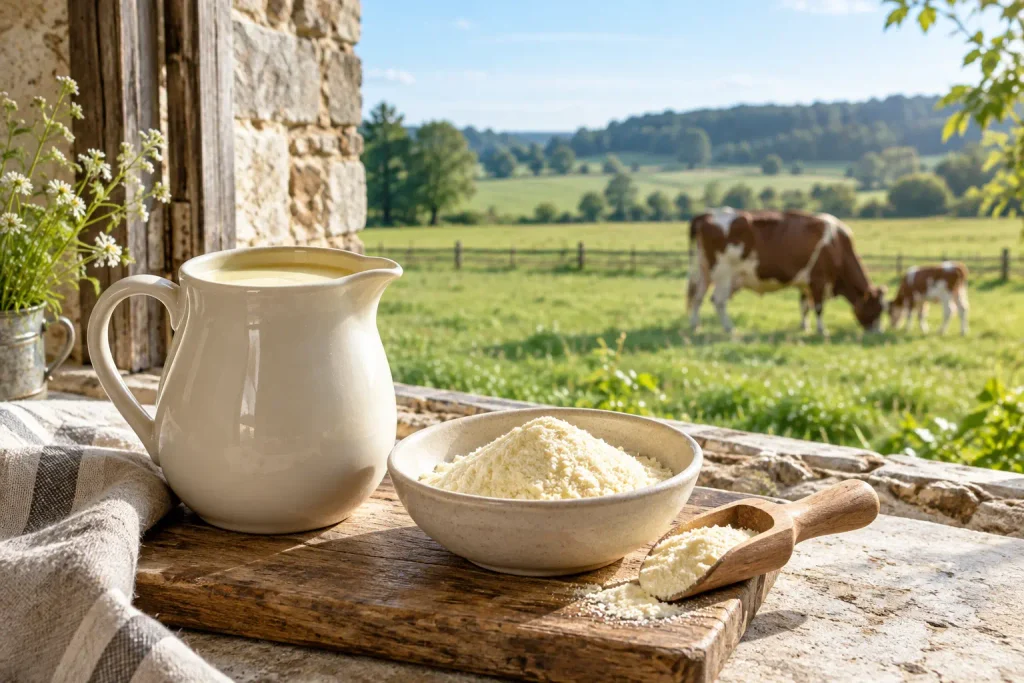
Earlier collection matters because colostrum changes quickly after birth.
Research shows IgG concentration generally declines as the time between calving and collection increases. That makes first-milking colostrum a useful quality signal.
It still doesn’t guarantee a specific IgG percentage or tell you how the finished powder was handled. That’s why collection timing and finished-product testing belong in the same conversation.
3. Compare the Actual Amount Per Serving
This is where labels can get needlessly clever.
What matters is the total colostrum in a full serving, not how many capsules happen to be in the bottle.
For example:
- Six 500 mg capsules = 3 grams
- One 3-gram scoop = 3 grams
- Two 500 mg capsules = 1 gram
So compare grams per serving, servings per container, and cost per gram. A giant capsule count doesn’t mean much if the serving itself is tiny.
That matters because many colostrum studies, especially in athletes, use gram-level servings. A smaller retail serving isn’t automatically useless, but it shouldn’t borrow the results of a much larger dose without saying so.
4. Understand IgG Content
IgG is useful, but it isn’t the whole product.
It’s the main immunoglobulin used to assess bovine colostrum quality, which is why brands love putting the percentage on the front.
The testing method matters, though. Scientific reviews note that methods such as radial immunodiffusion and ELISA can directly measure immunoglobulins, while refractometers and colostrometers provide indirect estimates.
And percentage alone can be misleading:
- 1 gram at 40% IgG = 400 mg IgG
- 5 grams at 20% IgG = 1 gram IgG
So a higher percentage doesn’t automatically mean a larger total amount.
We don’t publish a standardized IgG percentage for our colostrum. Our priority is whole, non-defatted first-milking colostrum with finished-product testing for biological activity and contaminants. If IgG percentage is your main buying criterion, compare products that publish a verified finished-product figure.
5. Whole Colostrum vs Defatted Colostrum
Whole colostrum keeps its naturally occurring fat, while defatted colostrum has some or most of that fat removed.
Removing fat can raise the percentage of protein and immunoglobulins by weight, which can make a defatted product look stronger on a comparison chart. But the trade-off is that you’ve also removed part of the original food.
Whole colostrum keeps more of the natural matrix intact, while defatted products are better suited to brands that want a more standardized or concentrated protein fraction.
Neither approach automatically proves better clinical outcomes.
We choose whole, non-defatted colostrum because we’d rather preserve the food than remove part of it to optimize a single headline number.
6. Examine the Processing Method
Colostrum has to be processed because fresh colostrum is highly perishable. The useful question is how much processing happened and whether the company can explain it.
You’ll see methods such as spray drying, freeze-drying, pasteurization, filtration, and low-temperature processing. Heat, pressure, oxygen, and storage can all affect sensitive proteins and other compounds, so gentler processing makes sense when the goal is preservation.
Our Grass-Fed Colostrum uses low-temperature, low-pressure processing and spray drying to create a shelf-stable product while maintaining biological activity.
No process keeps every component perfectly unchanged. What matters is whether the company tests the finished product instead of asking you to trust words like raw, bioactive, or untouched.
7. Require Third-Party Testing
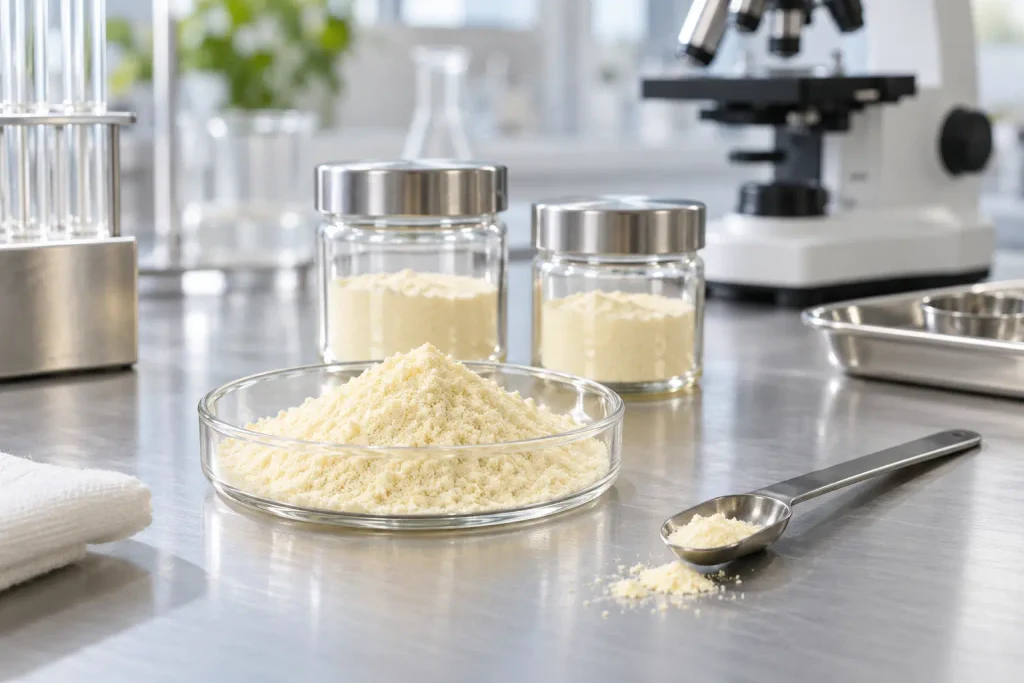
With colostrum, testing matters because the product passes through a farm, collection, processing, and manufacturing chain before it gets to you.
Useful testing can include:
- Identity and purity
- Biological activity
- Heavy metals
- Pesticides
- Microbial contaminants
- Other contaminants relevant to the finished product
Our colostrum is independently tested during and after manufacturing for purity, biological activity, heavy metals, pesticides, and microbes.
That tells you more than another badge on the front of the jar.
8. Check for Unnecessary Ingredients
Colostrum doesn’t need much company.
Flavors, sweeteners, gums, lecithin, and flow agents can make a product easier to mix or more pleasant to drink, but they also make the formula harder to compare.
If you want the simplest option, look for unflavored colostrum with as little added as possible. Then check the actual ingredient list rather than relying on whatever the front label calls “clean.”
9. Powder vs Capsules
| Feature | Colostrum powder | Colostrum capsules |
| Serving size | Easier to provide several grams | May require several capsules |
| Convenience | Needs a scoop or mixing | Portable and simple |
| Taste | Dairy flavor is noticeable | Little or none |
| Serving flexibility | Easy to adjust by scoop | Adjusted by capsule count |
| Cost per gram | Often lower | Often higher |
| Travel | Less convenient | More convenient |
| Best for | Value and larger servings | Ease and portability |
Powder usually makes more sense when you care about grams and value, while capsules make more sense when convenience wins.
There’s no good evidence that the format itself makes colostrum more bioavailable, so choose the one you’ll actually use.
Packaging, Storage, and Origin
Packaging matters, but it comes after the colostrum itself. The same goes for storage and country of origin.
Is a Glass-Jar Colostrum Better Than Capsules?
No. A glass jar is packaging, not proof of better colostrum.
Glass can provide a good moisture barrier and reduces direct contact with plastic, but it can still hold mediocre colostrum.
Source, collection timing, serving size, processing, and testing tell you far more.
A beautiful jar can still contain very expensive dairy dust.
Does Colostrum Need to Be Refrigerated?
Usually not if the finished product is designed to be shelf-stable. Follow the label and keep it tightly sealed, cool, dry, and away from direct sunlight.
Refrigeration isn’t automatically better for powder because repeated opening can introduce condensation.
Does the Country of Origin Matter?
It can tell you something about agricultural standards, traceability, and manufacturing rules, but a country name doesn’t prove quality.
A domestic product can be poorly handled, while an imported product can be transparent and well tested.
Follow the whole chain, not the flag on the label.
How to Compare Colostrum Prices Fairly
Jar price alone is almost useless.
Use these instead:
- Cost per full serving: Price ÷ number of full servings
- Cost per gram: Price ÷ total grams in the container
- Cost per gram of IgG: Only if the IgG percentage is verified and the serving size is clear
- Ongoing cost: Check the recurring price if you’re comparing subscriptions
A bottle with 180 capsules sounds enormous until you realize six capsules make one serving.
Our current free-form powder contains 180 grams across 60 servings, while the capsule bottle contains 180 capsules across 30 full servings. Check the current product page for pricing because promotions and subscriptions change.
How Much Colostrum Should a Supplement Provide?
There’s no universal ideal serving because products, goals, and research protocols vary.
What you can compare is the amount of actual colostrum in the serving.
Keep these numbers separate:
- Milligrams per capsule
- Capsules per full serving
- Grams per scoop
- Grams per full serving
- Amounts used in relevant research
A product shouldn’t hide a tiny serving behind a giant capsule count.
Red Flags When Buying Colostrum
Some labels tell you more by what they overpromise.
Be cautious with:
- “Natural vaccine”
- “Heals leaky gut”
- “Works like injectable growth factors”
- Guaranteed muscle gain
- Claims to prevent or treat illness
- “Clinically proven” without product-specific evidence
- No serving amount
- No sourcing information
- No testing information
- No milk-allergen warning
- Research using much larger amounts than the retail serving
- Testimonials standing in for evidence
Colostrum is already an interesting food. It doesn’t need to cosplay as a drug.
Heart & Soil Grass-Fed Colostrum
Our Grass-Fed Colostrum is built around the same principle we use for other animal foods: start with a high-quality source, keep the food as complete as practical, and avoid unnecessary processing.
Both formats use first-milking colostrum from grass-fed, pasture-raised cattle. It’s whole and non-defatted, processed at low temperature and pressure, spray-dried, and independently tested for purity, biological activity, heavy metals, pesticides, and microbial contaminants.
Free-Form Grass-Fed Colostrum: 180 grams, 60 servings, roughly 3 grams per full serving.
Grass-Fed Colostrum Capsules: 500 mg per capsule, 180 capsules, six capsules per full serving, or roughly 3 grams.
So the nutrition is doing the same job. The format is what changes.
Embed video: Benefits of Colostrum AKA “Liquid Gold”
Heart & Soil Powder vs Capsules
| Feature | Free-Form Grass-Fed Colostrum | Grass-Fed Colostrum Capsules |
| Full serving | About 3 grams | Six 500 mg capsules, about 3 grams |
| Servings | 60 | 30 |
| Format | Powder | Capsules |
| Taste | Mild dairy taste | Minimal |
| Travel | Less convenient | More convenient |
| Cost per gram | Usually lower | Usually higher |
| Best for | Value and flexible use | Convenience and portability |
Choose the powder when value and an easy three-gram serving matter most. Choose the capsules when portability and avoiding the taste matter more.
How to Take It
For the free-form powder, current guidance is one scoop once daily. New users can start with half a scoop and increase after a week until they reach a full serving.
For the capsules, current guidance is six capsules once daily. New users can start with one capsule daily and increase by one capsule each week until they reach the full serving.
Follow the current label rather than pushing the serving higher just because a study used more.
FDA Disclaimer:
These statements have not been evaluated by the Food and Drug Administration. This product is not intended to diagnose, treat, cure, or prevent any disease.
Is Heart & Soil the Best Colostrum Supplement?
It’s the best fit for someone who shares our whole-food priorities.
We chose first-milking colostrum from grass-fed, pasture-raised cattle, kept it whole and non-defatted, used low-temperature and low-pressure processing, and test the finished product for purity and biological activity.
If your only priority is the highest published IgG percentage, another product may compare better on that one number. That’s fine. We’re optimizing for the quality and completeness of the food, not for a percentage that looks good in 72-point font.
How to Compare Heart & Soil With Other Brands
Use the same criteria for everyone.
| Column | What to record |
| Brand | Product and format |
| Colostrum per serving | Grams in a full serving |
| First milking | Stated or not |
| Grass-fed | Stated and supported |
| Whole or defatted | Disclosed status |
| IgG disclosed | Percentage and testing method |
| Third-party testing | What’s tested |
| Powder or capsules | Formats available |
| Cost per gram | Price divided by total grams |
Only compare claims you can verify from the current label, official product page, testing documentation, or a direct manufacturer response.
Otherwise you’re just ranking marketing departments.
Questions to Ask a Colostrum Brand Before Buying
If the label leaves you guessing, ask:
- How many grams are in a full serving?
- Is it first or early milking?
- Is it whole or defatted?
- Is the IgG percentage measured in the finished product?
- Which testing method is used?
- Is every batch independently tested?
- What contaminants are tested?
- Where are the cattle raised?
- Are they grass-fed and pasture-raised?
- How is the product processed?
- What other ingredients are included?
- Is quality documentation available?
- How should it be stored?
A company that sells colostrum should be able to tell you what’s in the colostrum.
Who Should Not Take Bovine Colostrum?
People with a cow’s-milk allergy should avoid bovine colostrum because it contains milk proteins that can trigger an allergic reaction.
Lactose intolerance is different from a milk-protein allergy, so tolerance varies by person and product.
Pregnancy, breastfeeding, use in children, and significant gastrointestinal disease also deserve more individualized guidance because supplement-specific safety data is limited.
Competitive athletes should check testing and certification requirements too, since prohibited-substance contamination can matter even when it isn’t intentional.
This is one of the few sections where caution deserves the spotlight. For everyone else, colostrum is still what it has always been: a nutrient-rich first food.
How to Pick the Best Colostrum Supplement, and Where Heart & Soil Stands
You don’t need a 40-point scorecard. Start with the things that actually change the product.
- Verify the source.
- Look for first or early milking.
- Compare the full serving amount.
- Understand what the IgG number actually represents.
- Check whether the colostrum is whole or defatted.
- Look at the processing method.
- Require meaningful third-party testing.
- Compare cost per gram.
- Pick the format you’ll actually use.
Our Grass-Fed Colostrum checks those boxes in the way that matters to us: first-milking colostrum from grass-fed, pasture-raised cattle, kept whole and non-defatted, processed gently, and tested for purity and biological activity.
The powder gives you 60 servings and better value per gram, while the capsules give you the same approximate full serving in a format that travels better.
That’s really the point. Colostrum doesn’t need more marketing theater. It needs a good source, careful handling, and enough transparency that you know what you’re paying for.
Want the science behind the food itself? Read our guide to bovine colostrum benefits.
Frequently Asked Questions About the Best Colostrum Supplement
What is the best colostrum supplement?
The best colostrum supplement has transparent sourcing, early collection, a meaningful serving, appropriate processing, and finished-product testing. After that, the right choice depends on whether you care most about whole-food composition, a standardized IgG percentage, convenience, or cost per gram.
What should I look for in a colostrum supplement?
Look for first or early-milking bovine colostrum, traceable sourcing, a clear amount per serving, an explained processing method, independent testing, minimal added ingredients, and a milk-allergen warning. If the label won’t tell you how much colostrum you’re actually getting, that’s an easy reason to keep looking.
Is grass-fed colostrum better?
Grass-fed sourcing tells you something about how the cattle were raised, but it hasn’t been proven clinically superior in head-to-head human trials. We still prioritize grass-fed, pasture-raised cattle because sourcing matters to our whole-food standard, alongside collection timing, processing, and testing.
Does first-milking colostrum matter?
Yes. Colostrum changes rapidly after birth, and IgG concentration generally falls as the time between calving and collection increases. First milking is therefore a useful quality signal, although finished-product testing still matters because collection timing alone doesn’t tell you what survived processing.
How much IgG should a colostrum supplement contain?
There’s no universal consumer target for IgG percentage. If you’re comparing IgG, look at the verified percentage together with the grams of colostrum in a full serving. A higher percentage in a tiny serving can still provide less total IgG than a lower percentage in a much larger serving.
Is 40% IgG always better than 20% IgG?
No. One gram of colostrum at 40% IgG contains 400 mg, while five grams at 20% contains one gram. Percentage only tells you concentration, so you still need the serving size and a reliable testing method before the number means much.
Is whole colostrum better than defatted colostrum?
Whole colostrum keeps the naturally occurring fat and broader food matrix, while defatted colostrum removes fat and can concentrate proteins and immunoglobulins by weight. We prefer whole, non-defatted colostrum because it keeps more of the original food intact, although neither format has been proven clinically superior in every context.
Is colostrum powder better than capsules?
Powder usually wins on grams per serving and cost per gram, while capsules win on portability and convenience. There’s no strong evidence that one format is inherently more bioavailable, so the better choice is usually the one that fits your routine.
Is a glass-jar colostrum better?
Not automatically. Glass is a packaging choice, not proof of sourcing, potency, or testing. It can reduce direct plastic contact and provide a good moisture barrier, but the quality of the colostrum still depends on what happened before it reached the jar.
Does bovine colostrum need refrigeration?
Most commercial colostrum powders and capsules don’t need refrigeration when the label describes them as shelf-stable. Keep the product tightly sealed in a cool, dry place and follow the storage directions on the package.
Is expensive colostrum worth it?
Only if the higher price buys something useful, such as better sourcing, a meaningful serving, careful processing, transparent testing, or stronger documentation. Compare cost per gram rather than jar price, because a cheaper-looking container can become expensive fast when the serving is tiny.
What is the serving size of Heart & Soil Grass-Fed Colostrum?
Both current formats provide roughly three grams per full serving. The free-form powder contains 180 grams across 60 servings, while the capsule format uses six 500 mg capsules per full serving and provides 30 servings per bottle.
Is Heart & Soil Grass-Fed Colostrum first milking?
Yes. Our Grass-Fed Colostrum is collected at first milking from grass-fed, pasture-raised cattle. We use first-milking colostrum because composition changes quickly after birth and earlier collection better preserves the characteristic colostrum profile.
Is Heart & Soil Colostrum third-party tested?
Yes. Our current product information states that independent labs test Grass-Fed Colostrum during and after manufacturing for purity, biological activity, heavy metals, pesticides, and microbial contaminants.
Does Heart & Soil disclose its IgG percentage?
No. We don’t publish a standardized finished-product IgG percentage. Our approach focuses on whole, non-defatted first-milking colostrum and finished-product testing for biological activity and contaminants rather than building the product around one headline IgG number.
Who should avoid bovine colostrum?
Anyone with a cow’s-milk allergy should avoid bovine colostrum because it contains milk proteins. Pregnancy, breastfeeding, significant gastrointestinal disease, and use in children deserve more individualized guidance, while competitive athletes should also check any sport-specific testing requirements.
Subscribe to future articles like this:
