


Medical Disclaimer: This article is for informational purposes only and is not a substitute for professional medical advice, diagnosis, or treatment. Always consult your physician or another qualified healthcare provider before making changes to your diet or supplement routine.
You can drink water all day and still feel drained and foggy. You don’t need to force yourself to drink more water; in fact, that could make it worse.
The solution is electrolytes.
Every time you sweat, breathe, or use the bathroom, you’re not just losing water; you’re also losing minerals your nerves and muscles need to fire properly. Plain water can’t put them back.
This guide covers what are electrolytes, why they matter for your health, and how to make sure you’re hydrated the right way for radical health.
Key Takeaways
- What are electrolytes? Electrolytes are minerals: sodium, potassium, calcium, magnesium, chloride, and phosphate, that carry an electric charge in your body fluids.
- Electrolytes control fluid balance, nerve signaling, and muscle contraction.
- Every one of your roughly 37 trillion cells depends on an electrolyte gradient to function (1).
- Whole-food mineral sources replace electrolytes in ratios closer to what your body actually loses than most synthetic sports drinks.
Table of Contents
What Are Electrolytes, Exactly?
What are electrolytes? They are minerals dissolved in your blood, sweat, and other body fluids that carry an electric charge. That charge is what lets them conduct the electrical signals your nerves and muscles depend on.
The term was coined in 1834 by British scientist Michael Faraday. He combined “electro” with the Greek word “lytos,” meaning loosed or soluble (2).
The six electrolytes that matter most for your health:
| Electrolyte | Role |
| Sodium (Na+) | The primary electrolyte outside your cells. Controls fluid volume and blood pressure. |
| Potassium (K+) | The primary electrolyte inside your cells. Regulates muscle contraction and heart rhythm. |
| Chloride (Cl-) | Partners with sodium to maintain fluid balance and acid-base equilibrium. |
| Calcium (Ca2+) | Triggers muscle contraction and supports nerve transmission. |
| Magnesium (Mg2+) | Helps muscles relax after contracting. Supports over 300 enzymatic reactions. |
| Phosphate | Works with calcium in bone. Supports cellular energy production (ATP). |
Hydration means having enough water and electrolytes both inside and outside your cells. Water alone cannot do this job.
Why Do Electrolytes Matter for Hydration and Sweat Loss?
Electrolytes matter because your body cannot regulate fluid, nerve, or muscle function without them. Every one of your roughly 37 trillion cells depends on an electrolyte gradient to function (3).
Water makes up roughly 50% to 60% of body weight in adults and about 75% in infants (4).
That water sits in specific compartments, inside cells and outside cells. Electrolytes keep it where it needs to be.
Sweat is where most people lose electrolytes fastest. A peer-reviewed analysis of 1,303 athletes found sweat sodium concentration ranges from about 200 mg to 2,000 mg per liter, with a whole-body average of roughly 830 to 1,000 mg per liter (5).
→ During one hard, hot hour of exercise, a heavy sweater can lose well over 1,000 mg of sodium.
The Role of Carbohydrates in Hydration
Carbohydrates make electrolyte absorption faster. A drink with natural sugar in the 6% to 8% range activates SGLT1 (sodium-glucose linked transporter 1) in your small intestine.
This transporter pulls sodium and glucose into your intestinal cells together. Water follows through a process called solvent drag.
This isn’t a marketing claim. A controlled 1968 clinical study in cholera patients found glucose-electrolyte solutions significantly improved water and sodium absorption compared with electrolyte-only formulas (6).
Artificial sweeteners do not activate this pathway, since SGLT1 requires an actual glucose or sucrose molecule to bind and co-transport sodium. The sugar has to be real for the mechanism to work.
What Threatens Your Hydration Beyond Exercise?
Sweating isn’t the only drain on your electrolyte reserves:
- You lose water and minerals every time you urinate.
- You also lose water simply by breathing, before heat, altitude, or illness even enter the picture.
- Fasting and low-carb diets deplete electrolytes faster than a standard diet. This is established renal physiology: lower circulating insulin reduces sodium reabsorption in the kidneys, increasing sodium and water excretion, which is a well-documented mechanism behind the headaches and fatigue some people report in the first week of carbohydrate restriction.

What Happens When You Don’t Get Enough Electrolytes?
An electrolyte imbalance disrupts the exact functions these minerals control: fluid balance, nerve signaling, and muscle contraction.
- Fatigue and weakness: Low sodium or potassium impairs the nerve signals that generate muscle force, a well-established mechanism in clinical electrolyte-disorder literature.
- Irregular heartbeat: Your heart is a muscle that depends on the same sodium, potassium, and calcium signals; clinically significant potassium or calcium shifts are a documented cause of arrhythmia.
- Headaches and brain fog: Often reported alongside fluid and sodium loss, though headache has many causes, and this symptom alone doesn’t confirm an electrolyte problem.
- Poor coordination: Faltering nerve-muscle signaling can affect balance and reflexes when electrolyte disturbances are significant.
- (Source)
Why Potassium Is the Electrolyte Most People Are Missing
Sodium gets most of the attention. Potassium is the electrolyte modern diets consistently shortchange.
An analysis found fewer than 3% of U.S. adults consumed potassium above the then-current 4,700 mg/day Adequate Intake (7).
The National Academies revised that benchmark down in 2019, to 3,400 mg/day for men and 2,600 mg/day for women, but even against the lower current target, national survey data consistently show most U.S. adults fall short.
In the same NHANES sample, over 90% of adults exceeded the sodium Tolerable Upper Intake Level while fewer than 3% met the potassium benchmark, the exact mismatch between the two electrolytes that whole-food formulations are designed to correct.
This gap exists because potassium comes mainly from whole plant foods. The modern diet leans on processed foods high in sodium and stripped of potassium.
How Do Sodium, Potassium, Calcium, and Magnesium Work Together?
These four minerals function as a coordinated system, not in isolation. Replacing “just sodium” or “just potassium” misses the point.
Sodium and chloride sit outside your cells. They control the osmotic pressure that keeps fluid distributed correctly across your blood and tissues.
Potassium sits inside your cells. It is actively pumped there by the sodium-potassium ATPase, a cellular pump that trades three sodium ions out for two potassium ions in, established cellular physiology confirmed across decades of membrane transport research.
This pump resets your nerve and muscle cells after every contraction, which is why severe potassium depletion is linked to fatigue and, in clinical settings, muscle weakness.
Calcium and magnesium govern the contraction-relaxation cycle. Calcium release triggers the actin-myosin cross-bridge that causes a muscle fiber to contract.
Magnesium then competes with calcium at that same site, allowing the muscle to relax. Without enough magnesium, muscles can stay partially contracted, one reason low magnesium is linked to cramping.
Calcium and phosphate also combine in an approximate 2:1 ratio by mass in hydroxyapatite, the mineral phase of bone. Bone-derived calcium sources deliver both minerals already in that naturally occurring ratio, rather than as isolated single-mineral salts.
How Do You Replace Electrolytes You Lose in Sweat?
You replace electrolytes by matching what you actually lose, not by grabbing whatever is marketed as a sports drink. Most conventional options get the ratio wrong.
Sugar-heavy sports drinks load in refined sugar (commonly 21 to 32 grams per serving) but supply comparatively little sodium and almost no magnesium or calcium.
Zero-sugar electrolyte mixes solve the sugar problem but skip the SGLT1 carbohydrate mechanism, which means slower fluid and sodium uptake.
A whole-food electrolyte source avoids both problems. Look for these four markers:
- A complete mineral spectrum: sodium, potassium, magnesium, calcium, chloride, and phosphorus.
- A sodium-to-potassium ratio that corrects the modern diet, rather than mirroring it.
- Natural carbohydrate in the 6% to 8% range, sourced from real food like coconut water, coconut sugar, honey, or maple syrup.
- Whole-food mineral sourcing, such as seawater magnesium and bone-derived calcium, instead of isolated synthetic salts.
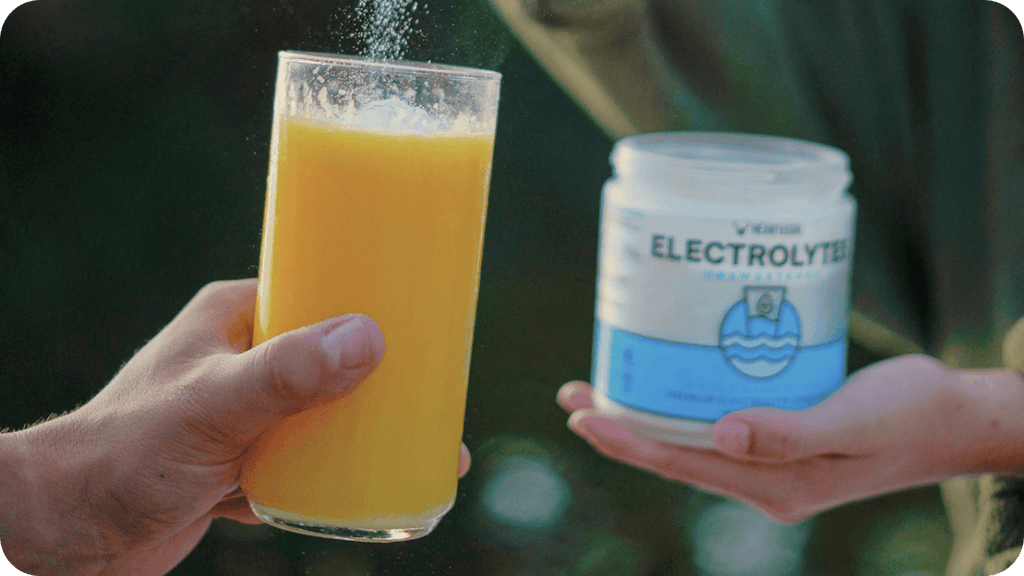
Heart & Soil Electrolytes applies this standard. It uses organic coconut water, ancient mineral salt, seawater magnesium, and a bovine bone matrix (MCHA) instead of synthetic isolates.
Be First to Try Heart & Soil Electrolytes
Join the waitlist to be the first to know when they launch.
Comparison: Whole-Food vs. Conventional Electrolyte Formulas
| Product | Sodium | Potassium | Magnesium | Calcium | Carb Source |
|---|---|---|---|---|---|
| Heart & Soil Electrolytes (Coconut Nectar) | 950 mg | 520 mg | 176 mg | 320 mg | 15 g, organic coconut sugar |
| LMNT | 1,000 mg | 200 mg | 60 mg | 0 mg | 0 g |
| Liquid I.V. Hydration Multiplier | 510 mg | 370 mg | 0 mg | 0 mg | 11 g + synthetic vitamins |
| Gatorade Thirst Quencher Powder | 230 mg | 70 mg | 0 mg | 0 mg | 32 g, refined sugar |
| BodyArmor Sports Drink | 25 mg | 680 mg | 75 mg | 0 mg | 25 g, refined sugar |
Values per labeled serving. Sources: Heart & Soil internal formulation data; competitor nutrition labels.
Glossary of Key Terms
Electrolyte: A mineral that carries an electric charge when dissolved in body fluid.
Hydration: The state of having sufficient water and electrolytes inside and outside your cells.
SGLT1: An intestinal protein that co-transports sodium and glucose together, pulling water in with them.
Electrolyte Imbalance: A deficiency or excess of one or more electrolytes that disrupts fluid, nerve, or muscle function.
Solvent Drag: The process by which water is pulled through cell membranes alongside actively transported electrolytes.
FAQ
What are the main electrolytes in the human body? The six main electrolytes are sodium, potassium, calcium, magnesium, chloride, and phosphate. Sodium and chloride dominate outside your cells; potassium dominates inside.
How do I know if I have an electrolyte imbalance? Reported signs include fatigue, headaches, and irregular heartbeat; muscle cramping is also commonly reported, though research on its exact cause is mixed. A blood test from your doctor is the only reliable way to confirm an imbalance.
Do I need electrolytes if I don’t exercise? Yes. You lose electrolytes continuously through urine and breathing. Low-carb diets, fasting, and hot climates all raise your needs beyond exercise alone.
Is coconut water enough to replace electrolytes? Coconut water is strong in potassium, but naturally low in sodium, the mineral you lose most in sweat. A complete formula pairs both.
What is the ideal sodium-to-potassium ratio for hydration? No clinical trial has established one universally “ideal” ratio, since sweat sodium loss varies widely between individuals (8). Whole-food formulations commonly target a 1.8:1 to 2.8:1 sodium-to-potassium ratio by mass as a design choice meant to offset the typical American diet’s sodium excess and potassium shortfall, documented in NHANES data above, not as a figure proven optimal in controlled trials.
Related Reading
- Who is Jason Grubb? His Incredible Journey to 7x CrossFit Champion
- Athletic Performance & an Animal-Based Diet: A Perfect Match?
What Are Electrolytes? The Bottom Line
Electrolytes are not optional. Sodium, potassium, magnesium, calcium, chloride, and phosphate run the systems behind fluid balance, nerve signals, and muscle contraction.
You lose them every day, not just during a workout, but through sweat, urine, and breathing. Most people aren’t drinking too little water; they’re not getting the right balance of electrolytes.
Whole-food electrolyte sources, sodium from clean salt, potassium from coconut water, magnesium from seawater, and calcium from bone matrix, replace what sweat actually takes. That’s the difference between drinking water and rehydrating.
Subscribe to future articles like this:
