
The information in this blog is for educational purposes only. It is not a substitute for professional medical advice. Consult your healthcare provider if you’re seeking medical advice, diagnoses, or treatment. These statements have not been evaluated by the Food and Drug Administration. Our products are not intended to diagnose, treat, cure, or prevent any disease.
Beef protein powder sounds straightforward. You want more animal protein. Preferably without dairy. So beef seems like an easy place to start.
Then you check the labels.
Some powders come from different bovine tissues. Some are much richer in collagen than others. Protein per scoop varies. So do the amino acid profile, sourcing, ingredients, testing, and price.
That can make two products labeled “grass-fed beef protein” very different purchases.
In this guide, we’ll show you what to check on a beef protein label, compare five grass-fed options worth considering, and help you figure out whether beef protein makes sense for what you actually want from a protein powder.
Table of Contents
Best Grass-Fed Beef Protein Powders to Compare
|
Product |
Protein type |
Protein / serving |
Approx. price / serving |
Best for |
|
Equip Prime Protein |
Grass-fed beef isolate from meat and bones, with naturally occurring collagen and gelatin |
21 g |
$2.13 |
Best overall beef protein |
|
PaleoPro Paleo Protein |
Grass-fed beef protein + collagen + egg white protein |
26 g |
$3.20 |
Highest protein dose / beef-and-egg blend |
|
Transparent Labs Grass-Fed Beef Protein Isolate |
Hydrolyzed grass-fed beef protein isolate |
25 g |
$2.00 |
High-protein isolate with strong testing transparency |
|
Be Well by Kelly Unflavored Grass-Fed Beef Protein |
Swedish grass-fed and grass-finished beef isolate |
23 g |
$2.17 |
Simplest unflavored formula |
|
Active Stacks Beef Protein |
HydroBEEF hydrolyzed beef isolate with added glycine |
22 g |
$2.75 |
Simple dairy-free flavored beef protein |
Prices and formulas checked September 2026. Price per serving is based on the one-time purchase size reviewed, before subscription discounts, shipping, or tax.
1. Equip Prime Protein
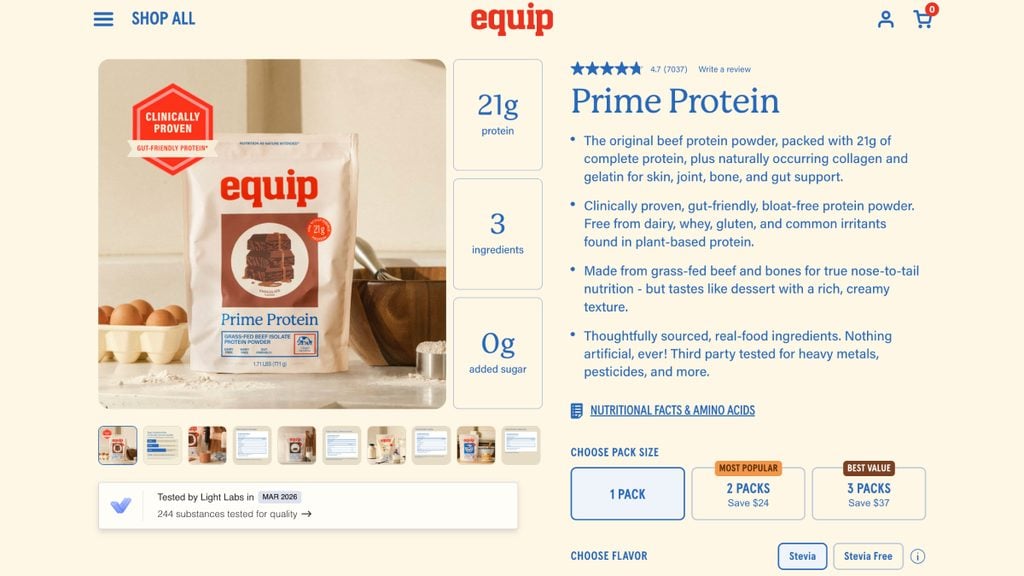
Equip Prime Protein earns our top spot because it makes most of the important stuff easy to see.
You get 21 grams of protein from grass-fed beef and bones, with all nine essential amino acids and a short ingredient list. Each batch is also tested for heavy metals, pesticides, and other contaminants.
There are also enough flavor options to keep you from drinking the same shake every day.
Customers tend to like the chocolate flavor and how it mixes, although the beefy smell or aftertaste comes through for some people.
There is one part of the label worth looking at more closely.
Equip contains a meaningful amount of collagen-derived protein, and its leucine content is lower than what you would typically get from whey or egg protein. So if your main goal is muscle, do not stop at the words “complete protein.”
The amino acid profile tells you what kind of protein those 21 grams actually give you.
2. PaleoPro Paleo Protein
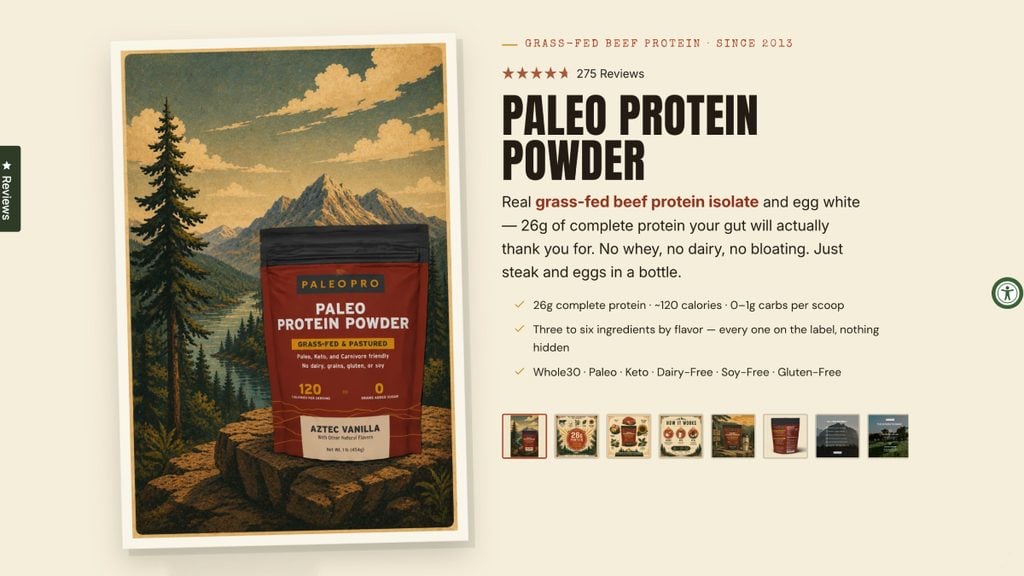
PaleoPro makes a smart trade. It gives up some beef purity to build a stronger complete-protein profile.
Each serving provides 26 grams of protein from grass-fed beef isolate and egg white. The egg white brings more essential amino acids into the mix and helps PaleoPro stand apart from beef powders that lean heavily on collagen-derived protein.
That makes it especially appealing if you are avoiding dairy but still want a protein powder geared toward muscle and recovery.
The catch is simple.
It’s not a pure beef protein powder, and the egg white takes it off the table for anyone avoiding eggs.
If your priority is complete animal protein without whey, PaleoPro is one of the strongest options in the category.
3. Transparent Labs Beef Protein Isolate
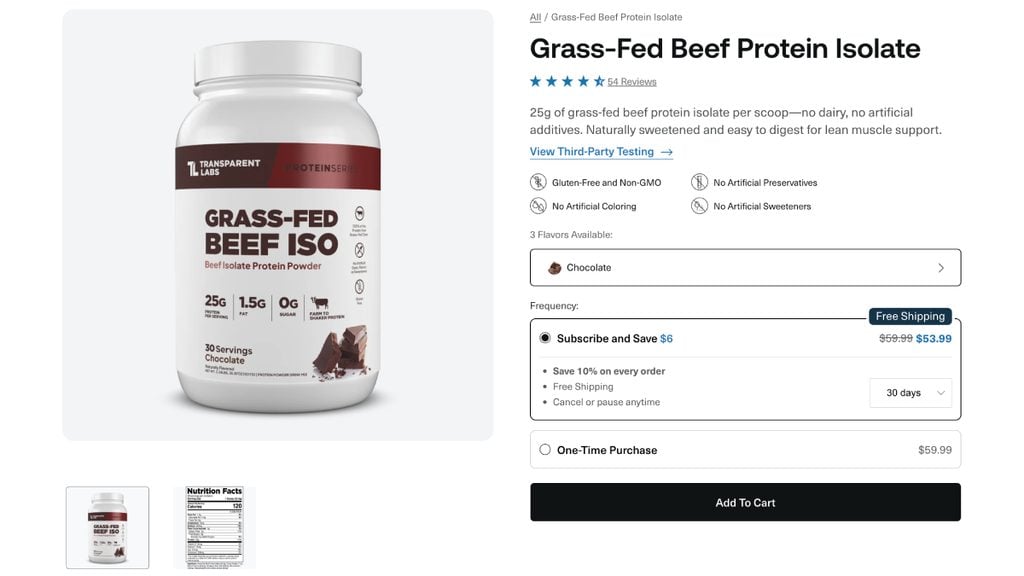
Transparent Labs makes the quality-control side easy to verify.
Each serving provides 25 grams of grass-fed beef protein isolate, and the company says the powder is more than 95% protein by weight. It also publishes third-party test results and checks batches for heavy metals and microbiological contaminants. That level of testing transparency is a real strength.
Customer feedback is generally positive around taste, digestion, and mixability.
The part we would still want to see more clearly is the amino acid profile.
Transparent Labs highlights glycine, proline, and hydroxyproline, which points to a meaningful collagen contribution. That doesn’t make it a bad protein, only that the 25 grams on the label doesn’t tell you the whole story.
If testing and purity are your top priorities, Transparent Labs is one of the easiest products in the category to trust.
4. Be Well by Kelly
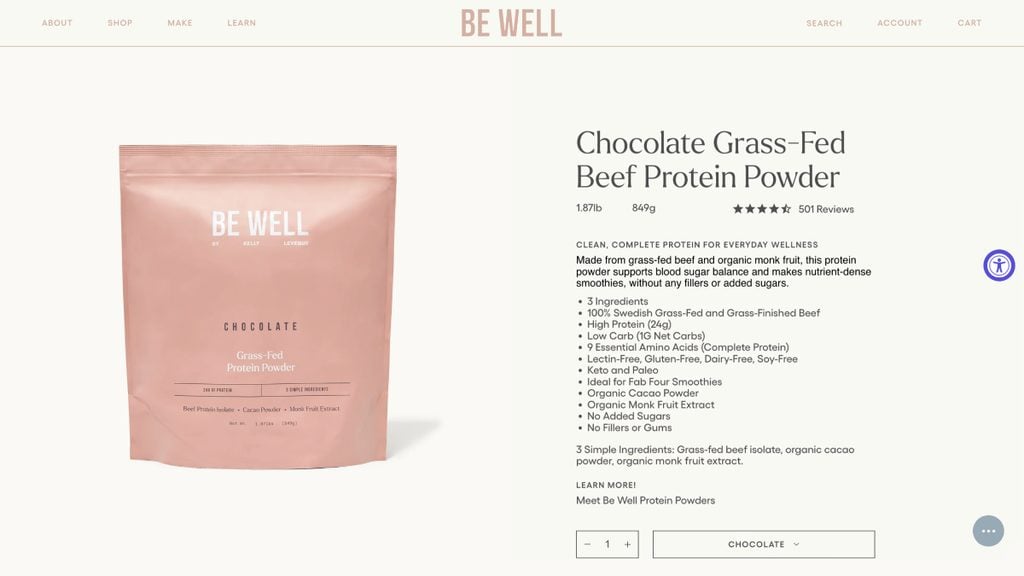
Be Well by Kelly keeps the formula simple and gives you more sourcing detail than most beef protein brands.
The unflavored version has one ingredient and provides 23 grams of protein from Swedish grass-fed and grass-finished cattle. The company also says every batch is tested for heavy metals, pesticides, mold, and allergens.
It has a solid following among people looking for minimalist beef powders, and the flavored options tend to get good feedback for taste.
But the source matters here.
Be Well says its protein comes from flesh-covered bones, joints, and tendons. That means the grass-fed and grass-finished label tells you how the cattle were raised, but not what the finished amino acid profile looks like.
Great sourcing is a real plus. We would still want to see the full amino acid panel before treating those 23 grams like 23 grams of whey or muscle-derived protein.
5. Active Stacks
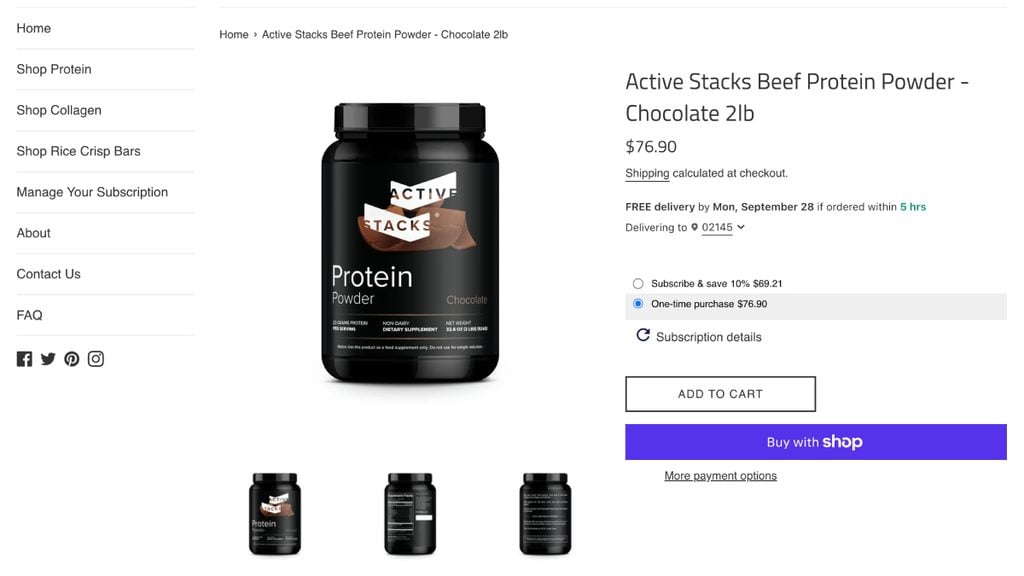
Active Stacks keeps the formula short and the testing fairly easy to understand.
Its chocolate powder provides 22 grams of protein from HydroBEEF, along with cocoa, glycine, and stevia. The company also says it tests for lead, mercury, cadmium, arsenic, and microbiological contaminants.
People who like it tend to mention two things. It sits well, and it does not taste much like beef. That is useful in a category where both digestion and flavor can be deal-breakers.
The source still deserves a closer look.
Active Stacks uses a bone-derived beef protein, and the company says cattle may receive supplemental grain. It also adds glycine separately, which makes the finished amino acid profile harder to use as a clean read on the base protein itself.
The ingredient list is simple. The protein story is a little more complicated.
If You Tolerate Dairy, Whey Is Still Hard to Beat
Beef protein makes a lot of sense when you want an animal-based protein without dairy. But if dairy works well for you and beef itself is not the requirement, whey gives you another straightforward way to get complete protein.
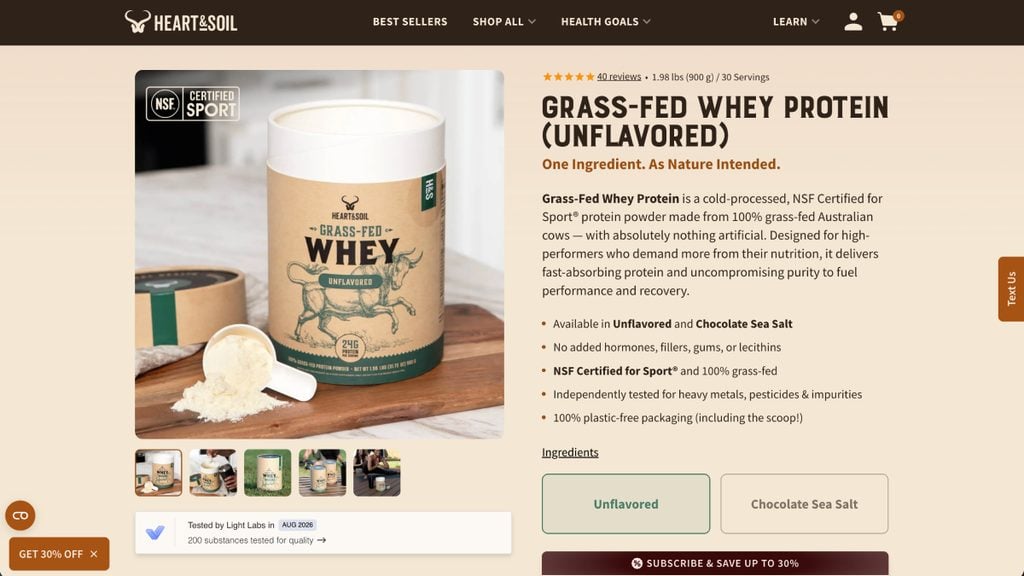
Heart & Soil Grass-Fed Whey Protein provides 24 to 25 grams of protein per serving for someone who tolerates dairy and wants a simple grass-fed option. The unflavored version has one ingredient, and the product is NSF Certified for Sport.
But that doesn’t make the five beef proteins above the wrong choice. On the contrary.
If you avoid dairy, prefer beef, or simply found a beef protein that fits your diet better, stay with beef.
The point is to know what you need from the protein before you commit to it.
Do You Actually Need Beef Protein Powder?
Beef protein powder makes sense when you want an animal-based protein without dairy. If whey works well for you, beef isolate is not automatically the better choice. Look at the protein you are actually getting, where it came from, and what you want it to do.
Beef sounds simple.
It came from a cow. It has protein. What else is there to know?
Quite a bit, as it turns out.
The cow on the front does not tell you what kind of protein is in the scoop.
One beef powder may start largely with muscle. Another may use bone and connective tissue and end up much richer in collagen. Both came from cattle. Both can say beef protein. Their amino acid profiles can still look very different.
That becomes especially important when your goal is muscle.
Whey naturally provides a strong essential amino acid profile and plenty of leucine. Beef powders vary much more because the starting tissue and processing vary.
A 2019 systematic review and meta-analysis found no significant difference between beef and whey supplementation for changes in lean body mass or fat mass across the trials studied. The beef research base was much smaller, though.
There is no good reason to assume beef isolate beats whey simply because beef feels more ancestral.
What Is Beef Protein Powder Actually Made From?
Beef protein powder is concentrated protein made from bovine material, but the raw material isn’t the same from brand to brand. A powder may begin with muscle, bone-associated tissue, connective tissue, or a combination. That starting material, along with the way it is processed, helps determine the amino acids and peptides in the finished powder.
That is why calling something “beef protein” only gets you so far.
Beef is the animal source. And the tissues are not interchangeable. Muscle protein and collagen-rich connective tissue begin with very different amino acid profiles.
Once manufacturers start concentrating and hydrolyzing those proteins, another variable enters the picture:
Processing.
This is why the words on the front of the tub are not enough.
Beef Protein Isolate vs Hydrolyzed Beef Protein
Beef protein isolate describes a concentrated protein ingredient. Hydrolyzed beef protein describes protein that has been broken into smaller peptide fragments. A powder can be both.
Isolation is about concentrating the protein fraction and removing much of what surrounds it.
Hydrolysis is different. Enzymes cut larger proteins into smaller pieces. A broader review of food-derived peptides explains how digestion and processing can release peptide sequences that were previously part of a larger protein.
Neither word tells you everything you probably want to know.
- “Isolate” doesn’t tell you which bovine tissues supplied the protein.
- “Hydrolyzed” doesn’t tell you which peptide profile was produced.
So keep reading. The amino acid panel tells you far more about the protein in the scoop than either manufacturing term on its own.
Is Beef Protein Powder the Same as Collagen?
No. Beef protein and collagen can both come from cattle, but they are not nutritionally interchangeable. Collagen is rich in glycine, proline, and hydroxyproline and lacks tryptophan. If you want a complete protein for muscle, look at leucine and total essential amino acids instead of assuming every beef powder does the same job.
A powder made largely from collagen-rich connective tissue will look very different on an amino acid panel from one built around muscle protein or a blend with egg white. Both can come from cattle. Both can carry the words “beef protein.”
How to Tell What Kind of Protein You’re Buying
Look for six things:
- Tryptophan. Collagen does not provide it, so collagen by itself is not a complete protein.
- Leucine. Especially useful to check when muscle is the goal.
- Total essential amino acids. These tell you more about complete-protein quality than total grams alone.
- Glycine. Typically abundant in collagen-rich protein.
- Proline. Another amino acid strongly associated with collagen.
- Hydroxyproline. A particularly useful clue that a meaningful amount of collagen is present.
A high glycine, proline, and hydroxyproline profile isn’t a red flag. It tells you what kind of protein you bought.
And that can be useful.
Collagen brings a very different amino acid pattern from whey, egg, or muscle protein. The better question is whether that pattern fits what you wanted from the powder in the first place.
A randomized trial using 5 grams of a defined collagen peptide preparation alongside resistance training found greater increases in Achilles tendon cross-sectional area than training with placebo.
A separate study using 15 grams of a different collagen preparation found no improvement in tendon size or mechanical properties.
These studies should not be treated as a head-to-head dose comparison, but they do reinforce one useful point though:
“Collagen” is not one uniform ingredient. The peptide preparation itself can differ.
How to Choose a Quality Beef Protein Powder
Look for a beef protein powder that clearly explains its source, amino acid profile, protein amount, sourcing, and testing. Then use ingredients, price, taste, and mixability to choose between otherwise solid options.
- Protein source. Check whether the protein comes from muscle, bone-associated material, connective tissue, or a blend. Also note whether it is isolated, hydrolyzed, or both.
- Amino acid profile. Look for all nine essential amino acids, plus leucine and tryptophan. Higher glycine, proline, and hydroxyproline can signal a more collagen-rich protein.
- Protein per serving. Most products we reviewed land around 20 to 26 grams per serving. Treat that as context, not a quality cutoff. Compare protein amount with amino acid composition.
- Grass-fed sourcing. Grass-fed can tell you something meaningful about how the animal was raised. Beef metabolites differ between grass-fed and grain-fed cattle.
- Third-party testing. Look for accessible COAs or testing for heavy metals such as lead, cadmium, mercury, and arsenic, plus microbiological contaminants. Competitive athletes may also want NSF Certified for Sport or Informed Sport.
- Ingredients and value. Check sweeteners, flavors, gums, allergens, and other additions. Compare price per 25 grams of protein, not just price per tub. Taste and mixability matter, but they should come after protein quality and testing.
Does Grass-Fed Matter for Beef Protein Powder?
Yes, but mostly as a sourcing signal. Grass-fed tells you something meaningful about how cattle were raised and what they ate. Research on whole beef shows that pasture finishing can change fatty acids, vitamins, minerals, and other metabolites. It does not prove that the finished protein isolate has a better amino acid profile, purity, or contaminant profile.
A 2025 metabolomics study found that pasture-finished beef developed a different nutrient and metabolite profile from grain-finished beef.
There is another layer too.
A review of pasture systems found that more diverse forage can produce a broader range of phytochemicals in meat and milk than monoculture pasture. So even “grass-fed” does not describe one identical feeding system.
That’s a good reason to value transparent sourcing.
Beef Protein vs Whey vs Collagen
Beef protein can provide complete animal protein without dairy, whey offers a naturally EAA- and leucine-rich complete protein, and collagen has a different amino acid profile and is not complete on its own.
|
Beef protein |
Whey |
Collagen | |
|
Animal-derived |
Yes |
Yes |
Yes |
|
Dairy-free |
Usually |
No |
Usually |
|
Complete protein |
Verify finished profile |
Yes |
No |
|
Essential amino acid density |
Product-dependent |
High |
Lower |
|
Research for muscle gain |
Growing but limited |
Extensive |
Different nutritional role |
|
Best fit |
Dairy-free complete-protein seekers when profile supports it |
Complete protein when dairy is tolerated |
Collagen-rich connective-tissue protein |
Is Beef Protein Powder Worth It?
Beef protein powder can be worth it if you want an animal-based protein without dairy and the finished product has the essential amino acids, testing, ingredients, and price you are looking for. It is not automatically worse than whey, but beef powders vary enough that the amino acid profile matters more than the name on the tub.
Beef protein is worth paying for when:
- You want to avoid dairy altogether but still prefer an animal-derived protein.
- The company publishes enough amino acid information to show that the protein fits your goal.
- The finished product is independently tested and the ingredient list works for you.
- You actually like the taste and tolerate the product well enough to use it consistently.
So, Which Beef Protein Powder Is Best?
Equip Prime Protein is our strongest all-around beef protein pick, while PaleoPro makes the most sense if complete dairy-free protein matters more than staying 100% beef. Transparent Labs stands out for testing transparency, Be Well by Kelly for ingredient simplicity and sourcing, and Active Stacks for a short formula with solid testing.
What separates these products is not the word beef, but what each brand does with it.
Equip gives you the best balance of sourcing, testing, flavor range, and overall usability. PaleoPro changes the equation by adding egg white. Transparent Labs makes quality control unusually visible. Be Well keeps the formula stripped back. Active Stacks is simple and practical, but more collagen-forward.
FAQ
What is the best beef protein powder?
The best beef protein powder is Equip Prime Protein based on our comparison of sourcing, testing, ingredient simplicity, amino acid quality, and overall usability. PaleoPro is the stronger option if you want a dairy-free complete-protein blend and do not mind egg white.
Is beef protein powder dairy-free?
Beef protein powder is dairy-free when the formula uses bovine protein without milk-derived ingredients. Check the full ingredient and allergen statement, because flavored products can include additives processed alongside milk or other dairy ingredients.
Is beef protein powder lactose-free?
Beef protein powder is naturally lactose-free because lactose comes from dairy, not beef. A pure beef protein isolate should contain no lactose, but the finished formula still needs checking for added milk-based ingredients.
Is beef protein isolate a complete protein?
Beef protein isolate can be a complete protein if the finished powder contains all nine essential amino acids. Do not assume every beef isolate has the same profile. Check for tryptophan, leucine, and a published amino acid panel.
How can I tell if a beef protein powder is mostly collagen?
A beef protein powder is likely collagen-heavy when its amino acid panel is high in glycine, proline, and hydroxyproline and relatively low in leucine or tryptophan. The source material also helps. Bone, joints, tendons, and connective tissue point toward more collagen-derived protein.
Does beef protein powder taste like beef?
Beef protein powder usually does not taste like cooked beef. Hydrolysis and flavoring change the taste considerably. Unflavored versions can still have a savory smell or aftertaste, while chocolate and vanilla formulas are generally designed to mask it.
How much protein should a beef protein powder provide per serving?
A beef protein powder typically provides about 20 to 26 grams of protein per serving in the products we reviewed. The number alone is not enough, though. Compare the serving size with the amino acid profile so you know what those grams actually contain.
Subscribe to future articles like this:
