


There are hundreds of electrolyte products out there.
So why did Heart & Soil decide to make another one?
Because when our research and development team started looking at what was already available, we kept seeing versions of the same formula: synthetic mineral sources, zero-calorie sweeteners, fillers, flow agents, and other ingredients we didn’t want.
We thought there had to be a better way.
So instead of taking an existing electrolyte formula and putting our name on it, we started from zero.
Nearly a year, almost 10 iterations, and a lot of trial and error later, Heart & Soil Electrolytes was finally ready.
Here’s why it took so long, and why we think it was worth it.
The information in this blog is for educational purposes only. It is not a substitute for professional medical advice. Consult your healthcare provider if you’re seeking medical advice, diagnoses, or treatment. These statements have not been evaluated by the Food and Drug Administration. Our products are not intended to diagnose, treat, cure, or prevent any disease.
Key Takeaways
- Heart & Soil Electrolytes was developed from scratch around four standards: meaningful mineral amounts, high-quality sourcing, no unnecessary additives, and a formula that actually works in the real world.
- The minerals come from organic coconut water, ancient mineral salt, seawater, and bovine bone matrix rather than relying on synthetic mineral salts.
- Finding ingredients that met those standards wasn’t easy. It took more than six months just to source an organic coconut water powder without added excipients.
- Heart & Soil offers two formulas: Unsweetened for everyday hydration and Coconut Nectar for times when additional carbohydrate alongside electrolytes makes sense.
- Both formulas provide sodium, chloride, potassium, magnesium, calcium, and phosphorus without artificial sweeteners, artificial flavors, fillers, or added flow agents.
Table of Contents
Why Did Heart & Soil Make an Electrolyte Product?
We didn’t start with, “How do we make an electrolyte powder?”
We started with, “What would an electrolyte powder have to look like for us to actually want to use it?” That changed the process.
When our Research and Development (R&D) team reviewed the market, we noticed that many electrolyte products followed a similar blueprint: isolated mineral ingredients, non-caloric sweeteners, flavor systems, and manufacturing aids.
There wasn’t necessarily anything unusual about that approach. It’s simply how powdered supplements are commonly made. But it wasn’t how we wanted to make ours. So the team came up with four non-negotiables.
| Our Standard | What It Meant for Heart & Soil Electrolytes |
| Meaningful electrolyte amounts | Include substantial amounts of key minerals rather than trace amounts for the label |
| High-quality sourcing | Source minerals from whole foods or naturally occurring mineral sources whenever possible |
| No unnecessary junk | Skip artificial sweeteners, artificial flavors, fillers, and added flow agents |
| Actually works | The powder still had to taste good, mix well, flow properly, package correctly, and be manufacturable |
Writing that list was the easy part, but making it happen was harder.
1. We Wanted More Than Sodium
A lot of electrolyte conversations begin and end with sodium.
Sodium matters, but it isn’t the only electrolyte involved in hydration.
Heart & Soil Electrolytes provides six key minerals:
- Sodium
- Chloride
- Potassium
- Magnesium
- Calcium
- Phosphorus
The goal wasn’t to throw tiny amounts of additional minerals into the formula so we could list them on the label.
We wanted meaningful amounts from sources that met our standards. That decision created the first big challenge: where were we actually going to get them?

2. We Wanted the Minerals to Come From Real Sources
Getting enough sodium wasn’t particularly difficult.
Getting potassium, magnesium, and calcium without simply ordering the same synthetic ingredients used throughout the supplement industry was another story.
Potassium: Organic Coconut Water
Potassium was one of the first hurdles. There aren’t many foods concentrated enough in potassium to work well in a powdered electrolyte formula.
Banana and banana peel powder came up during development, but the amount required, and the flavor that came with it, made them impractical.
Coconut water was the obvious next choice, but then we found another problem.
Most dried fruit juice powders require excipients or flow agents to keep them usable as powders. We wanted an organic coconut water powder without them.
It took our team more than six months to find a source that met those standards.
That organic coconut water powder became the potassium source in Heart & Soil Electrolytes.
Magnesium: Seawater
It’s difficult to find a food source with enough magnesium to make sense in an electrolyte powder. Eventually, we found a company producing a magnesium-rich concentrate from inland seawater.
That gave us a naturally occurring mineral source that could provide the amount of magnesium we were looking for without falling back on a conventional synthetic magnesium ingredient.
Calcium and Phosphorus: Bone
Then came one of our favorite parts of the formula: bone.
Heart & Soil already works with bovine bone matrix, also known as microcrystalline hydroxyapatite or MCHA. It’s essentially a mineral-rich matrix derived from bone that naturally provides calcium and phosphorus.
So we started experimenting with it in the electrolyte formula, and it solved two problems at once.
3. Bone Helped Us Get Rid of a Flow Agent
Powdered products have to move through manufacturing equipment.
They need to blend evenly. They need to flow. They need to get into the package without clumping up the entire production line.
Manufacturers often solve that problem with anti-caking agents and flow agents. We didn’t want to.
So our R&D team started experimenting with bovine bone matrix, and to our surprise, it worked extremely well as part of the powder’s flow system.
And unlike a conventional flow agent that’s added solely to make manufacturing easier, bone matrix also contributes calcium and phosphorus to the finished formula.
That’s the kind of solution we were looking for throughout development: an ingredient that earns its place in the formula.
4. The Formula Still Had to Work
It would have been easy to create an ingredient list we loved and stop there.
Unfortunately, that’s not how product development works.
Heart & Soil Electrolytes still had to:
- Mix into water
- Taste good
- Move through the manufacturing equipment
- Stay consistent from serving to serving
- Fit into practical packaging
- Be something you’d actually want to drink
Every restriction we placed on the ingredient list made those things harder.
That’s part of why the formula went through almost 10 iterations.
We weren’t willing to solve every manufacturing problem by adding another excipient. The team had to keep going back to the formula and figure out another way.
What’s Actually in Heart & Soil Electrolytes?
After all that experimentation, here’s where the formulas landed:
| Per Serving | Unsweetened | Coconut Nectar |
| Sodium | 950 mg | 950 mg |
| Chloride | 1,816 mg | 1,816 mg |
| Potassium | 330 mg | 520 mg |
| Magnesium | 175 mg | 176 mg |
| Calcium | 310 mg | 320 mg |
| Phosphorus | 42 mg | 42 mg |
| Total carbohydrate | 8 g | 15 g |
| Artificial sweeteners | No | No |
| Artificial flavors | No | No |
| Added flow agents | No | No |
The mineral sources are intentionally simple:
- Ancient mineral salt provides sodium and chloride.
- Organic coconut water powder provides potassium and naturally occurring carbohydrates.
- Magnesium-rich seawater provides magnesium.
- Bovine bone-derived MCHA provides calcium and phosphorus.
Both formulas are also third-party tested and manufactured in a cGMP facility.
Be First to Try Heart & Soil Electrolytes
Join the waitlist to be the first to know when they launch.
Why Are There Two Versions?
Sugar ended up being one of the final decisions.
Because we chose coconut water as the potassium source, both versions were always going to contain some naturally occurring carbohydrate.
The question was whether we wanted to add more, and the answer depended on how the electrolytes were going to be used.
Heart & Soil Electrolytes Unsweetened
Unsweetened was designed with everyday hydration in mind.
It contains 8 grams of carbohydrate from the coconut water powder, but no added sugar.
You can drink it as is or add your own carbohydrate source, like honey or maple syrup, depending on what you’re doing that day.
Heart & Soil Electrolytes Coconut Nectar
Coconut Nectar was designed for higher-output situations when additional carbohydrate alongside electrolytes can be useful.
It contains 15 grams of total carbohydrate, with organic coconut sugar added alongside the coconut water.
Think harder workouts, long hikes, endurance events, or other situations where you’re using more fuel.
We didn’t think one formula needed to be everything to everyone, so we made two.

Why Not Make Them Zero-Calorie?
We chose organic coconut water as our potassium source, and naturally occurring carbohydrates come with it. We could have used a different ingredient just to hit zero calories, but we don’t fear carbs, and in an electrolyte drink, they can actually be useful.
Glucose and sodium are transported together through SGLT1 in the small intestine, helping support sodium and water absorption (#).
That’s also why we made two versions: Unsweetened for everyday hydration and Coconut Nectar with more carbohydrate for harder workouts or endurance activity.
The goal wasn’t zero calories. It was better ingredients and a formula that made sense.
And Then There Was the Packaging
The formula wasn’t the only thing we thought about.
At Heart & Soil, we try to minimize plastic contact with our products wherever possible. That made conventional electrolyte stick packs another challenge.
The first priority was offering Heart & Soil Electrolytes in glass jars.
Our team is also working toward a completely plastic-free stick-pack system planned for early 2027.
Like the formula itself, packaging turned out to be another place where doing things differently required more work.
Watch the Full Story by Jonnie
Jonnie Lawler, Heart & Soil’s Senior Research & Development Specialist, walks through the nearly year-long development process, including the ingredient sourcing challenges, failed ideas, manufacturing hurdles, and decisions that eventually became the finished formula.

FAQ
What makes Heart & Soil Electrolytes different?
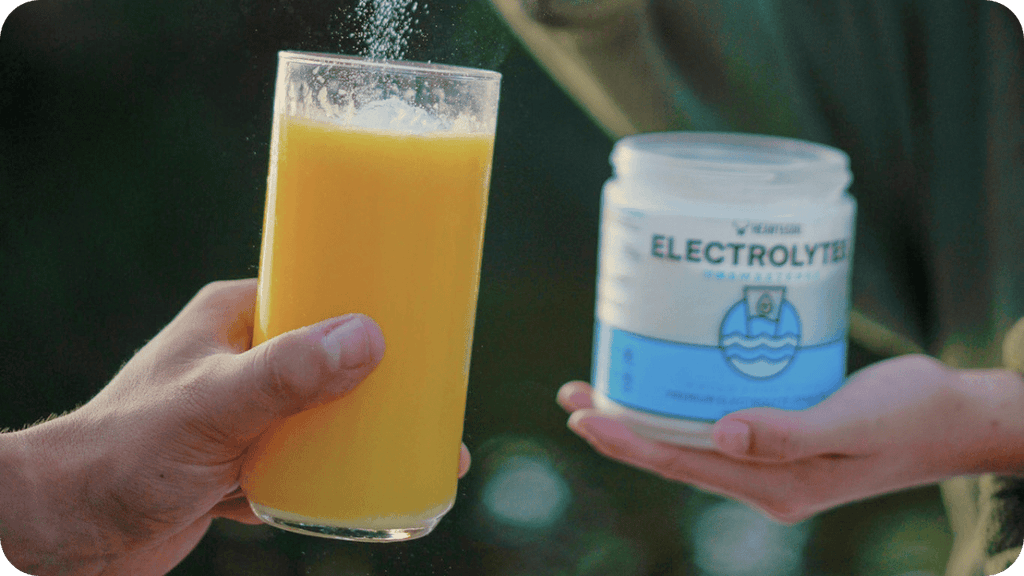
Heart & Soil Electrolytes provides six key minerals from whole-food and naturally occurring mineral sources: ancient mineral salt, organic coconut water, magnesium-rich seawater, and bovine bone matrix. The formulas contain no artificial sweeteners, artificial flavors, fillers, or added flow agents.
Does Heart & Soil Electrolytes contain sugar?
Both formulas contain naturally occurring carbohydrates because organic coconut water powder is used as the potassium source. Unsweetened contains 8 grams of total carbohydrate with no added sugar. Coconut Nectar contains 15 grams of total carbohydrate and includes organic coconut sugar for additional fuel.
Why does Heart & Soil Electrolytes contain calcium?
Calcium is one of the six minerals included in the formula. Heart & Soil gets calcium and phosphorus from bovine bone-derived microcrystalline hydroxyapatite, or MCHA. The bone matrix also helped the team solve a manufacturing challenge by supporting powder flow without relying on a conventional added flow agent.
Which Heart & Soil Electrolytes should I choose?
Unsweetened was formulated for everyday hydration and gives you the flexibility to drink it plain or added in another beverage. Coconut Nectar includes additional carbohydrates and was designed with more demanding physical activity in mind.
Why did Heart & Soil use coconut water?
The R&D team wanted a naturally derived source of potassium that could work in a powdered electrolyte formula. Organic coconut water powder met that goal while also supplying naturally occurring carbohydrates.
Related Reading
- Electrolytes for Fasting: 5 Reasons They’re Valuable
- Electrolyte Imbalance: Signs to Pay Attention To
- Clean Electrolyte Powder: How to Tell What’s Actually Clean
- The Science of Sweat: 5 Fascinating Steps That Keep You Cool
The Bottom Line
We didn’t make Heart & Soil Electrolytes because the world needed another flavored powder packet.
We made it because we couldn’t find the electrolyte product we wanted for ourselves and our families.
We wanted meaningful amounts of six key minerals. We wanted them from whole-food and naturally occurring sources. We didn’t want artificial sweeteners, artificial flavors, fillers, or added flow agents. And we still needed the finished product to taste good and actually work.
Try Heart & Soil Electrolytes for yourself and tell us what you think.
Subscribe to future articles like this:
