
Walk down the supplement aisle and iron gets complicated fast. One bottle gives you 65 milligrams of elemental iron, another promises a gentler form, while a whole-food product may use liver, spleen, and blood without reducing everything to one big iron number.
They’re all sold around iron, but they’re not doing the same job.
The best iron supplement depends on what you need it to do. If you’re correcting a confirmed deficiency, a known elemental-iron dose matters because it can be matched to bloodwork. But for everyday nutrition, we favor heme iron from nutrient-dense animal foods such as red meat, liver, spleen, and blood.
That’s because iron doesn’t show up alone in those foods. Liver and other organs also bring vitamin B12, copper, riboflavin, vitamin B6, folate, protein, and other naturally occurring nutrients.
Within our Animal-Based approach, food comes first. We generally recommend around 1–3 ounces of organs per day, including about 0.5–1 ounce of liver. If fresh organs aren’t practical, freeze-dried organs can make that habit much easier to keep.
Heart & Soil Lifeblood is our most targeted whole-food option for iron-related nutrition. It combines whole blood extract, spleen, and liver to support healthy iron stores, normal red blood cell formation, oxygen utilization, stamina, and exercise performance.
A diagnosed deficiency is different, though. When you need a precise therapeutic dose, a standardized iron supplement may be the better tool.
Table of Contents
What Does Iron Do in the Body?
Iron helps your body move and use oxygen. It’s part of hemoglobin, which carries oxygen in red blood cells, and myoglobin, which helps supply oxygen to muscle.
You also need iron for:
- Red blood cell formation
- Cellular energy processes
- Muscle function
- Neurological function
- Growth and development
- Normal hormone synthesis
That’s why low iron can leave someone feeling tired or unusually winded. But iron isn’t a stimulant, so more isn’t automatically better. If your stores are already adequate, taking extra iron doesn’t create extra energy.
What Is the Best Iron Supplement?
There isn’t one best product for everyone because everyday nutrition and confirmed deficiency are different use cases.
A simple way to think about it:
- Confirmed iron deficiency: A standardized product with a known elemental-iron amount gives you the precision needed for dosing and follow-up.
- Sensitive stomach: Lower doses or forms such as bisglycinate, heme iron, carbonyl iron, or polysaccharide complexes may be easier for some people.
- Everyday nutrition: We favor heme iron from red meat, liver, spleen, shellfish, and blood-derived foods.
- Fresh organs aren’t practical: Freeze-dried organs can help you keep liver and other organs in the routine.
- Pregnancy: Iron needs change substantially, so this is better handled with prenatal guidance rather than a generic recommendation.
The biggest number on the bottle only matters if that number matches the job.
Heme Iron vs Nonheme Iron
| Feature | Heme iron | Nonheme iron |
| Common sources | Meat, liver, spleen, blood, shellfish | Plant foods, fortified foods, most isolated iron compounds |
| Absorption | Generally higher | Generally lower and more variable |
| Meal effects | Less affected by other dietary compounds | More affected by phytates, polyphenols, vitamin C, and meal composition |
| Heart & Soil focus | Meat and organs | Not our primary dietary iron strategy |
| Supplement examples | Heme iron polypeptide, organ-based products | Ferrous sulfate, fumarate, gluconate, bisglycinate |
Heme iron is generally more bioavailable and less affected by compounds such as phytates and polyphenols. That’s one reason meat and organs make so much sense to us as foundational iron sources.
Nonheme iron still works, though. Most standardized iron supplements use it because it’s easy to dose precisely, which matters when you’re treating a confirmed deficiency.
What Is Elemental Iron?
Elemental iron is the amount of actual iron a supplement delivers. That’s different from the total weight of the compound carrying it.
For example, NIH notes that ferrous fumarate is about 33% elemental iron by weight, ferrous sulfate about 20%, and ferrous gluconate about 12%.
So a 325 mg ferrous sulfate tablet provides roughly 65 mg of elemental iron. The rest is the sulfate portion of the compound.
If you’re using a standardized supplement, check the Supplement Facts panel rather than assuming the biggest number on the front tells you how much iron you’re getting.
Common Types of Iron Supplements
Different forms mainly trade off dose, cost, absorption, and stomach tolerance.
Ferrous Sulfate
Ferrous sulfate is inexpensive, well studied, and widely used. But it can also cause constipation, nausea, abdominal discomfort, diarrhea, and dark stools, especially at higher doses.
Ferrous Fumarate
Ferrous fumarate contains more elemental iron by weight than sulfate, so a smaller amount can deliver a relatively large dose. That doesn’t automatically make it easier on the stomach, though.
Ferrous Gluconate
Ferrous gluconate contains less elemental iron per gram, which can make lower-dose products easier to formulate. It can still cause stomach upset.
Iron Bisglycinate
Iron bisglycinate is a chelated form that some people find easier to tolerate. But “gentle” still depends on the dose and the person taking it.
Heme Iron Polypeptide
Heme iron polypeptide is animal-derived and provides iron in heme form, so meal composition tends to affect it less than nonheme iron. Products vary in dose and price.
Carbonyl Iron and Polysaccharide-Iron Complexes
These are alternative forms sometimes used when conventional ferrous salts are difficult to tolerate. They can still cause side effects, so no form gets a universal free pass.
What Iron Supplement Is Easiest on the Stomach?
It depends, but lower elemental doses and forms such as bisglycinate, heme iron, carbonyl iron, or polysaccharide complexes may be easier for some people to tolerate.
Dose matters just as much as form. A “gentle” iron supplement can still be rough at a high enough dose, while a smaller dose of a simpler form may be easier to take consistently.
Taking iron with food may reduce nausea, although food can also reduce absorption. So when iron is being used therapeutically, tolerance and absorption both matter.
Whole-food organ supplements solve a different problem. They provide iron-containing tissues within a broader food matrix rather than delivering a large isolated dose.
Is a Whole-Food Iron Supplement Better?
For everyday nutrition, that’s our preference. For correcting a confirmed deficiency, not necessarily.
We’d rather get iron in the context of real food, where it comes with other nutrients that matter too. Liver, spleen, red meat, and blood provide heme iron alongside vitamin B12, copper, riboflavin, vitamin B6, folate, protein, and more.
That’s why organs are foundational for us. We generally recommend 1–3 ounces of organs per day, including around 0.5–1 ounce of liver. And if fresh organs aren’t practical, freeze-dried organs make the same nose-to-tail approach easier to maintain.
A confirmed deficiency is different because dose precision may matter. In that case, a standardized iron supplement can do something a whole-food organ formula may not: tell you exactly how many milligrams of elemental iron you’re taking.
Whole-food nourishment and precise therapeutic dosing solve different problems, so the better choice depends on what you actually need iron to do.

Heart & Soil’s Organ-Based Iron Options
We make several formulas with naturally iron-rich organs, but they serve different roles.
Lifeblood is our most targeted iron-related formula, while Beef Organs goes broader across five organs and Pure American Liver focuses on liver.
Heart & Soil Lifeblood
Heart & Soil Lifeblood combines grass-fed and grass-finished whole blood extract, spleen, and liver.
That combination makes sense for iron-related nutrition because blood and spleen are naturally iron-rich, while liver also brings vitamin B12, copper, riboflavin, vitamin B6, folate, and other nutrients involved in normal blood formation.
Lifeblood is positioned to support healthy iron stores, normal red blood cell formation, oxygen utilization, cardiovascular health, stamina, and exercise performance.
It isn’t a standardized therapeutic iron dose, though. The current product information doesn’t give one elemental-iron amount per serving, so Lifeblood shouldn’t be treated as a milligram-for-milligram replacement for a clinically selected iron supplement.
Heart & Soil Beef Organs
Beef Organs combines liver, heart, pancreas, spleen, and kidney.
Because it contains both liver and spleen, it naturally overlaps with iron-related nutrition. But it’s built for broader nose-to-tail nourishment rather than iron specifically.
If you want breadth, Beef Organs makes sense. If iron-related support is the main goal, Lifeblood is the more targeted option.
Heart & Soil Pure American Liver
Pure American Liver is our liver-only option.
Liver contains heme iron, but that’s only part of why we value it. It also provides vitamin B12, copper, riboflavin, folate, vitamin B6, and other nutrients, which is why we see liver as foundational food rather than just another way to deliver iron.
If your goal is simply to get more liver into your routine, Pure American Liver keeps things straightforward.
Lifeblood vs Beef Organs vs Pure American Liver
| Product | Organs included | Best fit |
| Lifeblood | Whole blood extract, spleen, liver | More targeted iron-related support |
| Beef Organs | Liver, heart, pancreas, spleen, kidney | Broader nose-to-tail nutrition |
| Pure American Liver | Liver | Focused liver nutrition |
You don’t have to treat these as mutually exclusive because our organ supplements are designed to work together. Shared ingredients are expected, so look at what you already eat and what you want the rest of your routine to provide.
FDA Disclaimer:These statements have not been evaluated by the Food and Drug Administration. These products are not intended to diagnose, treat, cure, or prevent any disease.
Do You Actually Need Iron?
If you’re wondering because you feel tired, weak, or unusually winded, symptoms alone can’t tell you that iron is the problem. But if you’re simply trying to eat a more nutrient-dense diet, you don’t need a diagnosis to put iron-rich foods on your plate.
That distinction matters because eating iron-rich food is very different from using a high-dose supplement to correct a deficiency.
Does Iron Help With Fatigue?
Iron may help when low iron is actually contributing to the fatigue. But poor sleep, too little food, illness, stress, medication effects, thyroid problems, and other nutrient deficiencies can feel similar.
Possible signs of low iron can include:
- Fatigue or weakness
- Reduced exercise tolerance
- Shortness of breath
- Headaches or dizziness
- Pale skin
- Difficulty concentrating
- A racing or pounding heartbeat
Because none of those symptoms is unique to iron deficiency, bloodwork matters when deficiency is the question.
Which Blood Tests Are Relevant?
Clinicians usually look at several markers together, including:
- Complete blood count
- Hemoglobin and hematocrit
- Mean corpuscular volume
- Ferritin
- Serum iron
- Transferrin saturation
- Total iron-binding capacity
- Reticulocyte measures
- C-reactive protein in some situations
Ferritin reflects stored iron, but inflammation can affect it. So one number rarely tells the whole story.

Low Ferritin vs Iron-Deficiency Anemia
Low ferritin generally points to reduced iron stores, while iron-deficiency anemia means iron depletion has progressed far enough to affect hemoglobin and red blood cell production.
Someone can have falling iron stores before a standard blood count becomes abnormal, which is why ferritin adds useful context.
And if low iron keeps coming back, replacing it isn’t the whole job. Blood loss, increased requirements, low intake, or poor absorption may still need attention.
Whole-food organ nutrition can remain part of the diet, but the more clinically significant the deficiency becomes, the more useful dose precision and follow-up testing become.
Getting Iron From Food
For everyday nutrition, we’d rather start with food.
Heme iron from animal foods is generally better absorbed than nonheme iron, while those foods also bring protein and other nutrients along for the ride.
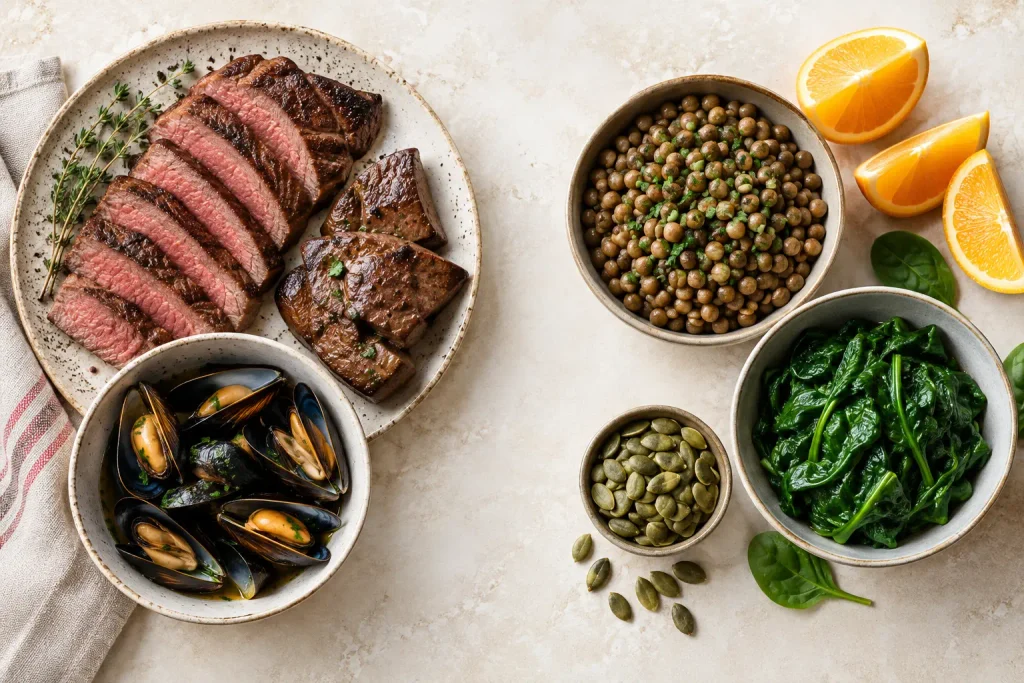
Best Animal-Based Food Sources of Iron
Our favorites are simple:
- Liver and spleen: Naturally rich in heme iron, while liver also brings vitamin B12, copper, riboflavin, vitamin B6, and folate.
- Red meat: Beef, lamb, bison, and other ruminant meats provide heme iron alongside complete protein.
- Blood-derived foods: Traditional blood foods provide heme-bound iron as part of the food itself.
- Shellfish and seafood: Oysters, mussels, clams, sardines, and other seafood add iron plus complementary minerals.
We generally recommend around 0.5–1 ounce of liver as part of 1–3 ounces of total organs per day. If fresh organs aren’t practical, freeze-dried organs are an easy alternative.
Fruit can fit here too because vitamin C supports nonheme iron absorption, and foods such as citrus, kiwi, and berries make that easy within an Animal-Based diet.
What Can Reduce Iron Absorption?
Nonheme iron is more sensitive to what you eat with it.
Factors that can reduce absorption include:
- Phytates
- Tea and coffee polyphenols
- Calcium taken at the same time
- Some antacids and acid-suppressing medications
- Certain gastrointestinal conditions
- Bariatric surgery
- Inflammation
- Some medication interactions
That doesn’t mean every meal needs to become a chemistry experiment. If you’re eating iron-rich animal foods, you usually don’t need to obsess over every interaction.
Medication timing is different, though, because some drugs can interact meaningfully with supplemental iron.
Iron Safety and Who Should Avoid It
Iron matters, but more isn’t always better, especially with high-dose or isolated iron supplements. That’s a different conversation from eating meat and organs as normal foods.
Can You Take Iron Without Being Deficient?
You can eat iron-rich foods without proving a deficiency first. Red meat, liver, spleen, and shellfish are foods, and we consider them valuable parts of an Animal-Based diet.
High-dose isolated iron is different because excess iron can cause gastrointestinal symptoms and may be dangerous for people who are prone to iron overload.
NIH lists an adult tolerable upper intake level of 45 milligrams per day from food and supplements for the general healthy population. That’s an upper limit, not a target, and clinicians may intentionally use more when treating confirmed deficiency.
Too much supplemental iron can cause:
- Nausea
- Constipation
- Abdominal pain
- Vomiting
- Diarrhea
- Iron overload in susceptible people
The practical takeaway is simple: keep iron-rich foods in the diet, but treat therapeutic iron like the concentrated tool it is.

Who Should Not Take Iron Without Medical Guidance?
Extra caution makes sense for:
- People with hemochromatosis or another iron-loading disorder
- Anyone with unexplained anemia
- People with known or suspected gastrointestinal bleeding
- People receiving repeated blood transfusions
- Children
- Pregnant people using therapeutic-dose iron
- Anyone taking medications that interact with iron
- Anyone already using several iron-containing products
The common thread is that these situations involve more than simply choosing an everyday food-based supplement.
Iron Safety Around Children
Iron overdose can be dangerous and can be fatal in young children.
Keep iron-containing supplements securely out of reach. If a child accidentally swallows a large amount, contact Poison Control or emergency services rather than waiting for symptoms.
How to Choose a Good Iron Supplement
Start with the job, then read the label.
- Know why you’re taking it: Everyday nourishment and correction of confirmed deficiency aren’t the same thing.
- Check elemental iron when dose precision matters: If you need a therapeutic amount, the label should tell you exactly how much you’re getting.
- Choose a form you can tolerate: A perfect dose on paper isn’t useful if you stop taking it.
- Look at the whole formula: Vitamin B12, folate, copper, vitamin B6, and vitamin C may be useful, but they may also duplicate other supplements.
- Check sourcing and testing: Ingredient identity, contaminants, manufacturing quality, and label accuracy matter.
- Ignore magic claims: Guaranteed ferritin increases, instant energy, zero side effects, or promises to “fix anemia” should make you skeptical.
For whole-food organ products, add one more question: does the formula actually tell you which organs you’re getting?
Real food shouldn’t need to hide behind vague language.
Is the Highest-Dose Iron Supplement the Best?
No. More iron isn’t automatically better.
A higher dose can mean more gastrointestinal symptoms and more iron than you actually need.
If the goal is therapeutic correction, the useful dose is the one that matches the situation. If the goal is everyday nutrition, we’d rather start with food than chase the biggest number on the shelf.
Whole-Food Iron vs Conventional Iron
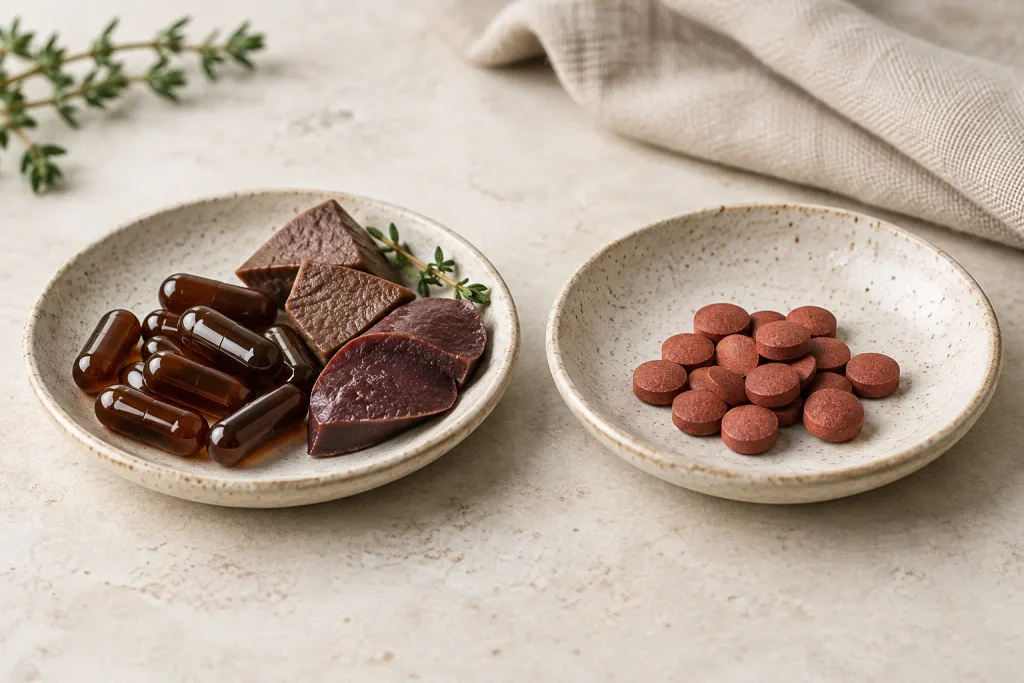
| Feature | Whole-food organ formula | Conventional iron supplement |
| Iron source | Liver, spleen, whole blood, other animal tissue | Iron salt, chelate, complex, or heme isolate |
| Elemental iron amount | May not be standardized or listed | Usually clearly listed |
| Nutrient context | Naturally includes other nutrients from the food | Usually built around a defined iron dose |
| Best fit | Everyday whole-food nutrition | Precise dosing when indicated |
| Tolerance | Depends on product and serving | Depends strongly on form and dose |
| Best for confirmed deficiency | Not automatically | Often more useful because the dose is known |
Those categories answer different questions. Whole-food iron makes sense when you want more nutrient-dense animal nutrition, while a standardized supplement makes more sense when you need a precise number of milligrams.
Is Lifeblood the Best Iron Supplement?
Lifeblood is our most targeted whole-food option for iron-related nutrition, but it isn’t automatically the best choice for every person with low iron.
It combines whole blood extract, spleen, and liver from grass-fed and grass-finished cattle, so you’re getting naturally iron-rich animal tissues rather than an isolated iron salt.
Lifeblood may be a strong fit if you want:
- Whole-food organ nutrition
- Heme-iron-containing tissues
- Liver and spleen in the same formula
- Support for healthy iron stores and red blood cell formation
- Support for oxygen utilization, stamina, and exercise performance
It’s a weaker fit when the main goal is a known therapeutic elemental-iron dose, because the current product information doesn’t provide one standardized elemental-iron amount per serving.
That limitation doesn’t make Lifeblood less useful; it simply places it on the whole-food side of the iron conversation rather than the therapeutic-dose side.
How to Take Lifeblood
Current Lifeblood guidance is six capsules once daily.
Follow the current label rather than increasing the serving in an attempt to get “more iron.” Lifeblood is a whole-food organ formula, not a self-adjusted therapeutic iron dose.
The Best Iron Supplement Matches Your Bloodwork, and Where Heart & Soil Fits
The best iron supplement isn’t the bottle with the biggest number. It’s the one that fits what you’re actually trying to accomplish.
For everyday nutrition, we’d start with the foods humans have always gotten iron from: red meat, liver, spleen, shellfish, and other nutrient-dense animal foods. If fresh organs aren’t realistic every day, freeze-dried organs can make that same approach much easier.
If you’re correcting a confirmed deficiency, though, precision matters more because a known elemental-iron dose can be matched to bloodwork and adjusted over time.
Those ideas don’t contradict each other. Food can stay the foundation while a targeted supplement does a specific job when it’s needed.
That’s where Lifeblood fits for us. It combines whole blood extract, spleen, and liver to make iron-rich organ nutrition easier to keep in your routine.
Iron matters because oxygen matters. But before nutrition became a shelf full of isolated compounds, we got these nutrients from food.
We still think that’s a pretty good place to start.
Frequently Asked Questions About the Best Iron Supplement
What is the best iron supplement?
The best iron supplement depends on what you need it to do. If you’re correcting a confirmed deficiency, a standardized product with a known elemental-iron amount is usually more useful. For everyday nutrition, we favor heme iron from red meat and organs, with Lifeblood as our most targeted whole-food option.
What iron supplement is easiest on the stomach?
There isn’t one form that’s easiest for everyone. Iron bisglycinate, heme iron, carbonyl iron, and polysaccharide complexes may be better tolerated by some people, while dose often matters just as much as form. A lower elemental dose can sometimes be easier to take consistently than a larger dose of a “gentle” product.
What is a whole-food iron supplement?
A whole-food iron supplement uses naturally iron-containing tissues such as liver, spleen, or whole blood rather than building the formula around an isolated iron salt. That means the iron arrives alongside other nutrients from those foods, although the elemental-iron amount may not be standardized like it is in a conventional iron tablet.
Is heme iron better than nonheme iron?
Heme iron is generally more bioavailable and less affected by meal composition than nonheme iron. That gives animal foods such as meat, liver, spleen, and shellfish an absorption advantage. Nonheme iron still works, though, and it remains the basis of many effective standardized supplements.
Does iron help with fatigue?
Iron may help fatigue when low iron is actually contributing to it because iron is essential for hemoglobin and oxygen transport. But fatigue has many other causes, so symptoms alone can’t tell you that more iron is the answer.
Can I take iron without bloodwork?
You don’t need bloodwork before eating iron-rich foods such as red meat, liver, spleen, or shellfish. High-dose isolated iron is different. If you suspect deficiency, testing helps confirm whether iron is actually low and whether a precise therapeutic dose makes sense.
What is elemental iron?
Elemental iron is the actual amount of iron a supplement provides rather than the total weight of the compound carrying it. For example, 325 milligrams of ferrous sulfate provides roughly 65 milligrams of elemental iron. That’s the number that matters when you need a defined dose.
Why does iron cause constipation?
Supplemental iron can irritate the gastrointestinal tract, while higher doses tend to leave more unabsorbed iron behind. That can contribute to constipation, nausea, or abdominal discomfort. Tolerance varies with the form, dose, schedule, and person.
Is a natural iron supplement better?
Not automatically. Whole-food organ products fit our preference for getting nutrients in the context of real food, while standardized iron supplements are better at delivering a known elemental dose. Which one makes more sense depends on what you need it to do.
Is beef liver a good iron supplement?
Beef liver is a valuable whole-food source of heme iron, but iron is only part of the story. Liver also provides vitamin B12, copper, riboflavin, folate, vitamin B6, and other nutrients, which is why we see it as foundational food rather than simply an iron delivery system.
Is spleen a good source of iron?
Yes. Spleen is naturally rich in heme iron, which is why it appears in organ formulas built around iron-related nutrition. In Lifeblood, it’s paired with whole blood extract and liver for a broader whole-food approach.
What is Heart & Soil Lifeblood?
Lifeblood is our freeze-dried organ formula made with grass-fed and grass-finished whole blood extract, spleen, and liver. It’s designed to support healthy iron stores, normal red blood cell formation, oxygen utilization, cardiovascular health, stamina, and exercise performance.
Does Lifeblood treat anemia?
No. Lifeblood is a dietary supplement, not a treatment for anemia. It supports iron-related nutrition, but confirmed anemia may require a defined elemental-iron dose, investigation of the underlying cause, and follow-up testing.
How much iron is in Lifeblood?
The current Lifeblood product information identifies iron as a key nutrient but doesn’t publish one standardized elemental-iron amount per serving. That matters if you need to match a supplement to a therapeutic milligram target.
Is Beef Organs an iron supplement?
Beef Organs isn’t positioned as a dedicated iron supplement, although it contains liver and spleen. It’s built for broader nose-to-tail nutrition, while Lifeblood is our more targeted option when iron-related support is the main goal.
Can too much iron be harmful?
Yes. High supplemental iron can cause gastrointestinal symptoms, and excess iron can be dangerous for people who are susceptible to iron overload. NIH lists an adult upper intake level of 45 milligrams per day for the general healthy population, although clinicians may use higher amounts when treating confirmed deficiency.
Who should not take iron supplements?
People with hemochromatosis or another iron-loading disorder need particular caution with supplemental iron. The same applies when anemia is unexplained, bleeding is suspected, pregnancy changes iron needs, medications interact with iron, or several iron-containing products are already being used.
Subscribe to future articles like this:
