
Iron looks simple on a nutrition label. Your body does something much more complicated with it.
Most of the iron already inside you is tied up in hemoglobin and myoglobin, helping move and store oxygen. And when old red blood cells are broken down, your body doesn’t simply throw that iron away.
Much of it is recovered, transported, and used again.
So good iron nutrition goes beyond how many milligrams you eat. The form of iron, how well you absorb it, and how well your body can move and recycle it once it gets in matters too.
That’s where the difference between heme and non-heme iron becomes useful.
Table of Contents
What Is Heme Iron?
Heme iron is the form of iron found inside hemoglobin and myoglobin, the proteins that help carry and store oxygen in blood and muscle.
That gives heme iron a very different biological context from the iron added to a fortified cereal or swallowed as an isolated mineral.

You find it in beef, lamb, poultry, fish, shellfish, liver, spleen, blood, and other animal tissues.
And here’s a more useful way to think about it:
The iron in these foods comes from tissues that were already using iron for oxygen transport, metabolism, and normal cellular function.
Once absorbed, that iron joins a much larger system. Your body stores some, transports some on transferrin, uses some to build new hemoglobin, and continually recycles iron from old red blood cells.
That’s why Heart & Soil doesn’t view iron as an isolated number.
Liver, spleen, red meat, and other animal foods bring iron alongside B12, copper, protein, and other nutrients involved in the same broader system.
Heme iron is easier for the body to absorb because it stays inside the heme structure as it moves through the gut and uses a different uptake pathway from non-heme iron.
That gives it a practical advantage:
- It is less affected by phytates and polyphenols in the rest of the meal
- It does not rely as heavily on stomach conditions to become absorbable
- Its absorption is generally more consistent from one meal to the next
- It comes naturally packaged in foods like meat, liver, spleen, and seafood
But absorption is only the first step.
Most of the iron in the body is already tied up in hemoglobin and myoglobin, and the body continually recovers iron from aging red blood cells rather than starting from scratch every day.
Copper also participates in that system. Copper-dependent proteins help move iron out of cells and onto transferrin so it can be transported where it’s needed.
So better absorption is one reason heme iron stands out. Efficient iron handling after absorption is another part of the story.
What Is Non-Heme Iron?
Non-heme iron is the form of iron found in plant foods, fortified foods, and many conventional iron supplements. It is more sensitive to the rest of the meal than heme iron.
Before non-heme iron can be absorbed, it has to remain soluble and be converted into a form the intestinal cells can take up.
That’s why meal composition has such a large effect.
Vitamin C can improve non-heme iron absorption. Phytates and polyphenols can reduce it by binding iron or making it harder to absorb.
Common sources include spinach, legumes, grains, seeds, fortified cereals, breads, and many iron supplements.
Heart & Soil doesn’t build its nutrition strategy around those foods. The Animal-Based approach favors meat, organs, seafood, eggs, dairy, fruit, and root vegetables, with iron coming primarily from animal foods.
Getting iron into the gut isn’t the same thing as having healthy iron metabolism.
Iron still needs to circulate, move on transferrin, be stored appropriately, and be recycled from old red blood cells. That’s why looking at one iron number or one food label can miss a lot of what’s happening.
This also helps explain why Heart & Soil prefers foods that bring several related nutrients together. Liver and other organs provide iron alongside copper, B12, folate, and protein rather than delivering one isolated mineral on its own.
Heme vs Non-Heme Iron at a Glance
| Feature | Heme Iron | Non-Heme Iron |
| Main sources | Meat, poultry, seafood, organ meats | Plants, fortified foods, most supplements |
| Absorption | Generally higher | Generally lower, more variable |
| Phytate effect | Minimal | Can reduce absorption |
| Polyphenol effect | Minimal | Can reduce absorption |
| Vitamin C effect | Minimal | Can increase absorption |
| Vegetarian-friendly | No | Yes |
| Works well with | Whole-food animal meals | Vitamin C-rich produce |
Which Type of Iron Absorbs Best?
Heme iron is the more readily absorbed form of dietary iron. Roughly 15% to 35% of heme iron may be absorbed, compared with about 2% to 20% of non-heme iron, although your iron status changes those numbers.
Across an entire diet, that difference adds up.
NIH estimates iron bioavailability at roughly 14% to 18% in mixed diets containing meat, seafood, and vitamin C, compared with about 5% to 12% in vegetarian diets.
Your body also adjusts absorption according to need. When iron stores fall, the intestine increases iron uptake. As stores rise, absorption decreases.
Most of the iron already in your body is tied up in hemoglobin, with another portion held in myoglobin and storage proteins. Old red blood cells are continually broken down and their iron is recovered and reused.
Heme iron gives that recycling system a highly available dietary source to draw from.
Why Animal-Based Iron Has an Advantage
Meat, seafood, liver, spleen, and other animal foods provide heme iron in a form the gut absorbs efficiently, while animal protein can also improve the absorption of iron elsewhere in the meal.
We call this the meat factor.
Studies have found that adding muscle tissue from beef, poultry, or fish to a meal can increase non-heme iron absorption. A 2022 review found this effect repeatedly in single-meal studies, even when the meat itself had been stripped of heme. That suggests peptides or other components of muscle tissue are helping keep non-heme iron available for absorption.
That gives an Animal-Based meal several things working together.
Beef, liver, spleen, and seafood supply heme iron directly. Muscle meat can improve the availability of additional iron in the meal. These same foods also provide protein, B12, copper, and other nutrients involved in healthy blood formation and iron metabolism.
Heart & Soil builds iron intake around that whole-food package rather than looking at iron as a standalone milligram count.
What Helps Non-Heme Iron Absorb Better?
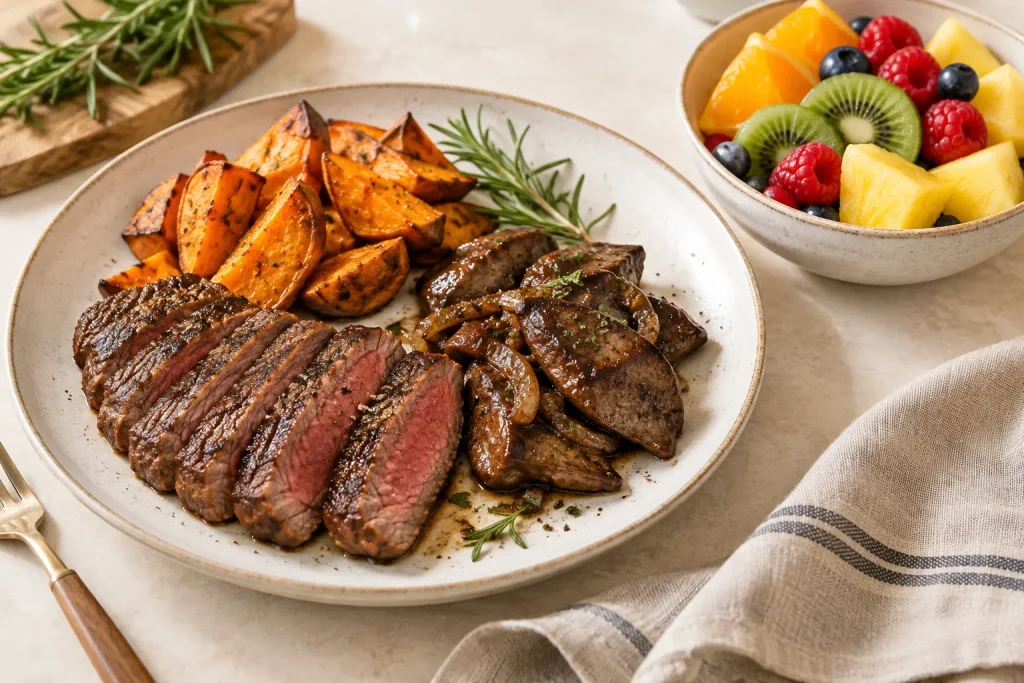
Vitamin C and animal protein are two of the most reliable ways to improve non-heme iron absorption.
Vitamin C does something very specific in the gut. It helps convert ferric iron into the more soluble ferrous form and can keep iron available long enough for intestinal cells to take it up. Research reviewed for the Nordic Nutrition Recommendations suggests that much of this meal-level effect occurs with the first 25 to 100 milligrams of vitamin C.
Fruit makes that easy to work into an Animal-Based meal.
Oranges, kiwi, berries, pineapple, mango, and other vitamin C-rich fruits can sit alongside beef, eggs, seafood, dairy, or organs without turning meal planning into a chemistry experiment.
Animal protein contributes too. Beef, poultry, and fish have repeatedly been shown to improve non-heme iron absorption when eaten in the same meal.
A simple Heart & Soil plate already brings those pieces together.
Meat or organs provide highly available heme iron. Fruit brings vitamin C. The rest of the meal works around foods humans can actually recognize and eat regularly.
What Gets in the Way of Non-Heme Iron
A handful of everyday habits can pull non-heme iron absorption down:
- Phytates in whole grains, beans, lentils, nuts, and seeds
- Polyphenols in tea, coffee, and cocoa can interfere too, especially close to an iron-rich meal.
- Calcium: the NIH notes it can reduce absorption of both heme and non-heme iron. Its real-world impact within a varied diet is still less clear.
- Reduced stomach acid: proton pump inhibitors like omeprazole can lower non-heme iron absorption, especially if you’re already low on iron. Never stop a prescribed medication without your doctor’s input.
Is Heme Iron Better Than Non-Heme Iron?
For everyday food, Heart & Soil favors heme iron because your body can absorb it efficiently with very little meal planning.
That whole-food context is a big part of the Heart & Soil philosophy. The body rarely uses one nutrient in isolation
Iron has to be absorbed, transported, stored, recycled, and eventually built back into proteins such as hemoglobin.
For a diagnosed iron deficiency, the job changes. A clinician may use a standardized iron supplement because it provides a known amount of elemental iron that can be adjusted and followed with bloodwork.
Food builds the foundation. Clinical dosing gives a clinician a precise tool when more iron is actually needed.
Why Do Vegetarians Need More Iron?
Vegetarians are advised to consume about 1.8 times more iron because plant-based diets rely on non-heme iron, which the body absorbs less efficiently than heme iron.
That higher target is really a bioavailability adjustment.
Ten milligrams of iron on two nutrition labels can look identical. Your digestive tract may see two very different meals. Non-heme iron is more affected by phytates, polyphenols, vitamin C, and the rest of the food eaten alongside it, so a greater intake helps compensate for the smaller fraction typically absorbed.
That means a plant-based iron strategy usually requires more attention to combinations.
Heart & Soil takes the more straightforward route.
Beef, liver, spleen, seafood, and other animal foods already provide highly available iron alongside the nutrients involved in building and maintaining healthy blood.
There’s one more useful point here.
A dietary recommendation tells you how much iron to aim for. It doesn’t tell you your personal iron status.
Hemoglobin, ferritin, serum iron, and transferrin saturation each describe a different part of iron handling, which is why bloodwork gives a much fuller picture than symptoms or food intake alone.
More deliberate planning is built into a vegetarian iron strategy. An Animal-Based diet gets much of that work done by the foods on the plate.
Best Heme Iron Food Sources
Reach for these iron-rich organ meats and animal foods:
- Oysters and other shellfish
- Beef and lamb
- Sardines
- Dark poultry meat
- Liver
- Spleen
- Blood-based foods
Liver stands out for more than iron alone. It carries vitamin B12, riboflavin, folate, vitamin B6, copper, and vitamin A in the same bite. Spleen has a long history as an iron-dense organ, which is why it shows up in whole-food iron formulas. Shellfish rounds out the list with protein, B12, and zinc alongside its iron content.
Best Non-Heme Iron Food Sources
Non-heme iron commonly comes from:
- Leafy vegetables
- Legumes
- Grains
- Nuts and seeds
- Fortified foods
- Most conventional iron supplements
Within an Animal-Based framework, these aren’t the foods Heart & Soil prioritizes for building iron intake because heme iron from meat and organs is generally more bioavailable.
A high iron number on a fortified-food label doesn’t automatically mean you’ll absorb that entire amount. The iron compound, the rest of the meal, and your existing iron status all affect the outcome.
Heme vs Non-Heme Iron for Low Ferritin
Low ferritin usually points to low or declining iron stores, though inflammation and other conditions can complicate the picture. Aferritin blood test is typically the starting point for confirming that. Diet plays a supporting role here, not a guaranteed fix.
Confirmed low ferritin often calls for more than a menu change:
- Finding the underlying cause
- Considering a standardized supplement, if appropriate
- Ongoing monitoring
- Follow-up bloodwork
Eating more liver or adding an organ-based supplement can support an iron-rich diet. It’s not a substitute for finding out why your ferritin is low. It also can’t tell you how low is too low for your situation.
Heme vs Non-Heme Iron for Anemia Support
Anemia can have several underlying causes. These include vitamin B12 deficiency, folate deficiency, chronic disease, kidney disease, blood loss, bone marrow disorders, and genetic conditions.
Iron only helps when the anemia is actually caused by low iron. Confirming that requires aniron-deficiency anemia diagnosis through bloodwork, not guesswork. For confirmed cases, your healthcare provider may recommend a standardized oral or intravenous iron product. The choice depends on severity, tolerance, cause, and other personal factors. A whole-food organ supplement isn’t built to replace that kind of targeted treatment.
Heme Iron Supplements vs Whole-Food Organ Products
Not all iron supplements work the same way. Two categories worth knowing:
Heme iron polypeptide supplements are processed and concentrated, usually with a stated amount of elemental iron. Non-heme supplement forms like ferrous sulfate or iron bisglycinate work similarly, are concentrated, and are easy to dose.
Whole-food organ products contain tissues like spleen, liver, or whole blood extract. They deliver iron inside a broader nutrient matrix, but often skip a standardized elemental-iron amount.
If a clinician has confirmed you need a specific milligram target, a standardized supplement is simpler to track. If you’re looking for broad, whole-food nutritional support, an organ-based product fits a different goal.
Meet Heart & Soil’s Organ-Based Iron Options
Heart & Soil built three products around organ nutrition, each with a different focus. These three products approach the heme vs non-heme iron question from a whole-food angle.
Lifeblood
Lifeblood combines grass-fed and grass-finished whole blood extract, spleen, and liver, three naturally iron-rich animal tissues. It’s formulated around healthy iron stores, oxygen utilization, normal red blood cell formation, cardiovascular function, and exercise stamina.
Beef Organs
Beef Organs takes a broader approach, combining liver, heart, pancreas, spleen, and kidney into one formula. The liver and spleen make it relevant to iron-rich organ meats specifically, while the heart contributes nutrients tied to cellular energy.
Pure American Liver
For readers who want liver alone, Pure American Liver delivers heme iron alongside vitamin B12, riboflavin, folate, vitamin B6, copper, and naturally occurring vitamin A. It’s a focused way to make liver a regular part of your routine, and it can also be used alongside Heart & Soil’s broader organ formulas when you want greater nose-to-tail variety.
| Product | Key Ingredients | Best Fit For |
| Lifeblood | Whole blood extract, spleen, liver | Targeted iron and blood-related support |
| Beef Organs | Liver, heart, pancreas, spleen, kidney | Broad nose-to-tail nutrition |
| Pure American Liver | Liver only | Focused liver-derived nutrients |
Athletes leaning on iron for stamina and oxygen delivery might also look at theExercise Performance Stack. It’s built around training and recovery rather than any single nutrient.
Can Too Much Iron Be a Problem?
Yes. Iron can build up when absorption or iron input stays higher than the body can safely handle.
Your body is extremely good at holding onto iron. Most of it is recycled again and again as old red blood cells are broken down and new ones are made. There’s no major pathway for actively excreting excess iron, so regulation happens largely by controlling how much enters from the gut.
That’s why hereditary hemochromatosis changes the equation.
In this condition, iron-regulating signals are disrupted. The intestine can keep absorbing more iron than the body needs. Repeated blood transfusions can also add large amounts of iron over time.
Building a Balanced Iron-Rich Meal
Within an Animal-Based diet, building an iron-rich meal can stay pretty simple:
- Beef or lamb: pair ruminant meat with fruit and a well-tolerated root vegetable such as potatoes or sweet potatoes.
- Liver and meat: add liver alongside beef or another animal protein, with fruit or root vegetables according to appetite.
- Seafood: shellfish or sardines can provide heme iron alongside protein, vitamin B12, zinc, and other naturally occurring nutrients.
Heart & Soil generally encourages around 1–3 ounces of organs per day, with roughly 0.5–1 ounce coming from liver. That makes liver a regular part of an Animal-Based diet rather than something that needs to be treated as an occasional food.
If you’re also taking a therapeutic iron supplement, meal timing and interactions with calcium or medications are a separate clinical consideration, so follow the guidance provided with your treatment.
When to Get Bloodwork Instead of Guessing
Consider talking to your healthcare provider if you notice any of these:
- Persistent fatigue or weakness
- Shortness of breath or dizziness
- A racing heartbeat
- Pale skin or restless legs
- Heavy menstrual bleeding
- Frequent blood donation
Pregnancy and gastrointestinal symptoms are also good reasons to check in. A clinician may look at your complete blood count, hemoglobin, hematocrit, ferritin, transferrin saturation, serum iron, and total iron-binding capacity.
These numbers tell a clearer story than symptoms alone ever could.
Common Myths About Heme and Non-Heme Iron
| Myth | Reality |
| Plant iron isn’t absorbed at all | It’s absorbed, just more variably, depending on the rest of the meal |
| Heme iron is always the better choice | It absorbs better, but it isn’t the only path to healthy iron levels |
| More absorption is always healthier | Not for people with excess iron or iron-loading conditions |
| Spinach is the best iron source | It contains iron, but compounds in the leaf limit how much you absorb |
| Vitamin C helps heme iron absorb better | Vitamin C mainly helps non-heme iron, not heme |
| Organ supplements resolve anemia on their own | They support intake; confirmed anemia needs diagnosis and proper treatment |
Iron Is a Recycling System
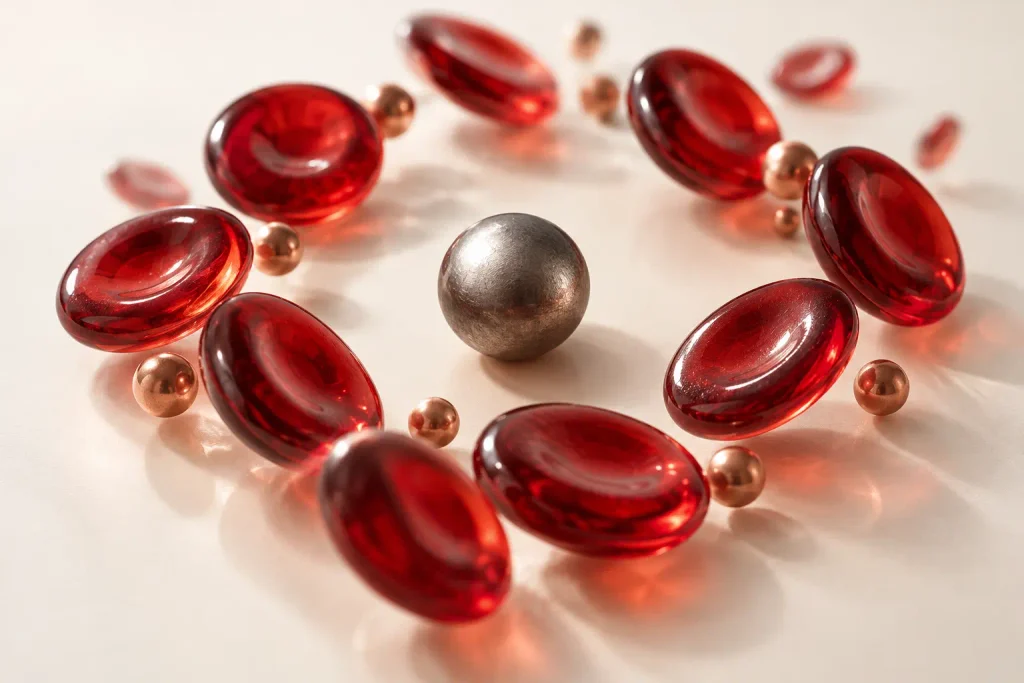
Iron is moving through you all day long.
Every second, your body breaks down and replaces millions of red blood cells. Iron from those aging cells is recovered, moved back into circulation, carried by transferrin, and sent toward the bone marrow where new red blood cells are being built.
That puts the whole heme versus non-heme conversation in perspective.
The iron you eat joins a system that is already working constantly. Absorption is one part of it. Transport, storage, recycling, copper status, and blood formation all have a role too.
Heart & Soil looks at nutrition through that wider lens. Beef, liver, spleen, seafood, and other animal foods bring highly available iron together with B12, copper, protein, and other nutrients involved in the same biological machinery.
When fresh organs are hard to eat consistently,Lifeblood,Beef Organs, and Pure American Liver make those foods easier to keep in your routine.
Your body has been recycling iron since before you knew what ferritin was. Give that system the raw materials it was built to use.
Still deciding what fits your routine?Our Health Success Team can help you sort through the options.
Frequently Asked Questions
What is the difference between heme and non-heme iron?
The difference between heme and non-heme iron is how your body handles them. Heme iron comes from animal foods and is absorbed more efficiently. Non-heme iron comes from plants, fortified foods, and many supplements, with absorption changing more according to the rest of the meal.
Is heme iron better than non-heme iron?
Heme iron has an advantage because your body absorbs it more efficiently and consistently. Meat, seafood, liver, spleen, and other animal foods provide heme iron naturally, making them Heart & Soil’s preferred everyday sources of dietary iron.
Which type of iron is best absorbed?
Heme iron is the best-absorbed form of dietary iron. It is generally absorbed more efficiently than non-heme iron and is less affected by phytates, polyphenols, and other compounds in the meal.
Why is animal-based iron more bioavailable?
Animal-based iron is more bioavailable largely because it includes heme iron. The heme structure helps keep iron available during digestion, while meat can also enhance the absorption of non-heme iron eaten alongside it.
What foods contain heme iron?
Foods that contain heme iron include beef, lamb, poultry, seafood, liver, spleen, whole blood, and other organ meats. Red meat and organs are especially useful within an Animal-Based diet because they also provide protein and nutrients involved in healthy blood formation.
What foods contain non-heme iron?
Foods that contain non-heme iron include spinach, beans, lentils, tofu, seeds, grains, and iron-fortified foods. Non-heme iron also appears in many conventional iron supplements. Heart & Soil builds everyday iron intake primarily around heme-rich animal foods.
Does vitamin C help iron absorption?
Vitamin C helps iron absorption by improving the uptake of non-heme iron. Fruit such as oranges, kiwi, berries, mango, and pineapple can provide vitamin C alongside an Animal-Based meal.
Does coffee block iron absorption?
Coffee can reduce iron absorption, especially non-heme iron, because its polyphenols can bind iron in the digestive tract. Heme iron is much less affected, which is another reason its absorption tends to be more consistent across different meals.
Does calcium block iron absorption?
Calcium can temporarily reduce the absorption of both heme and non-heme iron when consumed in the same meal. The size of this effect depends on the meal, and long-term studies suggest the impact on overall iron status is smaller than single-meal experiments might imply.
Can vegetarians get enough iron?
Vegetarians can get enough iron, but their iron needs are higher because plant foods provide non-heme iron. They need about 1.8 times the usual iron intake. Heart & Soil instead prioritizes heme-rich foods such as beef, liver, spleen, and seafood.
Is heme iron better for anemia?
Heme iron can be useful for anemia because it provides a highly bioavailable source of dietary iron. Confirmed iron-deficiency anemia also deserves bloodwork and clinician guidance so the cause, severity, and appropriate treatment can be identified rather than assuming more iron alone will solve it.
Does liver contain heme iron?
Liver contains heme iron along with vitamin B12, folate, riboflavin, vitamin B6, copper, and protein. That combination makes liver especially valuable within Heart & Soil’s whole-food approach to supporting healthy blood formation.
What is Heart & Soil Lifeblood?
Heart & Soil Lifeblood is a whole-food organ supplement made with grass-fed and grass-finished whole blood extract, spleen, and liver. It is designed to make these traditionally iron-rich animal foods easier to include consistently.
Can too much heme iron be harmful?
Too much heme iron can be a concern when the body is already accumulating excess iron. People with hereditary hemochromatosis, repeated transfusions, or another iron-loading condition should work with their healthcare provider before adding concentrated iron products or substantially increasing iron intake.
Subscribe to future articles like this:
