
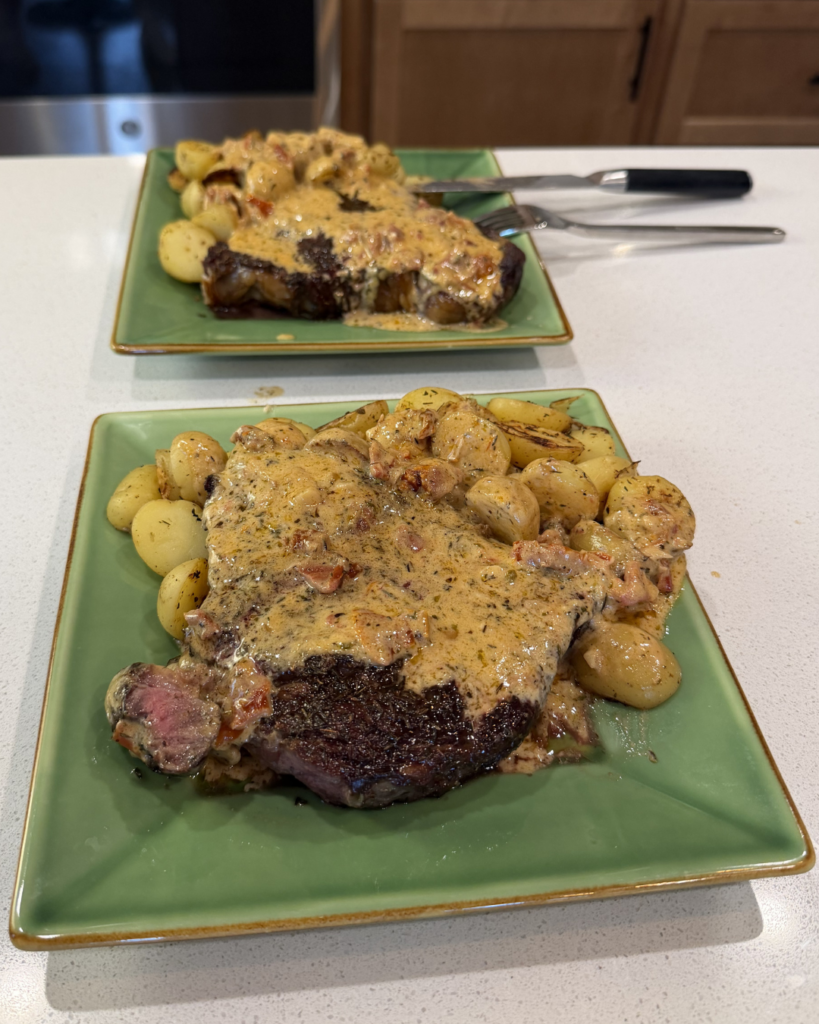
You have probably seen the “marry me chicken” sauce all over the internet. Creamy, herby, sun-dried tomato, parmesan. It works. But chicken doesn’t do what steak does. Swap the protein, keep the sauce, and you get the most delicious, nutrient-dense animal-based dinner: Marry Me Steak & Potatoes.
The sauce is delicious, but the star is a well-seared steak over crispy rosemary potatoes, finished with a pan sauce that makes the whole thing feel like a restaurant meal on a Tuesday night.
The steak delivers what chicken never will: a full spectrum of fat-soluble vitamins, heme iron your body absorbs immediately, and a fat profile built for sustained energy.
Table of Contents
TL;DR
Marry Me Steak & Potatoes is a rich, creamy one-pan dinner built on a seared steak of your choice, roasted mini gold potatoes, and a sun-dried tomato cream sauce adapted from the viral “marry me” formula. It takes under 45 minutes. The steak delivers complete protein, B vitamins, iron, and zinc. The potatoes deliver potassium, vitamin C, and complex carbohydrates. Skip the seed oils, use real butter and cream, and you have a meal your body actually uses and loves!
What Are the Nutritional Benefits of Beef?
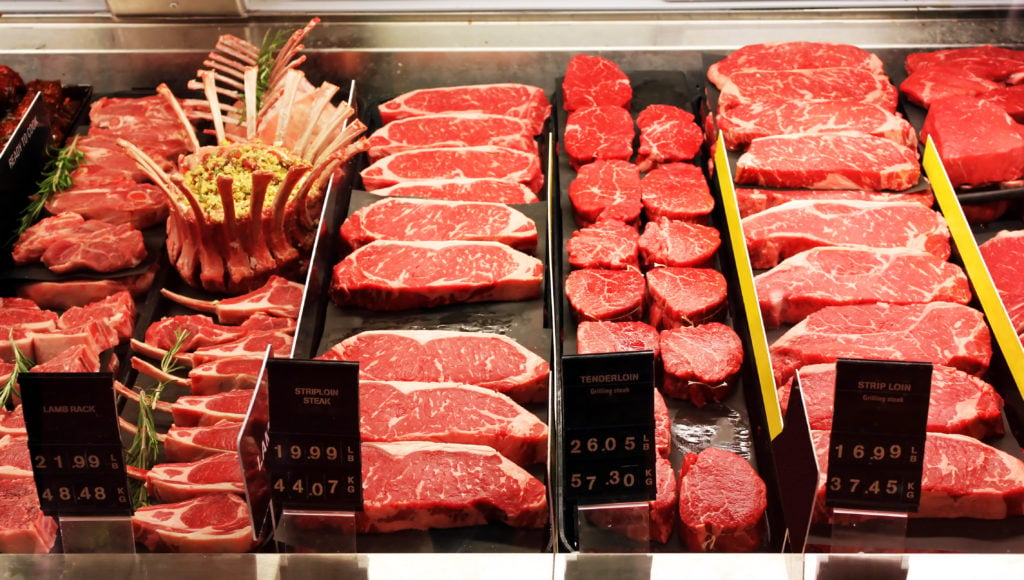
A 100 g serving of a USDA Prime steak delivers over 43% of your daily protein value. Every cut in this recipe, whether ribeye, strip loin, tenderloin, or top sirloin, qualifies as an “Excellent Source” of protein by USDA standards, according to a 2024 nutrient analysis of USDA Prime beef cuts published in Nutrients out of Texas Tech University (1). That is not a supplement doing the work. That is a single meal.
Protein is only the beginning. The same study found that all 4 cuts qualify as an “Excellent Source” of vitamin B12, with ribeye providing 70.4% of the daily value per 100 g serving and top sirloin providing 73.3%. B12 is found almost exclusively in animal foods, and it supports normal red blood cell formation and neurological function (2).
Selenium is another standout. Strip loin delivers 36.4% of the daily value, and all 4 cuts qualify as either a “Good” or “Excellent” source.
Zinc follows the same pattern. Strip loin and top sirloin both qualify as “Excellent” sources, at 20.9% and 22.5% of the daily value per 100 g, respectively.
These are not trace amounts. These are meaningful contributions to your daily requirements from a single animal-based meal.
Key Nutrients in USDA Prime Beef Cuts (% Daily Value per 100 g raw lean tissue)
| Nutrient | Strip Loin | Tenderloin | Top Sirloin | Ribeye |
| Protein | 43.4% E | 43.6% E | 46.4% E | 43.8% E |
| Vitamin B12 | 61.7% E | 62.9% E | 73.3% E | 70.4% E |
| Niacin (B3) | 30.6% E | 36.6% E | 27.6% E | 27.3% E |
| Selenium | 36.4% E | 42.4% E | 40.4% E | 40.7% E |
| Zinc | 20.9% E | 19.8% G | 22.5% E | 24.4% E |
| Riboflavin (B2) | 16.9% G | 13.8% G | 10.0% G | 8.5 |
| Phosphorus | 14.9% G | 16.2% G | 17.5% G | 13.6% G |
E = Excellent Source (>20% DV); G = Good Source (10–19% DV). Source: Mortensen et al., Nutrients, 2024 (3)
What Are the Nutritional Benefits of Potatoes?
Potatoes have an undeserved reputation problem. They are not junk food. A medium potato (150 g) delivers roughly 620 mg of potassium, more per serving than a banana, along with vitamin C, vitamin B6, and resistant starch that feeds the beneficial bacteria in your gut (4). When you roast mini gold potatoes with the skin on, you keep all of that intact.
The potassium content alone makes potatoes worth including in an animal-based diet. Most people eating primarily meat and organs eat very little potassium relative to their sodium intake. Potatoes balance that ratio. They are also one of the most satiating foods per calorie, which means you eat until you are genuinely full, not until your plate is empty.
Mini gold potatoes specifically have a naturally buttery flavor and a waxy texture that holds up under high heat. Season them with salt, rosemary, garlic powder, and onion powder, and they do not need anything else.
Potatoes are not the enemy. They are the potassium, the starch, and the satiety that rounds out a meat-centered plate.
Subscribe to future articles like this:
Ingredients for Marry Me Steak & Potatoes
For the Potatoes
- 1 lb mini gold potatoes, halved
- 2 tablespoons butter or tallow
- 1 teaspoon salt
- 1 teaspoon garlic powder
- 1 teaspoon onion powder
- 1 tablespoon fresh or dried rosemary
For the Steak
- 2 steaks of your choice (ribeye, New York strip, sirloin, or skirt)
- Salt, to taste
- Butter or tallow for searing
For the Marry Me Sauce
- 2 tablespoons butter
- 3 cloves garlic, minced
- 1 cup chicken or beef stock
- 1 cup heavy cream
- 1/2 cup grated parmesan cheese
- 1/3 cup sun-dried tomatoes, chopped
- 1/4 teaspoon oregano
- 1/4 teaspoon thyme
- 1 tablespoon fresh basil, for garnish
- Salt, to taste
How to Make Marry Me Steak & Potatoes
Step 1: Roast the Potatoes
Preheat your oven to 425°F. Toss the halved mini gold potatoes with butter or tallow, salt, garlic powder, onion powder, and rosemary. Spread them cut-side down on a sheet pan in a single layer. Roast for 25 to 30 minutes, until golden and crispy on the cut side. They can hold in a warm oven while you finish the steak.
Step 2: Sear the Steak
Pull your steaks from the refrigerator 20 minutes before cooking. Pat them completely dry with a paper towel. Season generously with salt on both sides. Heat a cast iron skillet over high heat until it is very hot, about 2 minutes. Add butter or tallow and sear the steaks 3 to 4 minutes per side for medium-rare, depending on thickness. Rest on a cutting board for 5 minutes before slicing.
Step 3: Build the Sauce
In the same skillet over medium heat, melt 2 tablespoons of butter. Add the minced garlic and cook for 1 minute until fragrant. Pour in the stock and scrape up any browned bits from the bottom of the pan. Those bits are flavor. Reduce heat to medium-low. Add the heavy cream and parmesan, stirring until the cheese is fully incorporated. Let the sauce simmer for 2 to 3 minutes until it thickens slightly. Add the sun-dried tomatoes, oregano, and thyme. Season with salt.
Step 4: Plate and Finish
Slice the steak against the grain. Arrange it over or alongside the roasted potatoes. Spoon the marry me sauce generously over the steak. Finish with fresh basil. Serve immediately.
Pro Tips for the Perfect Sear
Getting the sear right is the difference between a good steak and a great one.
- Dry the surface completely. Moisture is the enemy of a crust. Pat the steak dry before it hits the pan.
- Use a hot pan. A lukewarm pan steams the steak. You want a pan that will form a crust on contact.
- Do not move it. Let the steak release naturally. If it sticks, it is not ready to flip.
- Rest it. 5 minutes of rest allows the juices to redistribute. Slice it too early and they run out onto the cutting board.
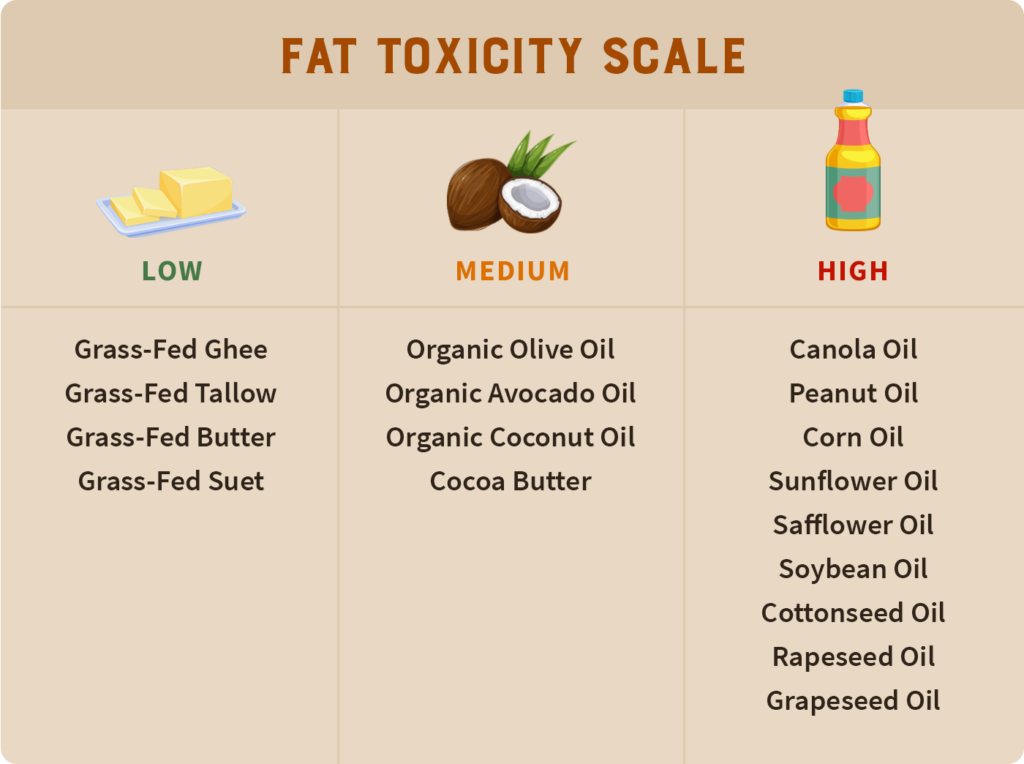
- Use real fat. Butter, tallow, or ghee. Not seed oils. Polyunsaturated fats from seed oils oxidize at high heat and create byproducts your body does not need.
Glossary
Animal-based: A dietary approach centered on animal foods, including muscle meat, organs, eggs, dairy, and animal fats, as the primary source of nutrition. Animal-based eating emphasizes foods that are biologically dense and evolutionarily familiar.
Heme iron: The form of iron found in animal tissue, particularly in red meat and organs. Heme iron is absorbed at a significantly higher rate than non-heme iron from plant foods, making it the most bioavailable dietary form.
Seed oils: Industrial oils extracted from seeds (canola, soybean, corn, sunflower, cottonseed) through chemical refining. High in polyunsaturated fatty acids, which oxidize readily at cooking temperatures. Heart & Soil and the broader animal-based community avoid seed oils in favor of stable animal fats.
Check out: The Complete List Of Seed Oils To Avoid
Saturated fatty acids (SFA): Fatty acids with no double bonds in their carbon chain. They are shelf-stable, resistant to oxidation at cooking temperatures, and are the predominant fat in animal products, including beef, butter, and tallow.
Organ meats: The internal organs of animals, including liver, heart, kidney, and spleen. Organ meats are among the most nutrient-dense foods in the human diet, containing concentrated amounts of fat-soluble vitamins, heme iron, B vitamins, and bioavailable minerals.
Fuel Your Body with Nature's Best
Grass-Fed Bone Marrow & Liver
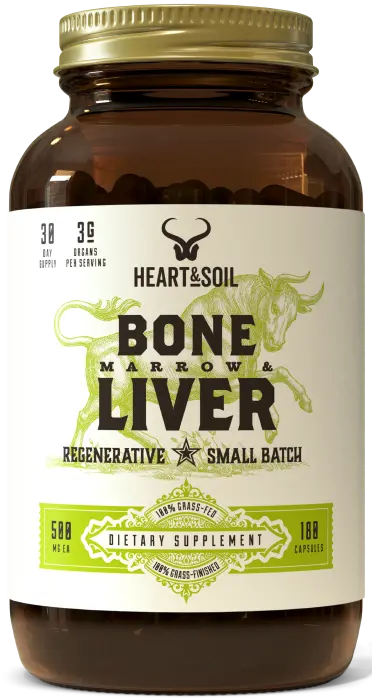
- Organ-based nutrition for bone strength, skin health, & emotional well-being
- Helps maintain energy levels and a healthy libido
- Delivers bioavailable vitamins, minerals, and nutrients for overall vitality
60-day risk-free guarantee. No questions asked.
FAQ
Can I use any cut of steak for this Marry Me Steak & Potatoes recipe? Yes. Ribeye, New York strip, sirloin, skirt steak, and flat iron all work well. Fattier cuts like ribeye pair especially well with the richness of the cream sauce. Leaner cuts like sirloin let the sauce do more of the heavy lifting.
Learn the difference between conventional and organic steak here: Key Differences Between Organic And Conventional Foods
Does the Marry Me Steak & Potatoes sauce work without the sun-dried tomatoes? The sauce still works without them, but the tomatoes add an umami depth that makes it distinct from a plain cream sauce. If you do not have sun-dried tomatoes, a small amount of tomato paste (1 teaspoon) delivers a similar flavor profile.
Why avoid seed oils in this Marry Me Steak & Potatoes recipe? Seed oils are high in polyunsaturated fatty acids (PUFAs), particularly linoleic acid, which oxidize when heated to cooking temperatures. Oxidized fats produce aldehydes and other compounds that are not favorable for metabolic health. Butter, tallow, and ghee are stable at high heat and have been used in cooking for thousands of years.
Can I make the Marry Me Steak & Potatoes sauce ahead of time? Yes. The sauce reheats well over low heat with a splash of cream or stock to loosen it. Make it within 2 days and store it covered in the refrigerator.
How do I know when the potatoes are done? Look for a deep golden-brown color on the cut side with some crisping on the edges. Pierce one with a fork. It should slide in with no resistance. If the surface is golden but the center is still firm, drop the heat to 400°F and continue for another 5 minutes.
What is the best way to slice steak for plating? Always slice against the grain. Look at the direction the muscle fibers run and cut perpendicular to them. This shortens the fibers and makes every bite tender regardless of the cut.
Is this Marry Me Steak & Potatoes recipe appropriate for a carnivore or animal-based diet? The steak and potatoes fit an animal-based approach as written. The parmesan and heavy cream are animal-sourced. The potatoes are a whole food starch. If you are strict carnivore, you can skip the potatoes and the sun-dried tomatoes and serve the steak with the cream sauce only.
Learn more: The Ultimate Animal-Based Diet Food List (PDF Included!)
Related Reading
- The Ultimate Guide To The Animal-Based Diet
- Is Corn Oil Healthy? 4 Dangers & What To Choose Instead
- 6 Dangers Of Eating Liver: What You Need To Know
- Beef Liver Vs Chicken Liver Benefits: Which Is Healthier?
More Animal-Based Recipes
- Healthy Angel Food Cake
- Carnivore Pizza Recipe: The High-Protein, Zero-Grain Crust You Need to Try
- Beef Tongue Tacos: A Delicious High-Protein, Animal-Based Recipe
- How to Make Crispy Carnivore Fried Chicken (6 Easy Steps)
- Homemade Samoas Protein Cookies: Easy 6-Ingredient Copycat
- How to Make Delicious BBQ Meatballs in Just 30 Minutes
Bottom Line
Marry Me Steak & Potatoes deserves a spot on your weekly meal plan! A well-seared steak provides complete protein, heme iron, zinc, B12, and a fat profile your body uses efficiently. Roasted mini gold potatoes deliver potassium, complex carbohydrates, and real satiety. A pan sauce built on cream, parmesan, garlic, and sun-dried tomatoes ties it together in under 45 minutes.
That is what Heart & Soil has always been about: the parts your ancestors ate, prepared the way they would have recognized.
Subscribe to future articles like this:
