
PLEASE NOTE: The information in this blog is for educational purposes only. It is not a substitute for professional medical advice. Consult your healthcare provider if you’re seeking medical advice, diagnoses, or treatment.
We often think of the foods we eat in terms of calories or overused catchphrases like “all-natural.” While these offer some useful information, this way of thinking can lead us astray.
What often gets ignored is the question, “what nutrients does this food provide?” One of those oh-so-important yet overlooked nutrients is vitamin A. It may not be sexy or marketable, but it has a tremendous impact on the human body.
In fact, in a world full of highly processed foods and fear of animal foods, some of the best sources may be missing from your diet.
This article outlines the many benefits of vitamin A, the best foods for vitamin A, and will help you find the right amount needed to feel your best!
Table of Contents
TL;DR: Best Foods for Vitamin A
The best foods for vitamin A are animal-based: beef liver leads by a wide margin, followed by egg yolks, dairy, and fatty fish. These provide preformed vitamin A (retinol), which your body absorbs at 70–90% efficiency (1). Plant foods like sweet potato and carrots supply provitamin A (beta-carotene), but absorption sits as low as 3% (2). If your goal is to actually get enough vitamin A, animal foods are not optional.
What Is Vitamin A, Really?
Vitamin A is not 1 nutrient. It is a family of fat-soluble compounds your body uses for vision, immune function, skin integrity, reproduction, and bone development (3, 4). You cannot make it yourself, which means every microgram has to come from food.
The nutrient appears in 2 forms: preformed vitamin A from animal foods, and provitamin A carotenoids from plants. Your body handles them very differently, and that difference is why the best food source for vitamin A is almost always an animal food, not a vegetable.
Vitamin A deficiency is a problem in more than 50% of countries globally (5). The consequences range from night blindness to anemia to a weakened immune system. Most people in Western countries are not severely deficient, but suboptimal intake is far more common than the official numbers suggest.
What Are the Two Forms of Vitamin A?
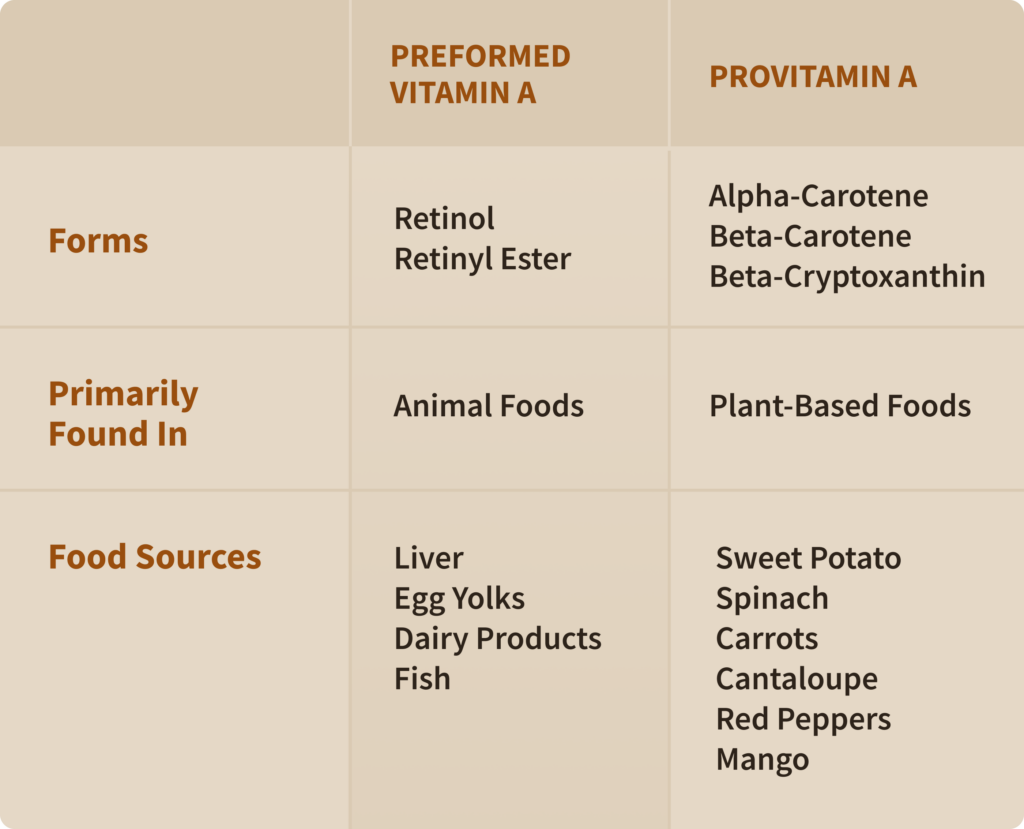
Preformed Vitamin A (Retinol, Retinyl Esters)
Preformed vitamin A is found in animal foods: liver, egg yolks, dairy, and fish. Your body absorbs it directly as retinol, the active form it can immediately use. Absorption rates sit between 70% and 90% (6). Preformed vitamin A accounts for roughly 70% of vitamin A intake in Western diets (7).
Provitamin A (Beta-Carotene and Carotenoids)
Provitamin A comes from plant foods.
- Carotenoids give fruits and vegetables their orange, yellow, and green colors (8). Before your body can use them, it has to convert carotenoids to retinol. The problem is conversion is inefficient, and absorption of provitamin A from carotenoids can be as low as 3% (9).
- Beta-carotene absorption varies widely, ranging from 7% to 65%, depending on cooking method, genetics, fat content of the meal, and the ripeness of the produce (10).
The practical takeaway: Eating a sweet potato does not deliver the same vitamin A as eating beef liver. The numbers look similar on a nutrition label. In the body, they are not.
What Are the Best Foods for Vitamin A?
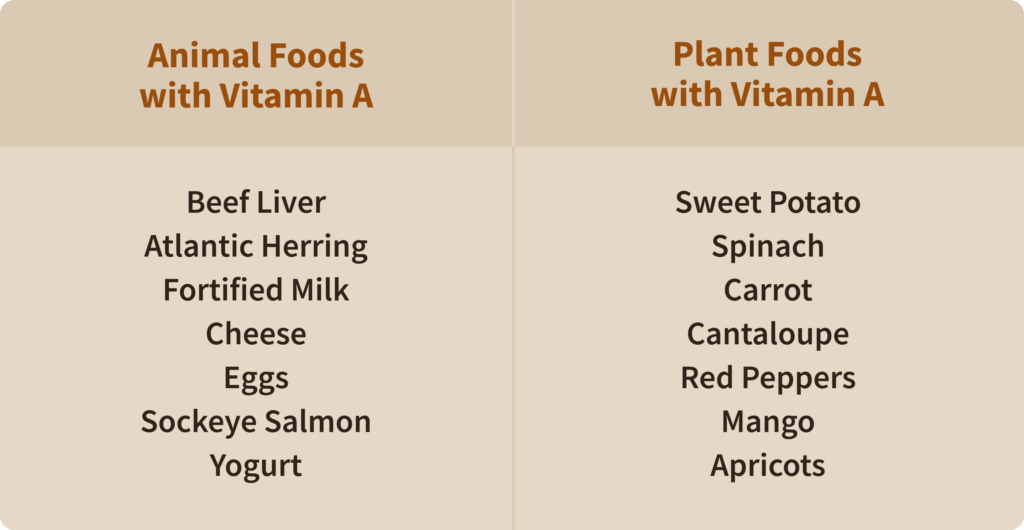
The best foods for vitamin A are concentrated sources of preformed retinol. These are also among the most nutrient-dense foods on the planet. Here is the full list, ranked from highest to most accessible for an animal-based diet (11):
The Animal-based best foods for vitamin A:
- Beef liver (3 oz): approximately 26,973 mcg RAE — over 2,000% of the daily recommended intake
- Lamb liver (3 oz): approximately 7,441 mcg RAE
- Chicken liver (3 oz): approximately 4,082 mcg RAE
- Cod liver oil (1 tbsp): approximately 4,080 mcg RAE
- Bluefin tuna (3 oz): approximately 1,287 mcg RAE
- King mackerel (3 oz): approximately 306 mcg RAE
- Salmon (3 oz): approximately 59 mcg RAE
- Egg (1 whole): approximately 74 mcg RAE
- Butter (1 tbsp): approximately 97 mcg RAE
- Whole milk (1 cup): approximately 112 mcg RAE
Check out: Beef Liver Supplements: Benefits, Dosage, & How to Choose the Best
Plant-based foods for vitamin A (provitamin A, low bioavailability):
- Sweet potato (1 medium, baked): approximately 1,403 mcg RAE equivalent before conversion losses
- Carrots (½ cup raw): approximately 459 mcg RAE equivalent
- Spinach (½ cup cooked): approximately 573 mcg RAE equivalent
- Cantaloupe (½ cup): approximately 135 mcg RAE equivalent
Why Is Beef Liver the Most Powerful Food Source for Vitamin A?
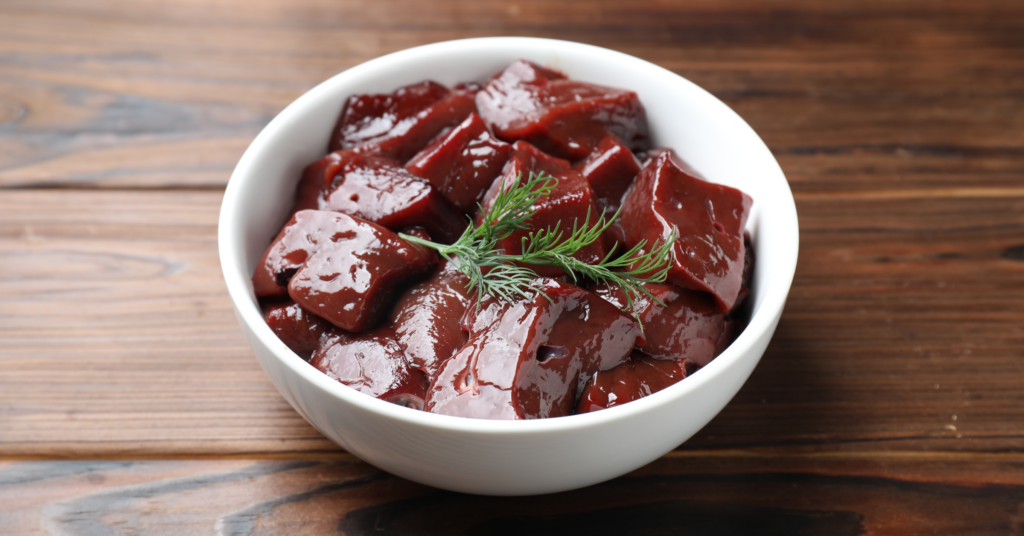
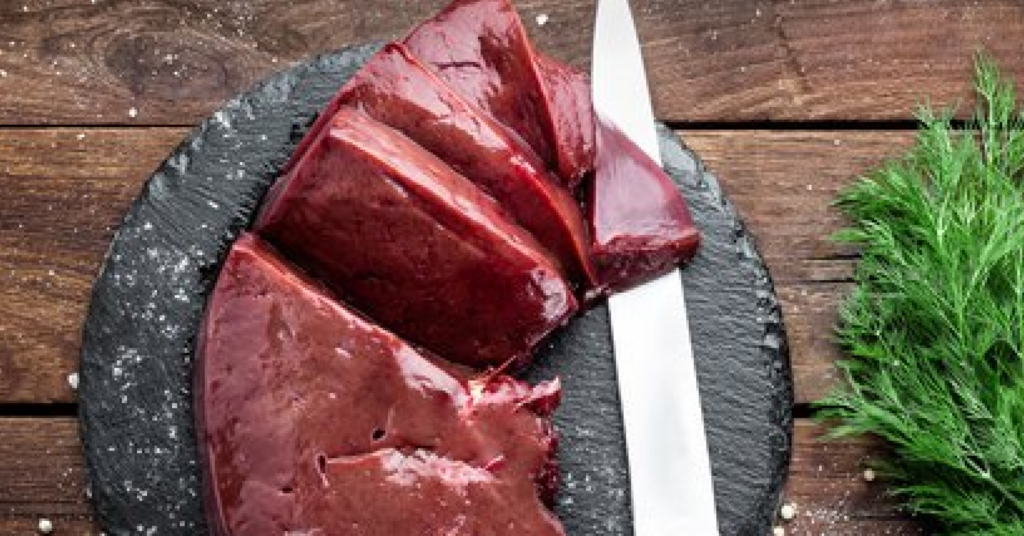
Beef liver does not just top the list for vitamin A. It is one of the most nutrient-dense foods on earth by virtually every measure (12). A single 3-ounce serving delivers:
- Vitamin B12 at roughly 70 mcg (over 1,000% of the RDI)
- Copper at approximately 14 mg (over 1,500% of the RDI)
- Iron, selenium, zinc, folate, riboflavin, and choline in meaningful amounts
These nutrients come in their natural food matrix. They are not isolated compounds assembled in a lab. Your body reads food differently than it reads a supplement, and beef liver is the clearest example of that difference.
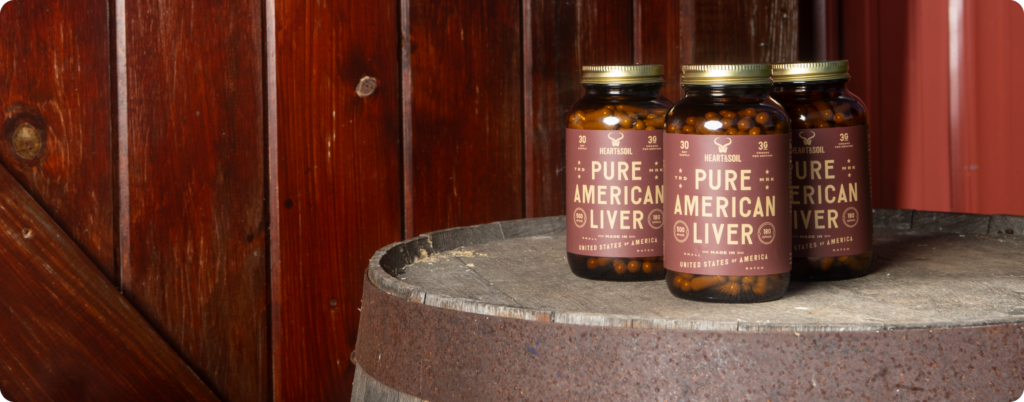
If fresh liver is unavailable or the taste is a barrier, Pure American Liver from Heart & Soil delivers the same concentrated nutrition in capsule form. It contains only grass-fed, USDA organic beef liver from American ranches. No fillers, no seed oils, no additives.
Nature's Ultimate Superfood
From Pure American Liver
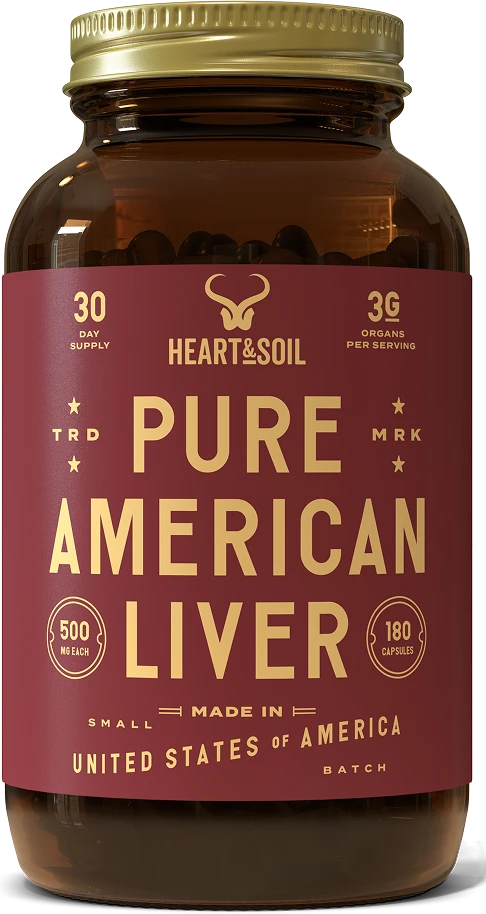
- Whole-food support for strength, energy, & vitality
- 100% American liver from grass-fed & pasture-raised cattle
- Nature's #1 superfood, freeze-dried to retain bioavailability
60-day risk-free guarantee. No questions asked.
How Does Vitamin A Support Skin and Eye Health?
Vitamin A Foods for Skin
Vitamin A regulates the production and lifecycle of skin cells (13). The vitamin A foods for skin that matter most are the ones providing retinol directly: liver, egg yolks, and dairy. Retinol supports the integrity of epithelial tissue, the layer of cells that lines your skin and mucous membranes. When vitamin A intake drops, skin integrity follows.
Retinoids, the pharmaceutical derivatives of vitamin A used in topical skincare, are effective precisely because they mimic what preformed vitamin A does inside the cell. Getting adequate vitamin A from food is the upstream version of the same process.
Vitamin A Foods for Eyes
Night blindness is the earliest clinical sign of vitamin A deficiency, and it is completely preventable with adequate intake (14). Retinal, a form of vitamin A, is a direct component of rhodopsin, the protein in rod cells that allows you to see in low light.
The foods for vitamin A for eye health with the highest impact are those providing preformed retinol: beef liver, fatty fish, eggs, and dairy.
Carotenoids from plant foods, particularly lutein and zeaxanthin, support eye health through a different mechanism as antioxidants concentrated in the macula (15). They are not interchangeable with retinol’s role in vision. Both matter.
What Is the Daily Recommended Vitamin A Intake?
The daily recommended vitamin A intake is measured in micrograms of retinol activity equivalents (mcg RAE). International units (IU) were the older standard; mcg RAE is now used because it accounts for the conversion differences between preformed and provitamin A (16).
Recommended Dietary Allowance (RDA) for vitamin A:
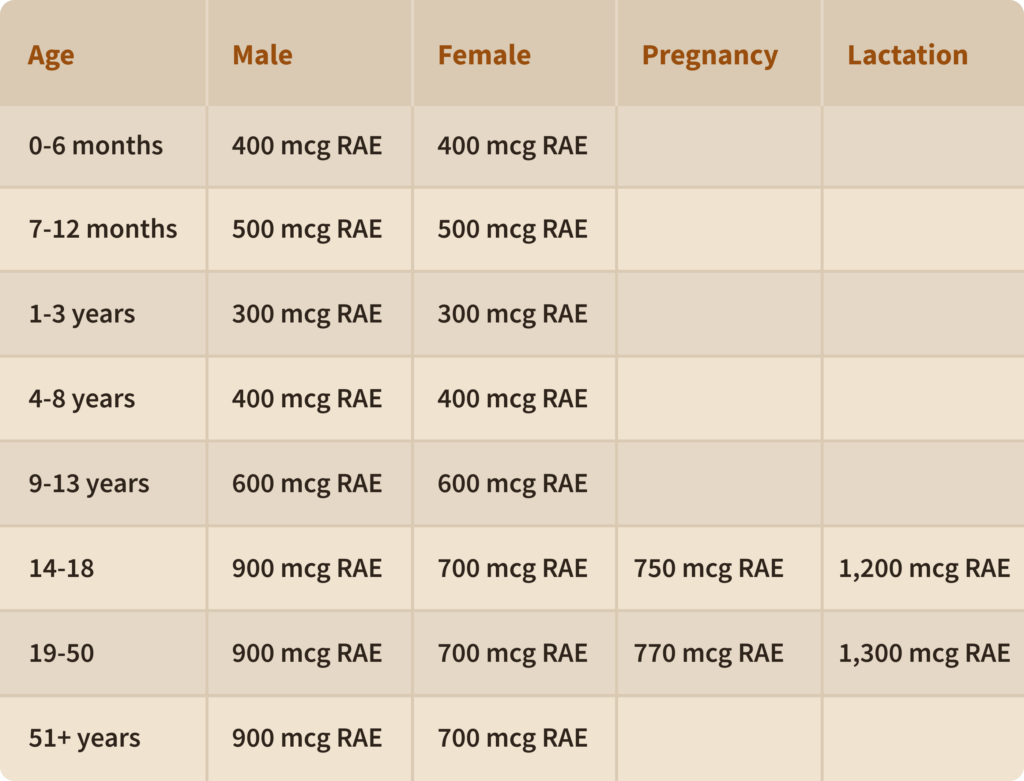
Infants and young children have higher relative demands for vitamin A given its role in growth and development, needing roughly 50% of adult intake (17, 18). For infants not on breast milk, bioavailable vitamin A from animal foods becomes especially important (19).
A single weekly serving of beef liver from a grass-fed animal covers your vitamin A needs for the entire week and then some.
Vitamin A Supplements: What to Know Before You Buy
Most people reaching for a vitamin A supplement are trying to solve a food problem. The better answer is usually to fix the food first. That said, supplements are not all the same, and the differences matter.
What Are the Different Forms of Vitamin A Available for Purchase?
Vitamin A supplements come in 3 main forms:
- Retinyl palmitate or retinyl acetate: preformed vitamin A, the same active form found in animal foods. Absorbed efficiently, but carries toxicity risk at high doses when taken in isolation over time.
- Beta-carotene: provitamin A. The body converts it to retinol as needed, which limits toxicity risk but also limits how much usable vitamin A you actually get. People with BCMO1 gene variants convert it poorly.
- Whole-food organ concentrates: freeze-dried liver or organ blends that deliver vitamin A in its natural food matrix, alongside the cofactors that come with it in real food. This is the closest supplement form to eating actual liver.
The form determines what you are actually getting. A label saying “5,000 IU vitamin A” from beta-carotene delivers far less usable vitamin A than the same amount from retinyl palmitate, and neither delivers it the way beef liver does.
How Do I Choose the Right Vitamin A Supplement for My Needs?
The right choice depends on why you are supplementing and what your diet already looks like.
- If you eat liver regularly, you likely do not need a vitamin A supplement at all.
- If you cannot or will not eat liver, a whole-food organ concentrate is the closest analog. Pure American Liver from Heart & Soil contains only grass-fed, USDA organic beef liver from American ranches, freeze-dried to preserve the full nutrient profile.
- If you are considering an isolated retinol supplement, work with a healthcare provider on dose. Isolated retinol does not come with the natural co-factors food provides, and chronic high-dose use is where toxicity risk becomes real.
- If you are considering beta-carotene, know that your ability to convert it is partly genetic and often low. It is a poor substitute for preformed vitamin A if your goal is improving actual vitamin A status.
For most people eating an animal-based diet with some liver, the food is enough. Supplementation is a backup, not a primary strategy.
Where to Buy Vitamin A?
One of the best foods for vitamin A is liver. Where to buy vitamin A depends on which form you are looking for. Isolated retinol and beta-carotene supplements are widely available at pharmacies, health food stores, and online retailers. Whole-food organ concentrates are a narrower category because quality varies considerably, and sourcing matters.
Pure American Liver from Heart & Soil ships directly and is sourced exclusively from USDA organic, grass-fed American cattle.
What Are the Benefits of Taking 10,000 IU of Vitamin A Daily?
10,000 IU of preformed vitamin A (retinol) equals approximately 3,000 mcg RAE, which sits right at the tolerable upper intake level for adults (20). At that level from an isolated supplement taken daily, you are at the ceiling of what is considered safe long-term. That does not mean it is wrong for everyone, but it is not a dose to take casually or without reason.
Context matters here. A one-time or occasional 10,000 IU dose from whole food, like a generous serving of beef liver, is metabolized very differently than 10,000 IU of isolated retinol taken daily in supplement form.
Whole foods for vitamin A are packaged with the nutrients that help the body regulate its use. An isolated supplement does not. If you are considering a high-dose retinol protocol, consult a healthcare provider who can assess your individual status and context.
Are There Any Risks Associated with Taking Vitamin A and D Together?
Direct answer: At food-based levels, no meaningful risk exists. The concern only shows up at high, isolated doses of one vitamin without the other, and for most people eating whole foods, that scenario doesn’t come up.
That risk picture is really just the flip side of a bigger story: these two vitamins aren’t just safe together, they appear to need each other to work at full strength.
Vitamin D’s receptor (VDR) has to pair with a partner receptor called RXR to switch genes on, and RXR is activated by a form of vitamin A. Lab studies show that when both receptors have their ligand present, gene activation is significantly higher than when either vitamin acts alone (21).
Vitamin D appears to need vitamin A on board to do its job at full strength, not just alongside it as a coincidence.
This is likely why animal foods evolved to deliver both nutrients as a package instead of one at a time. Beef liver, egg yolks, and fatty fish all provide meaningful amounts of preformed vitamin A and vitamin D together, in roughly the ratios the body’s receptor system is built around. Eating these foods gives you both halves of that receptor pair at once, rather than one signal firing without its counterpart.
Preformed vs. Provitamin A: Comparison Table
| Feature | Preformed Vitamin A (Retinol) | Provitamin A (Beta-Carotene) |
|---|---|---|
| Primary food sources | Beef liver, eggs, dairy, fatty fish | Sweet potato, carrots, spinach, leafy greens |
| Absorption rate | 70–90% (22) | As low as 3% (23) |
| Conversion required | No – directly usable as retinol | Yes – must convert to retinol in the body |
| Conversion efficiency | N/A | Varies widely: 7–65% for beta-carotene (24) |
| Affected by genetics | Minimal | Yes – BCMO1 gene variants reduce conversion |
| Fat required for absorption | Yes (fat-soluble) | Yes, and more fat improves conversion |
| Risk of toxicity | Yes, at very high supplemental doses | Very low – body regulates conversion |
| Best dietary context | Animal-based diet | Complement to, not replacement for, retinol |
FAQ
Q: What is a good food source for vitamin D?
A: Vitamin D and vitamin A are both fat-soluble vitamins concentrated in animal foods. The best food sources for vitamin D include fatty fish (salmon, mackerel, sardines), egg yolks, beef liver, and cod liver oil. Beef liver is one of the few whole foods that provides meaningful amounts of both vitamins simultaneously. For a full breakdown, see The Best Vitamin D Foods: Why Animal-Based Sources Win Every Time.
Q: What are the best foods for vitamin A?
A: The foods with the highest bioavailable vitamin A are animal-based: beef liver, lamb liver, chicken liver, cod liver oil, fatty fish, egg yolks, butter, and whole-fat dairy. Beef liver delivers more usable vitamin A per serving than any other food by a significant margin. Plant foods like sweet potato and carrots contain provitamin A carotenoids, but absorption is much lower and conversion is variable.
Q: What food has vitamin A in the highest concentration?
A: Beef liver has the highest concentration of preformed vitamin A of any commonly eaten food. A 3-ounce serving provides approximately 26,973 mcg RAE, which is well above the adult daily recommended intake of 700–900 mcg RAE (25). This is why most recommendations suggest eating liver once or twice per week rather than daily.
Q: What about vitamin A from supplements?
A: Isolated vitamin A supplements deliver retinol or beta-carotene outside their natural food matrix. Unlike beef liver, they do not provide the co-factors, additional nutrients, and cofactors that accompany vitamin A in whole food. The risk of toxicity from isolated retinol supplements is also higher than from food, since food-based vitamin A comes packaged with the nutrients that help regulate its use. If fresh liver is not practical, a whole-food organ supplement like Pure American Liver is a closer analog to food than an isolated vitamin A capsule.
Q: What are the best vitamin A sources for skin improvement?
A: The best vitamin A sources for skin improvement are those providing preformed retinol directly: beef liver, egg yolks, butter, and full-fat dairy. Retinol supports the production and turnover of skin cells and the integrity of epithelial tissue. It is the same compound that pharmaceutical retinoids are derived from, delivered upstream through food. Plant-based carotenoids contribute antioxidant activity at the skin level but do not substitute for retinol’s structural role. If your skin health is the goal, the food sources for vitamin A that move the needle are animal-based.
Q: What should I know about vitamin A dosage for different age groups? A: Vitamin A dosage varies by age, sex, and life stage. The full dosage table by age group is in the daily recommended vitamin A section above. Individual needs vary, so speak with a healthcare provider before supplementing, especially for children, pregnant women, or anyone with existing health conditions.
Q: Where can I buy genuine vitamin A products online or in stores?
A: Isolated vitamin A supplements (retinyl palmitate, retinyl acetate, beta-carotene) are available at most pharmacies, grocery stores, and online retailers. Quality control varies widely. For whole-food organ concentrates, Pure American Liver from Heart & Soil is available directly at shop.heartandsoil.co. It is sourced from USDA organic, grass-fed American cattle, freeze-dried without fillers or seed oils. When evaluating any vitamin A product, check the form (retinol vs. beta-carotene), the sourcing, and what else is in the capsule.
Q: Can you get too much vitamin A from food?
A: Toxicity from food-based vitamin A is rare at normal eating patterns. Extremely high, chronic intake of preformed vitamin A, primarily from supplemental sources, carries real risk. The tolerable upper intake level for adults is 3,000 mcg RAE per day from all preformed vitamin A sources.
A serving of beef liver 1–2 times per week is not a toxicity risk for most healthy adults, but individual circumstances vary. For a detailed look at the science on this question, see Vitamin A Toxicity: Is the Danger Real?
Q: Is beta-carotene the same as vitamin A?
A: No. Beta-carotene is a provitamin A carotenoid that the body can convert to retinol, but the conversion is inefficient and variable. Absorption of provitamin A from carotenoids can be as low as 3%, compared to 70–90% for preformed vitamin A from animal foods (26). People with variants in the BCMO1 gene convert beta-carotene particularly poorly. Eating carrots is not the same as eating liver when it comes to vitamin A status.
Q: Should I take a vitamin A supplement or eat liver?
A: Whole food is the better answer when it is practical. Beef liver delivers vitamin A alongside vitamin B12, copper, iron, riboflavin, selenium, and choline, all in their natural food matrix. An isolated vitamin A supplement delivers only retinol. If fresh liver is a barrier, a freeze-dried organ supplement from grass-fed beef is the closest food-equivalent alternative.
Related Reading
- The Ultimate Guide To The Animal-Based Diet
- 6 Dangers Of Eating Liver: What You Need To Know
- Beef Liver Vs Chicken Liver Benefits: Which Is Healthier?
Bottom Line: Foods for Vitamin A
The best foods for vitamin A are animal-based, full stop. Beef liver leads every list. Egg yolks, full-fat dairy, and fatty fish follow. Plant foods supply provitamin A carotenoids that the body may or may not convert, at low efficiency, depending on genetics, fat intake, and preparation. If you are eating an animal-based diet, you are already eating the right foods for vitamin A. If you are not eating liver regularly, that is the single highest-leverage addition you can make.
The part your great-grandmother ate without question, the one that got dropped from the modern Western diet, is the part your body actually runs on.
Subscribe to future articles like this:
