


Medical Disclaimer: This article is for informational purposes only and is not a substitute for professional medical advice, diagnosis, or treatment. Always consult your physician or another qualified healthcare provider before making changes to your diet or supplement routine.
“Clean.” “Pure.” “Natural.”
They sound reassuring on the front of an electrolyte container, but the problem is that those words don’t tell you very much on their own.
If you’re looking for a clean electrolyte powder, the better approach is to set aside the marketing language for a minute and focus on what you can actually verify.
Here’s how to do that.
Key Takeaways
- “Clean” is a marketing term, not a specific quality standard.
- A short ingredient list can be helpful, but every ingredient should be evaluated by its purpose rather than its name alone.
- Natural or premium mineral sourcing does not automatically guarantee low contaminant levels.
- Third-party testing is more meaningful when the company can provide actual test results.
- A Certificate of Analysis, or COA, can help verify what was tested and whether the product met specifications.
Table of Contents

Clean Electrolyte Powder: 6 Ways to Tell
1. Start With the Ingredient List, Not the Front Label
The word “clean” can mean almost anything depending on the brand.
One company might use it to mean no artificial colors. Another may mean no added sugar. Someone else might mean organic ingredients.
That makes it a poor shortcut. Instead, turn the package around and ask a simpler question:
What is every ingredient doing here?
An electrolyte formula will obviously contain mineral sources, flavoring ingredients, and possibly carbohydrates or sweeteners.
But you may also see ingredients added primarily to improve manufacturing, texture, or shelf stability.
That isn’t automatically a problem, but the useful question is whether the ingredient serves a purpose you actually care about.
2. Know What Fillers and Flow Agents Do
Powders have a tendency to clump. That’s why manufacturers sometimes add flow agents, also called anti-caking agents, to help the powder move smoothly during production and prevent it from sticking together in the container.
Common examples include silicon dioxide and magnesium stearate. These ingredients are widely used in food and supplements. Their presence doesn’t automatically make a product “bad.” But they also aren’t electrolytes; they’re there to solve a manufacturing problem.
That distinction can help if your goal is a simpler formula.
Some ingredients can perform more than one job. Microcrystalline hydroxyapatite, or MCHA, for example, supplies calcium and phosphorus while also helping a powder flow.
In that case, one functional ingredient can replace the need for an additional processing aid.

A shorter ingredient list isn’t automatically better. A more purposeful ingredient list is.
3. Don’t Assume “Natural” Means Contaminant-Free
This is one of the more important things to understand about mineral-based supplements.
Minerals come from the earth, water, rock, salt deposits, plants, and animal tissues. Those natural sources can also contain trace contaminants.
Heavy metals such as lead, arsenic, cadmium, and mercury occur naturally in the environment. Their presence is not limited to obviously “processed” foods.
That means words like:
- Sea salt
- Ancient salt
- Mineral-rich
- Artisanal
- Natural
- Unrefined
do not tell you the contaminant level of the finished product.
Independent testing of foods and supplements has repeatedly found that products marketed around natural or premium sourcing can still contain measurable heavy metals.
The takeaway isn’t that natural mineral sources are inherently unsafe. It’s that sourcing tells you where an ingredient came from; testing tells you what’s actually in it.
4. Look for Third-Party Testing
A company can say its product is “pure.” Testing is how you find out whether that claim holds up.
Third-party testing means an outside laboratory evaluates the product rather than relying only on the manufacturer’s internal quality checks.
Depending on the test, laboratories may evaluate:
- Heavy metals
- Microbial contamination
- Pesticides
- Ingredient identity
- Potency
- Label accuracy
- Other impurities
You can measure just how clean a clean electrolyte powder is through testing.
5. Ask Whether a Certificate of Analysis Is Available
A Certificate of Analysis, or COA, is a document that reports the results of laboratory testing.
A useful COA should identify things such as:
- The product or batch tested
- The laboratory
- The testing date
- What was tested
- The specifications or limits
- The actual results
This gives consumers something more concrete than “lab tested” written on a website.
If contaminant levels matter to you, asking a company whether it can provide a recent COA is one of the most practical things you can do.
A company doesn’t necessarily need to publish every document on the front page of its website, but it should be able to explain what testing it performs and provide meaningful information about the results.
6. Understand What cGMP Does (and Doesn’t) Tell You
You may also see the term cGMP on supplement labels or websites. That stands for current Good Manufacturing Practice.
cGMP requirements govern how dietary supplements are manufactured, packaged, labeled, and held. They cover areas such as quality systems, equipment, recordkeeping, and production controls.
That’s valuable, but cGMP and third-party product testing aren’t the same thing.
Think of it this way:
| Claim | What It Helps Tell You |
| “Clean” or “pure” | Very little without more information |
| Named ingredient sources | Where the ingredients come from |
| cGMP manufacturing | How the product is made and controlled |
| Third-party testing | Whether an outside lab evaluated the product |
| COA | The actual results from a specific analysis |

What Makes Heart & Soil Electrolytes Different?
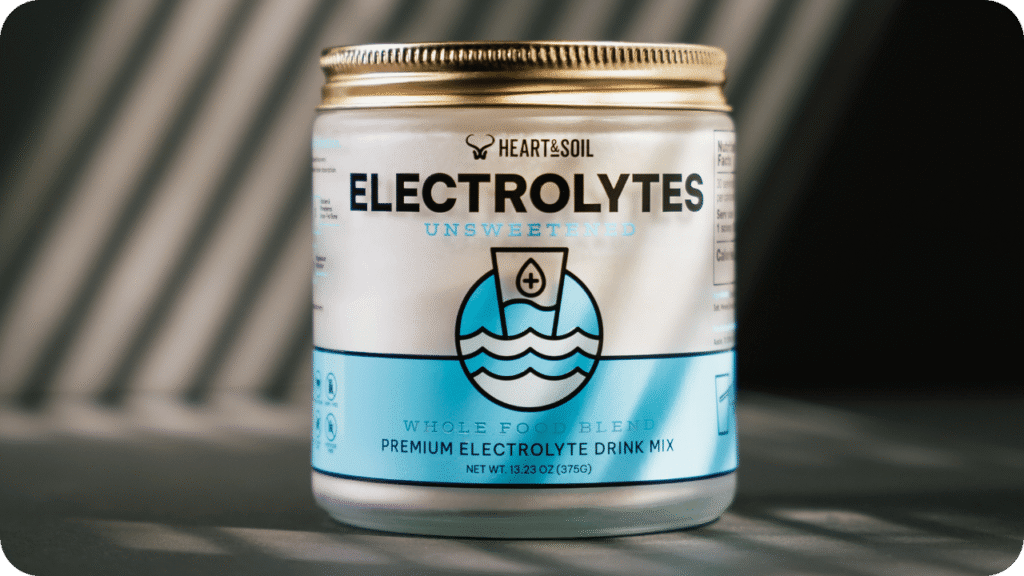
Heart & Soil Electrolytes was designed around a simple ingredient list and named mineral sources.
The bioavailable minerals come from:
- Ancient mineral salt for sodium and chloride
- Organic coconut water powder for potassium
- Seawater for magnesium
- Bovine bone-derived MCHA for calcium and phosphorus
The formulas contain no artificial sweeteners, artificial flavors, preservatives, fillers, synthetic vitamins, or added flow agents.
Both formulas are also third-party tested and manufactured in a cGMP facility. That combination is more meaningful than simply calling the product “clean.”
It tells you what’s in the formula, where those ingredients come from, and what quality controls are being used.
Be First to Try Heart & Soil Electrolytes
Join the waitlist to be the first to know when they launch.
A 60-Second Clean Electrolyte Powder Check
If you’re standing in a store or comparing products online, you don’t need to research every ingredient for an hour.
Use this quick check:
- Read the ingredient list. Can you identify what each ingredient is doing?
- Check for unnecessary extras. Are there fillers, artificial flavors, or processing aids you’d rather avoid?
- Look at the mineral sources. Does the company tell you where they come from?
- Check for third-party testing. Don’t stop at vague words like “quality tested.”
- Look for a COA or ask for one. Actual results matter more than marketing language.
- Check manufacturing standards. cGMP is useful context, but it doesn’t replace product-specific testing.
That’s a much more useful definition of “clean” than anything printed in oversized letters on the front of the container.
All of Heart & Supplements are tested for heavy metals, microbes, and pesticides.
Frequently Asked Questions
What is a clean electrolyte powder?
There is no single regulated definition. In practical terms, look for a purposeful ingredient list, clearly identified mineral sources, independent testing, and transparent quality-control information.
Are fillers and flow agents unsafe?
Not necessarily. Many are commonly used and permitted in food and supplements. The question is whether you want ingredients added mainly for manufacturing convenience or strictly for your health.
Do natural electrolytes have fewer heavy metals?
Not automatically. Natural mineral sources can contain trace contaminants, which is why finished-product testing matters.
What does third-party tested mean?
It means an independent laboratory evaluated the product rather than the manufacturer relying solely on internal testing.
What is a COA?
A Certificate of Analysis is a document showing laboratory test results for a product or batch.
Learn More
- What Are Electrolytes? Your Ultimate Hydration Guide
- Electrolytes for Fasting: 5 Reasons They’re Valuable
- Electrolyte Imbalance: Signs to Pay Attention To
The Bottom Line
“Clean” is easy to print on a label. Transparency takes more work.
If you want a clean electrolyte powder, don’t judge it by a single marketing word. Look at the ingredient list, understand what each ingredient does, check where the minerals come from, and find out how the finished product is tested.
Heart & Soil Electrolytes uses named mineral sources, skips artificial sweeteners, flavors, fillers, and added flow agents, and is third-party tested in addition to being produced in a cGMP facility.
That gives you something more useful than a clean claim: information you can actually check.
Subscribe to future articles like this:
