
Walk through the protein section of a grocery store and you’ll probably see words like clean, pure, and natural printed across the front of the tubs. What those words mean is less obvious, since the useful details are usually on the ingredient list and nutrition panel.
Two powders can list just one ingredient and still provide very different nutrition. Whey contains all nine essential amino acids, while collagen has a different profile that’s much lower in several amino acids your muscles need. If you’re choosing by ingredient count alone, you could end up with a perfectly simple powder that doesn’t do what you bought it for.
There’s nothing wrong with wanting fewer ingredients, and we prefer knowing exactly what’s in our food too. But we also want to know where the protein comes from, how much we’re getting in a serving, and whether the manufacturer can back up its sourcing and testing claims.
That’s why we keep our unflavored Grass-Fed Whey to one ingredient, whey protein concentrate. We believe complete animal protein should be easy to understand and easy to use, without adding flavors or sweeteners you didn’t ask for. The questions that follow can help you judge any powder, including ours.
Disclaimer: The information in this blog is for educational purposes only. It is not a substitute for professional medical advice. Consult your healthcare provider if you’re seeking medical advice, diagnosis, or treatment. These statements have not been evaluated by the Food and Drug Administration. Our products are not intended to diagnose, treat, cure, or prevent any disease.
Key Takeaways
Before you spend money on another tub, there are a few things worth knowing. Brands use the word clean to appeal to shoppers, but you’ll learn much more by checking the protein source, serving size, and testing details.
- “Clean protein powder” has no standardized FDA definition. Ingredient simplicity, transparent sourcing, protein quality, and credible testing provide a more useful buying framework.
- Protein quality matters as much as ingredient count. Whey and egg protein provide all nine essential amino acids, while collagen has a different amino-acid profile.
- Additives aren’t automatically harmful. Sweeteners, gums, and flavors can serve legitimate purposes, although you may prefer a formula without them.
- Third-party testing strengthens quality claims. Look for a named testing organization, the scope of testing, and information you can independently verify.
- The best formula depends on your goal. Muscle gain, dairy avoidance, connective-tissue nutrition, and ingredient minimalism don’t necessarily call for the same powder.
Table of Contents
Beyond the Word “Clean”
If you’re standing in a store trying to compare two powders, the word clean won’t settle much. There’s no FDA definition that turns it into a protein quality grade, so the useful questions start on the back of the package.
What Does “Clean Protein Powder” Mean?
There’s no official protein-powder standard hiding behind the word clean. It can mean a short ingredient list to one person and something quite different to another, which is why we look for the facts underneath the slogan. One-ingredient whey and one-ingredient collagen sound equally tidy, but your muscles won’t treat them as the same protein.
Federal labeling rules still apply regardless of the marketing language. Ingredients such as flavors, sweeteners, and stabilizers must be disclosed under the relevant requirements, which you can review in the FDA’s dietary supplement ingredient-labeling guidance.
Start With What the Protein Actually Provides
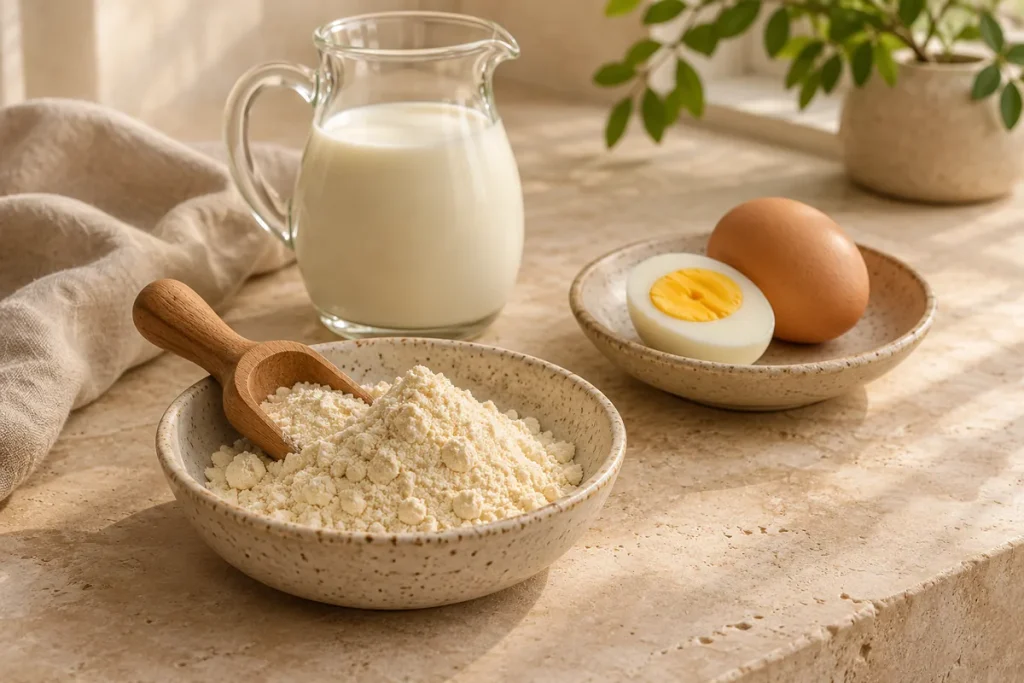
A short ingredient list is great, but you wouldn’t judge two meals just because each has three ingredients. The same goes for powders, because whey and collagen offer different amino acids even if both have one ingredient listed.
What Should You Look for in a Clean Protein Powder?
Think of this like shopping for food, not choosing the winner of a packaging contest. Start with what the protein is made from and how much the serving provides, then take a look at the other ingredients and any testing the brand can actually explain.
1. A Clearly Identified Protein Source
The ingredient list should name the protein source clearly enough for you to judge its amino-acid profile. Whey concentrate, whey isolate, casein, egg-white protein, beef protein isolate, and collagen peptides all come from animal sources, but their amino-acid profiles aren’t interchangeable.
2. A Meaningful Amount of Protein per Serving
Start by comparing the weight of a serving with the grams of protein it actually provides. A 35-gram scoop that supplies 25 grams of protein has a different composition from a 35-gram scoop providing 12 grams. The remaining weight may come from other nutrients, flavorings, carbohydrates, fats, or ingredients added for texture.
3. Protein Quality That Matches Your Goal
For muscle growth and maintenance, prioritize proteins containing all nine essential amino acids, particularly meaningful amounts of leucine. Whey is an especially useful option because its amino-acid profile is well suited to muscle protein synthesis.
4. Ingredients You Actually Want
After checking the protein itself, read the other ingredients for the job each one is doing. A flavoring can make a shake easier to drink consistently, while a thickener gives it a texture some people prefer.
5. Transparent Quality Testing
Testing information is most useful when the manufacturer explains who conducted it and what was examined. Programs such as NSF Certified for Sport and Informed Sport have defined certification requirements. Their relevance is particularly clear for competitive athletes who want additional assurance concerning substances prohibited in sport.
A Short Ingredient List Is Useful, Not Magical
We’re fans of keeping food simple, especially when you need a long explanation just to understand the ingredient list. That doesn’t mean every gum or flavor is a villain, or that a plain powder automatically suits your body better. It’s worth knowing what each ingredient does before you decide whether you want it.
Which Protein Powder Has the Fewest Ingredients?
Yes, you can find powders with a single ingredient, whether that’s whey, egg white, or collagen. That’s refreshingly simple, but it doesn’t end the conversation. You still need to know what that ingredient brings to the table and whether it suits the way you eat.
Is There Protein Powder With No Additives?
Absolutely. Some plain whey powders contain nothing but whey, while others add an emulsifier to make mixing easier. The important detail is the ingredient statement itself because unflavored doesn’t automatically mean nothing else was added.
Are Additives in Protein Powder Bad?
Not automatically, because these ingredients often have straightforward jobs. A gum can help a shake stay smooth, an emulsifier can help powder mix into water, and a sweetener can make plain protein more enjoyable to drink. These ingredients have functional uses recognized in the FDA’s guidance on food ingredients, although the suitability of a particular ingredient still depends on its use and amount.
What Additives Do People Commonly Avoid in Protein Powders?
People leave sweeteners, gums, and colors out of their shopping carts for all sorts of reasonable reasons. Maybe they want to choose their own flavor, maybe a particular ingredient doesn’t agree with them, or maybe they simply prefer fewer extras. That doesn’t mean every ingredient they avoid is dangerous, and it helps to know the difference.
- Added sugars: These contribute carbohydrates and calories. If you want protein without much additional energy, a low-added-sugar formula may suit you better.
- Non-nutritive sweeteners: Sucralose, aspartame, and acesulfame potassium add sweetness with little or no sugar. Some people dislike their taste or prefer not to use them.
- Sugar alcohols: Ingredients such as sorbitol and xylitol may cause digestive discomfort in some people, particularly at higher intakes.
- Gums and thickeners: Xanthan gum, guar gum, and cellulose gum influence texture. They’re not automatically problematic, but they may be unnecessary if you prefer a plain powder.
- Artificial colors: These generally contribute appearance rather than protein nutrition, making them easy to avoid when ingredient minimalism is the goal.
FDA-authorized sweeteners are permitted under specified conditions of use, which the agency explains in its sweetener guidance. You can still prefer a shorter ingredient list without having to make exaggerated claims about everything you’ve left out.
Are Natural Flavors “Clean”?
Natural flavors can still appear in a powder marketed as clean. The phrase tells you something about the labeling category, but not every individual flavor compound in the blend. If you want to know precisely what’s in the bag, a plainly named protein source gives you a clearer answer.
Sourcing, Processing, and Amino Acids Tell Different Stories
We care about the animal behind the food, and we’d hope you do too. Still, grass-fed tells you something different from concentrate, isolate, or complete protein. A good choice comes from putting those pieces together instead of asking one label claim to answer every question.
Does Grass-Fed Whey Make Protein Powder Cleaner?
We care how animals are raised, but the words grass-fed don’t answer every question about a powder. They don’t tell you the leucine content, the exact processing method, or what the finished batch was tested for. Caring about good farming and checking the nutrition panel are entirely compatible habits.
Whey Concentrate vs. Whey Isolate: Which Is Cleaner?
You can’t call either whey concentrate or isolate cleaner without explaining what you mean. They’re both complete whey proteins, with isolate going through additional filtration that generally removes more lactose and fat. If your stomach is happy with dairy, you have options. If lactose is a problem, that extra filtration may matter far more than the marketing language.
| Feature | Whey Concentrate | Whey Isolate |
| Processing | Generally less extensively filtered | More extensively filtered |
| Protein concentration | Lower than isolate | Usually higher |
| Lactose | Generally more | Generally less |
| Fat | Generally more | Generally less |
| Complete protein | Yes | Yes |
| Best fit | Less processing, dairy-component preference, value | Higher protein concentration, lower lactose |
Both provide complete protein for muscle-focused nutrition, although isolate generally contains less lactose and fat because it undergoes more filtration. Concentrate may appeal to someone who wants more of the original dairy components and less extensive processing, which is why neither should win the clean label by default.
What About Beef Protein Powder?
A cow pictured on the front doesn’t guarantee that the powder has an amino-acid profile like the steak you’d cook for dinner. Some beef protein powders are largely collagen-derived, which gives them a different balance of amino acids. We’d want to see that balance before treating the words beef protein as proof of anything.
What About Collagen as a Clean Protein Powder?
Collagen can be wonderfully simple, and we’re all for making use of connective tissue. But if you plan to rely on collagen as your main muscle-focused protein, it’s worth knowing that collagen has little leucine and lacks a complete essential-amino-acid profile. You can enjoy collagen-rich foods while relying on complete protein for muscle nutrition.
How Much Leucine Should a Protein Powder Have?
Leucine matters for muscle, but you don’t need to worship a single number on the side of a tub. It helps signal muscle protein synthesis, while the other essential amino acids provide the material to actually build tissue. A complete protein gives you those pieces together, which is why we pay attention to the whole amino-acid picture.
Trust the Evidence Behind the Badge

A badge on the front of the tub can be reassuring, but it should also be able to survive a little curiosity. Who did the testing, what did they actually measure, and does the claim apply to the finished powder you’re buying? Those are better questions than whether the seal looks official.
Does Third-Party Testing Matter?
Yes, particularly when a brand makes specific purity or sport-safety claims. Dietary supplements aren’t FDA-approved for safety and effectiveness before marketing, and manufacturers remain responsible for complying with applicable requirements, as the FDA’s dietary supplement guidance explains. Independent verification can provide additional information about what reaches the consumer.
The value depends on what the test covers, since competitive athletes may care most about banned-substance screening while another buyer wants to understand heavy metals, microbiological quality, or label accuracy. A third-party-tested badge is most informative when the manufacturer identifies the program and the scope rather than treating testing as a single all-purpose promise.

What Does “Third-Party Tested” Actually Mean?
It means somebody outside the company tested something. That’s a good start, but it’s worth finding out whether they checked for contaminants, verified label amounts, screened for substances banned in sport, or did something else altogether. A company that answers those questions is more helpful than one relying on an unexplained badge.
- Which independent laboratory or certification organization performed the testing?
- Was the finished product tested, or only certain ingredients?
- Which contaminants, label claims, or prohibited substances were examined?
- Does testing occur on every batch or another defined schedule?
- Can you verify the certification or published results independently?
Should You Worry About Heavy Metals in Protein Powder?
Asking about heavy metals is sensible when you’re using a powder regularly. But a trace finding doesn’t automatically mean a meaningful health risk, because the substance, amount, and frequency of exposure matter. Look for a brand willing to explain what it measures and how it interprets the results.
Rather than assuming every detectable trace is dangerous, ask what the finished product was tested for and how the results compare with relevant limits. A manufacturer able to explain that process gives you more useful information than either a dramatic contamination headline or an unexplained promise of exceptional purity.
Choose a Powder You Can Use With Real Food
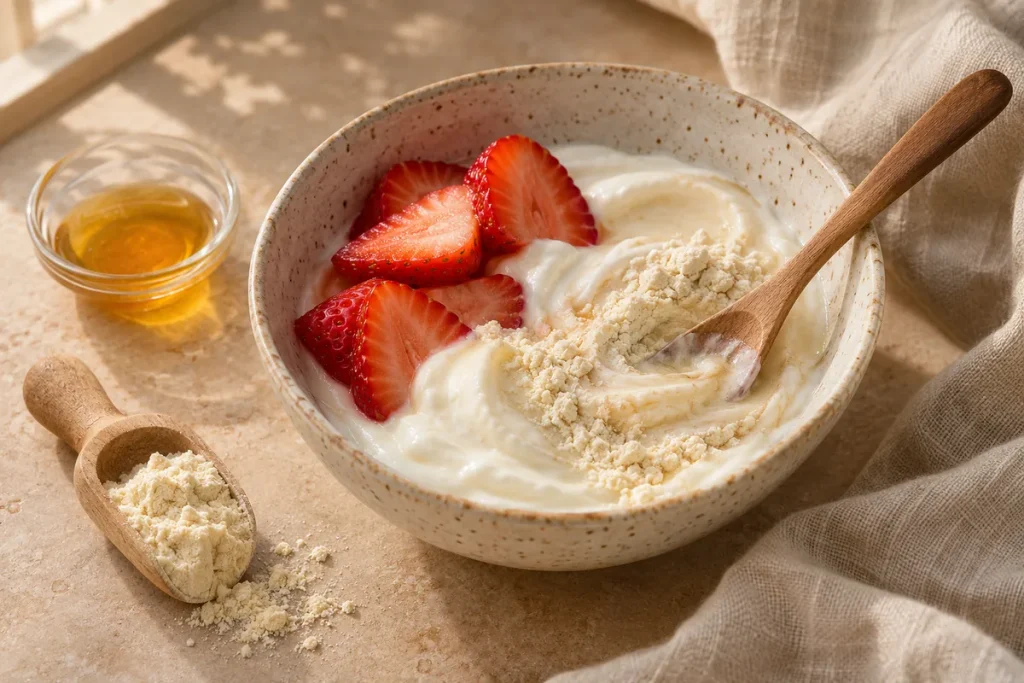
Most of us aren’t building a laboratory in the kitchen. We’re trying to make breakfast a little better, add protein after training, or find something we can use without upsetting our stomach. Once you know what the protein contributes, those real-life details help you choose.
Is Organic Protein Powder Cleaner?
Organic certification provides information about agricultural production standards, not a complete assessment of protein quality. A certified organic powder may appeal to you because of how its ingredients were produced. It can still contain flavorings, sweeteners, or a protein source that doesn’t match your nutritional goal.
Is Unflavored Protein Powder Always Better?
We like unflavored powder because it lets the food around it do the flavoring. A little fruit or honey is a more interesting decision than being locked into birthday-cake flavor for the next thirty breakfasts. Still, if a flavored powder helps someone eat enough protein and the ingredients suit them, there’s no need to turn the choice into a moral contest.
Best Clean Protein Powder for Muscle Gain
For building muscle, we’d start with a complete protein that brings a useful amount of leucine to the serving. Whey does that particularly well, which makes it an easy place to begin when dairy suits you. Then check whether the portion fits your meals and whether the rest of the label makes sense.
Best Clean Protein Powder for Dairy-Free Diets
Egg-white protein is one of the most straightforward dairy-free choices when complete protein is the main goal. Beef-derived powders can also work, although you should examine their amino-acid profiles to distinguish complete muscle-oriented products from collagen-heavy formulas. Bone broth protein and collagen peptides are dairy-free alternatives with different nutritional strengths.
Their higher glycine and proline content may be useful in a varied diet, but they generally shouldn’t replace complete protein when muscle preservation is the priority. If you’re avoiding dairy because of a milk allergy, check the entire label for milk-derived ingredients rather than assuming that an animal-based product is automatically dairy-free.
Clean Protein Powder Label Checklist
When two companies advertise nearly identical benefits, compare the information on the back of their tubs. The ingredient list and nutrition panel usually give you more useful information than another minute of reading the front. Here’s what we look at before bringing a powder home.
- [ ] Identify the protein source. Is it whey, casein, egg, beef, collagen, or a disclosed blend?
- [ ] Check the protein amount. How many grams of actual protein are in one serving?
- [ ] Compare the serving size. Is most of the powder contributing protein or something else?
- [ ] Check amino-acid quality. If muscle is the goal, does it provide all essential amino acids and meaningful leucine?
- [ ] Read the full ingredient list. Are sweeteners, flavors, gums, or other additions useful to you?
- [ ] Assess dietary compatibility. Does it contain milk or another ingredient you need to avoid?
- [ ] Review testing claims. Is the testing scope clear and independently verifiable?
- [ ] Consider daily use. Can you comfortably afford, tolerate, and prepare the product consistently?
Red Flags When Buying Protein Powder
The most meaningful red flags concern unclear information and unsupported claims, not the mere presence of unfamiliar ingredient names. Be cautious when a manufacturer obscures the protein source, fails to explain a proprietary blend, or markets collagen as equivalent to whey for muscle-building.
Why We Kept Our Whey Simple
We didn’t put one ingredient in our unflavored whey to win a contest for the shortest label. We did it because whey already brings complete protein to the table, and plenty of people would rather decide for themselves whether to mix it with milk, fruit, honey, or nothing at all.
How Our Grass-Fed Whey Fits a Clean-Label Approach
Our unflavored Grass-Fed Whey keeps the ingredient list to whey protein concentrate alone. Because whey naturally contains all nine essential amino acids, a simple formula here also supplies complete protein for people who want to support muscle-focused nutrition. You can add fruit or other foods yourself rather than relying on a predetermined flavor.
Best Clean Protein Powder: The Heart & Soil Perspective
There’s little value in a clean-looking tub if the protein doesn’t suit your needs. A powder that brings the nutrition you intended to buy, with ingredients you understand and a place in real meals, is worth far more. That’s the standard we’d use whether it had our name on it or someone else’s.
If you’d like to start with a single-ingredient complete protein, explore our Grass-Fed Whey. For a broader combination of animal-derived proteins, browse our protein collection.
Frequently Asked Questions About Clean Protein Powder
Once you look beyond the marketing on the front, a few practical questions tend to come up. Here’s how to sort through ingredient claims, testing badges, and protein differences without turning grocery shopping into a research project.
What Is the Cleanest Protein Powder?
There isn’t an officially recognized cleanest protein powder because “clean” isn’t a standardized FDA category. We’d start with an unflavored, single-source protein whose ingredients and quality controls are easy to check. For muscle-oriented nutrition, complete proteins such as whey and egg are particularly useful because they provide all nine essential amino acids.
Which Protein Powder Has the Fewest Ingredients?
Unflavored whey concentrate, whey isolate, egg-white protein, and collagen peptides can all be sold as single-ingredient products, although they don’t do the same nutritional job. Whey and egg provide complete protein, while collagen supplies relatively more glycine and proline and fewer essential amino acids.
Can Protein Powder Have No Additives?
Yes, a powder made from one protein ingredient can be free of added flavors, sweeteners, stabilizers, colors, and preservatives. Check the actual ingredient list to confirm the formula, though. The description “unflavored” alone doesn’t guarantee that the product contains only one ingredient, since an emulsifier may still be included.
Are Artificial Sweeteners Bad in Protein Powder?
FDA-authorized sweeteners are permitted under specified conditions of use, and they aren’t automatically harmful simply because they’re artificial. You may still prefer an unsweetened formula for taste, simplicity, or individual tolerance. The better choice depends on how you use protein powder and whether the product helps you meet your nutritional goals.
Is Whey Isolate Cleaner Than Whey Concentrate?
Neither is inherently cleaner, because the meaningful difference is how each is processed. Isolate is filtered further and generally has a higher protein percentage with less lactose and fat, whereas concentrate retains more non-protein milk components. Both supply complete protein, so tolerance, nutritional preference, and budget are more useful deciding factors.
Is Collagen a Clean Protein Powder?
Collagen can have a very simple ingredient list, making it clean by a minimalist labeling standard. It isn’t nutritionally equivalent to whey for muscle-building, though, because it provides less leucine and fewer essential amino acids. Collagen is better considered a complementary protein that supplies a distinctive mixture of glycine, proline, and hydroxyproline.
Does Third-Party Testing Matter?
Yes, independent testing can provide additional verification of quality, although what it tells you depends on what was examined. Some programs look for prohibited substances, while others focus on contaminants, label accuracy, or manufacturing requirements. Check the certifying organization and testing scope before treating a general third-party-tested claim as proof of a particular quality standard.
Subscribe to future articles like this:
