
Grass-fed is not a quality score.
Two protein powders can put “grass-fed” on the tub and still be very different products.
The claim tells you something about how the cows were fed. It does not tell you what else is in the formula, whether the finished powder was tested, or whether it’s worth the price.
So we’d separate this into two questions:
- What does grass-fed actually tell you about the cows?
- Is the protein powder itself any good?
Let’s start with the claim on the front of the tub.
Table of Contents
What Does “Grass-Fed” Mean on Whey Protein?
Grass-fed whey comes from milk produced by cattle raised under a grass- or forage-based feeding system. There is no single international definition that covers every grass-fed dairy product, so the feeding standard behind the claim matters.
The USDA once maintained a voluntary Grass (Forage) Fed Marketing Claim Standard, but that standard applied to ruminant livestock and meat. Milk and milk products were specifically outside its scope, and USDA withdrew the standard in 2016.
Dairy standards also differ around the world.
New Zealand’s government-recognized grass-fed dairy standard requires at least 90% grass-fed feed types and pasture access for at least 340 days per year and eight hours per day. Canada’s voluntary grass-fed dairy standard uses a minimum of 75% forage on a dry-matter basis.
|
Term |
What it generally describes |
What it does not automatically establish |
|
Grass-fed |
A grass- or forage-based feeding claim |
100% forage or year-round grazing |
|
100% grass-fed |
An entirely forage-based diet when backed by that kind of standard |
Fresh green grass every day |
|
Pasture-raised |
Where and how cattle are managed |
An exclusively forage-fed diet |
|
Organic |
Compliance with organic farming standards |
100% grass-fed |
|
Forage-fed |
A diet based primarily or entirely on forage |
Constant access to fresh pasture |
|
Grass-finished |
Final feeding before slaughter |
Particularly useful information about dairy whey |
That is why we’d rather see a company explain how the cows were actually fed than put a bigger green “grass-fed” badge on the label.
Does 100% Grass-Fed Mean Cows Eat Fresh Grass All Year?
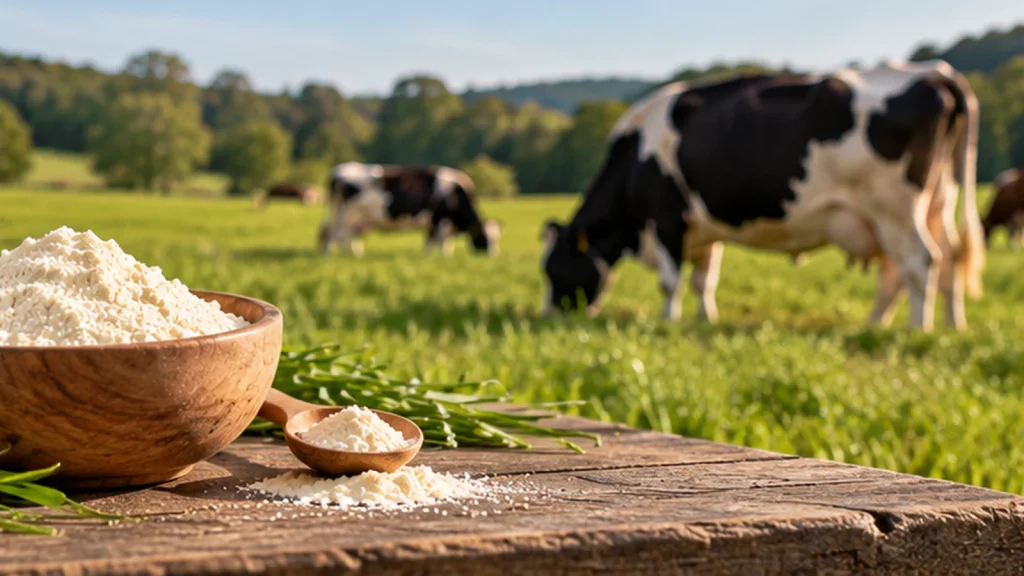
No. “100% grass-fed” does not mean cows have to eat fresh green pasture every day of the year. Grass-fed systems can also use conserved forage such as hay and silage when pasture growth slows or fresh grass is not available.
That is normal in pasture-based dairy farming.
Dairy Australia describes pasture as the most important home-grown feed for most Australian dairy farms, while also recognizing conserved forage such as hay and silage as part of how farmers bridge seasonal gaps in pasture supply.
So when you see 100% grass-fed, the useful question is:
Was their diet built around grass and forage rather than grain?
Heart & Soil’s whey comes from 100% grass-fed Australian cows. Pasture and forage play a central role in the country’s dairy systems, and conserved forage lets farmers maintain that feeding base through seasonal changes.
“Forage” is broader than fresh grass. Depending on the season and farm, it can include pasture grasses, hay, and silage.
Is Grass-Fed the Same as Organic or Pasture-Raised?
No. Grass-fed describes diet. Pasture-raised describes animal access and management. Organic certification covers a broader agricultural production system. One claim does not automatically give you the others.
USDA Organic rules give us a concrete example.
Organic ruminants must have access to pasture during a grazing season lasting at least 120 days per year and obtain an average of at least 30% of their dry-matter intake from pasture during that grazing season.
That is a meaningful pasture requirement. It is not the same thing as saying the animal ate nothing but grass and forage throughout its life.
A farm can also use a grass-fed or forage-fed system without being USDA Organic.
Is Grass-Fed Protein Powder Actually Better?
Grass-fed whey can come from a different feeding and farming system, and pasture feeding can change the fatty-acid profile of milk. Current evidence does not show an inherent advantage in protein content, leucine, muscle growth, digestion, or heavy-metal levels in the finished whey.
The interesting part is what pasture feeding really does change, and what survives once milk becomes whey powder.
Grass-Fed Milk Really Can Have a Different Fatty-Acid Profile
Research on pasture-based dairy has found differences in the composition of milk from grass-fed and conventionally fed cattle, particularly in the fat fraction.
Depending on the feeding system, studies have reported more omega-3 fatty acids, vaccenic acid, and conjugated linoleic acid in pasture-derived milk.
Whey powder is not whole milk.
Heart & Soil Grass-Fed Whey Unflavored, for example, currently contains 1 gram of fat in a 30-gram serving.
If most of the nutritional difference you are talking about occurs in the milk fat, you cannot simply take a whole-milk omega-3 study and turn it into a claim that a low-fat whey powder is now a meaningful omega-3 supplement.
That would require data from the finished powder itself.
Does Grass-Fed Whey Have Better Protein?
Grass-fed whey and conventional whey are both complete proteins. There is not good evidence that feeding cows grass inherently gives the resulting whey more leucine or a superior essential-amino-acid profile.
For protein quality, look at the actual powder:
- Total protein
- Essential amino acids
- Leucine
- Whey concentrate vs isolate
- Protein relative to the full scoop
Those numbers tell you what kind of protein serving you are actually buying.
Is Grass-Fed Whey Better for Building Muscle?
Grass-fed whey is not more anabolic simply because the cows ate grass. The muscle-building value comes from the whey itself. Or to be more precise, it comes from complete protein, essential amino acids, and enough leucine to stimulate muscle protein synthesis.
For active people, the International Society of Sports Nutrition gives20–40 grams of high-quality protein per meal as a useful general target, with enough leucine and the full essential amino acid profile to stimulate muscle protein synthesis.
Heart & Soil Grass-Fed Whey gives you 24–25 grams of complete protein, all nine essential amino acids, and 2.5 grams of leucine per serving.
For a broader look at protein sources, see our guide to plant-based vs animal-based protein powder.
Is Grass-Fed Whey Lower in Heavy Metals?
Not necessarily. “Grass-fed” does not tell you how much lead, cadmium, arsenic, or mercury is in the finished whey. Heavy metals have to be measured in the actual product.
Heart & Soil Grass-Fed Whey is independently tested for heavy metals, pesticides, and other impurities.
That testing tells you far more about contaminant levels than the words “grass-fed” ever could.
Is Grass-Fed Whey Easier to Digest?
There is no good evidence that grass-fed whey is easier to digest. The bigger factors are lactose, whey type, serving size, and what else is in the formula.
Studies comparing milk from pasture-fed and conventional cows have found very similar protein digestion.
If dairy tends to bother you, lactose is usually a more useful thing to look at. Whey isolate generally contains less lactose than concentrate.
How Can You Verify a Grass-Fed Protein Powder?
A grass-fed claim is stronger when the brand tells you exactly how the cows were fed, where the dairy comes from, and what “100% grass-fed” actually means.
You should be able to answer a few basic questions from the product page or sourcing information:
- Where does the dairy come from?
- Does 100% grass-fed mean grain is excluded?
- What counts as forage: fresh pasture, hay, silage, or all three?
- Do the cows have regular pasture access?
- Is the feeding standard documented or independently verified?
You do not need a page full of farming jargon. You need specifics.
Where are the cows? What are they fed? What does 100% mean?
If a brand cannot answer those questions, the label is doing more work than the evidence.
What Else Should You Check Before Buying Grass-Fed Whey?
Once you have looked at the sourcing, turn the tub around.
|
What to check |
What you’re looking for |
Why |
|
Protein per serving |
Roughly 20–30 g is common in whey products |
Shows the actual protein dose |
|
Essential amino acids |
All nine EAAs |
Confirms complete protein |
|
Leucine |
Disclosed amount where available |
Relevant to muscle protein synthesis |
|
Whey type |
Concentrate, isolate, or blend |
Changes lactose, fat, and protein concentration |
|
Ingredient list |
Everything else in the scoop |
Reveals sweeteners, gums, flavors, and fillers |
|
Contaminant testing |
Finished-product testing |
Shows what was actually measured |
|
Sport certification |
NSF Certified for Sport, Informed Sport, etc. |
Useful for tested athletes |
|
Price per serving |
One-time price divided by servings |
Makes the premium easy to compare |
Concentrate vs Isolate
Whey concentrate generally retains somewhat more lactose, fat, and carbohydrate.
Whey isolate goes through additional filtration and usually contains a higher percentage of protein with less lactose and fat.
Neither format wins simply because it is grass-fed. Choose based on dairy tolerance, protein density, and the formula you prefer.
What Is the Best Grass-Fed Protein Powder?
Heart & Soil Grass-Fed Whey is our pick for best overall in this comparison. The Unflavored formula contains one ingredient, the finished product is NSF Certified for Sport, and every batch undergoes independent quality testing.
Among these four products, Heart & Soil explicitly uses a 100% grass-fed claim. Transparent Labs says its whey comes exclusively from grass-fed cattle. AGN Roots uses independently verified Irish grass-fed sourcing, while Naked Whey describes its dairy as grass-fed and pasture-raised.
|
Product |
Type |
Protein |
Grass-fed claim |
Key verification |
|
Heart & Soil Grass-Fed Whey |
Concentrate |
24–25 g |
100% grass-fed Australian cows |
NSF Certified for Sport; independent quality testing |
|
AGN Roots |
Isolate |
25 g |
Irish grass-fed dairy; ≥95% grass-fed average |
Truly Grass Fed; Informed Sport / Protein |
|
Naked Whey |
Concentrate |
25 g |
Grass-fed, pasture-raised dairy |
NSF content certification; contaminant testing |
|
Transparent Labs Grass-Fed Whey |
Isolate |
28 g |
Exclusively grass-fed cattle |
Published third-party testing |
How We Compared Them
We checked each brand’s current product page and, where available, certification databases for protein per serving, whey type, grass-fed sourcing, third-party verification, and one-time purchase price.
Is Grass-Fed Whey Worth Paying More For?
Heart & Soil costs about $2.27 per serving, roughly 10 cents more than Transparent Labs and 18 cents more than Naked Whey in this comparison. Across 30 servings, that is about a 3–5.40 premium. AGN Roots is substantially cheaper per serving at $1.72.
|
Product |
Tub price |
Servings |
Price / serving |
|
Heart & Soil Grass-Fed Whey |
$68.00 |
30 |
$2.27 |
|
AGN Roots |
$81.00 |
47 |
$1.72 |
|
Naked Whey, 2 lb |
$62.99 |
30 |
$2.09 |
|
Transparent Labs, 2 lb |
$64.99 |
30 |
$2.17 |
Prices and formulas checked October 2026. Price per serving is based on the one-time purchase size reviewed, before subscription discounts, shipping, or tax.
Against Naked Whey and Transparent Labs, the difference is measured in cents per scoop, not dollars.
That gives you a much more useful way to judge the premium than looking at tub price alone.
What Heart & Soil Gets Right About Grass-Fed Whey
Heart & Soil keeps the formula easy to understand, then backs the finished product with outside verification. That combination is where the product gets especially strong.
Grass-Fed Whey Unflavored contains one ingredient. No gums. No lecithins. No flavor system. No sweeteners.
Chocolate Sea Salt stays simple too, adding organic maple syrup powder, organic raw cacao, and pink sea salt rather than leaning on artificial flavors or high-intensity sweeteners.
Then there is NSF Certified for Sport.
That certification screens products for 290 banned substances, verifies that the label matches the product, checks for unsafe contaminant levels, and includes manufacturing and supplier audits plus ongoing monitoring.
Heart & Soil also independently tests its whey for heavy metals, pesticides, and impurities.
Anyone can make a protein powder sound impressive. A short ingredient list, independent testing, and third-party certification give you something concrete to verify.
Want whey plus collagen and colostrum in the same scoop? Animal Based Protein takes that approach.
Frequently Asked Questions
What is grass-fed protein powder?
Grass-fed protein powder is protein powder made from dairy or other bovine ingredients sourced from cattle raised on a grass- or forage-based diet. For whey, the claim refers to the cows that produced the milk. It does not specify one universal feeding standard unless the brand defines the protocol behind the claim.
What does 100% grass-fed mean?
100% grass-fed means the cattle’s diet is entirely grass and forage under the standard being used. Forage can include fresh pasture, hay, haylage, silage, and legumes. It does not mean the animals eat fresh green grass every day of the year.
Does grass-fed mean no grain?
100% grass-fed generally means grain is excluded from the feeding program. A basic “grass-fed” claim is less specific because dairy standards vary. New Zealand’s grass-fed dairy standard, for example, uses a 90% grass-fed threshold, while Canada’s voluntary standard uses at least 75% forage on a dry-matter basis.
Is grass-fed whey organic?
Grass-fed whey is not automatically organic. USDA Organic dairy cows must graze for at least 120 days per year and receive at least 30% of their dry-matter intake from pasture during the grazing season. Organic certification therefore does not require a 100% grass- and forage-based diet.
Does grass-fed whey contain more omega-3?
Grass-fed whole milk can contain more omega-3 fatty acids, but grass-fed whey is not automatically a meaningful omega-3 source. Most of the documented difference is found in milk fat. Heart & Soil Grass-Fed Whey Unflavored, for example, contains only 1 gram of fat per 30-gram serving.
Is grass-fed whey lower in heavy metals?
Grass-fed whey is not proven to contain fewer heavy metals simply because the cows were grass-fed. Lead, cadmium, arsenic, and mercury must be measured in the finished powder. Heart & Soil Grass-Fed Whey is independently tested for heavy metals, pesticides, and other impurities.
Is grass-fed whey better for building muscle?
Grass-fed whey does not have a proven muscle-building advantage over conventional whey because of the cows’ diet. Muscle protein synthesis is driven more directly by protein dose and essential amino acids. Heart & Soil Grass-Fed Whey provides 24–25 grams of complete protein and 2.5 grams of leucine per serving.
Is Heart & Soil Grass-Fed Whey certified?
Heart & Soil Grass-Fed Whey is NSF Certified for Sport. NSF’s program verifies label accuracy, screens certified products for 290 banned substances, checks for unsafe contaminant levels, and audits manufacturing and suppliers. The certification applies to the finished supplement, not the cattle’s grass-fed feeding claim.
Subscribe to future articles like this:
