
Most protein powder roundups start with flavors, macros, and a dozen tubs lined up in a table.
That misses the question.
A label can say “no artificial sweeteners” and still contain stevia or monk fruit. So this guide uses a stricter standard.
We prioritized protein powders with no added sweetener at all. Then, we looked at the protein source, ingredient list, sourcing, third-party testing, and certification.
Heart & Soil Grass-Fed Whey Unflavored is the simplest example. One ingredient. No sucralose. No stevia. No monk fruit. No added sweetness to hide behind.
The rest of the list had to clear that same bar.
Table of Contents
Best Protein Powders Without Artificial Sweeteners
Our five picks are all unsweetened and contain no sucralose, stevia, or monk fruit. The main differences are protein type, sourcing, testing, certification, and protein per serving.
|
Product |
Protein type |
Protein / serving |
Approx. price / serving |
Verification |
Best for |
|
Heart & Soil Grass-Fed Whey Unflavored |
Grass-fed whey concentrate |
24–25 g |
$2.27 |
NSF Certified for Sport; independent contaminant testing |
Best overall |
|
Naked Whey Unflavored |
Grass-fed whey concentrate |
25 g |
$2.10 |
NSF content certification; contaminant testing |
Minimalist whey concentrate |
|
Momentous Whey Protein Isolate Unflavored |
Grass-fed whey isolate |
20 g |
$2.40 |
NSF Certified for Sport; batch COAs |
Sport-certified whey isolate |
|
Promix One Ingredient Whey |
Minimally filtered native whey |
25 g |
$2.00 |
Independent lot-level testing; GMP manufacturing |
Batch-level testing transparency |
|
Transparent Labs Grass-Fed Whey Isolate Unflavored |
Grass-fed whey isolate |
28 g |
$2.17 |
NSF Certified for Sport for currently listed lots; additional third-party testing |
Higher-protein sport-certified isolate |
Prices and formulas checked September 2026. Price per serving is based on the one-time purchase size reviewed, before subscription discounts, shipping, or tax.
1. Heart & Soil Grass-Fed Whey Unflavored
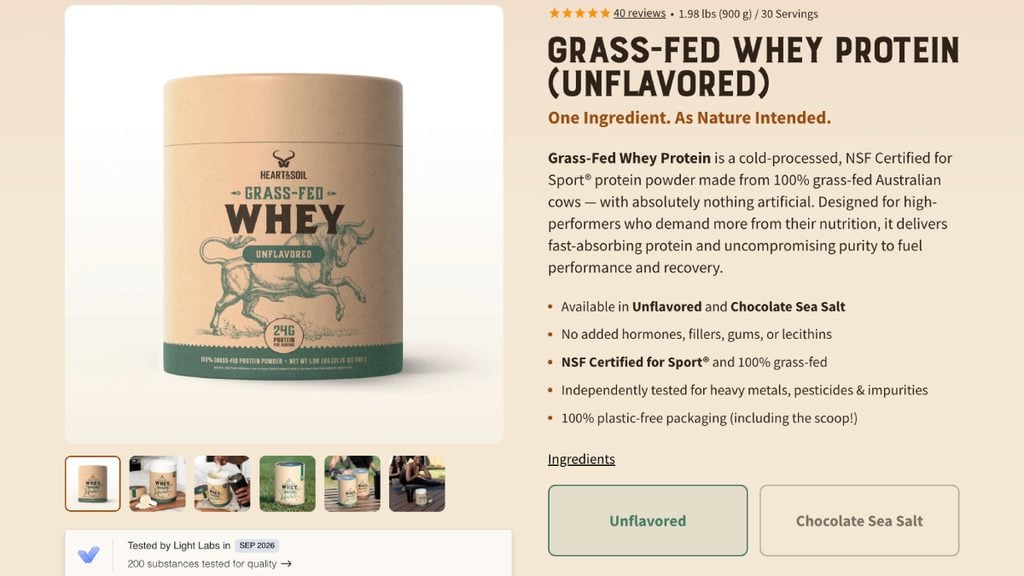
The current Heart & Soil formula is one ingredient: grass-fed whey protein concentrate.
It provides 24–25 g of complete protein, comes from 100% grass-fed Australian cattle, contains no gums, lecithins, fillers, added flavors, or sweeteners, and is independently tested for heavy metals, pesticides, and other impurities.
More importantly, this isn’t only a brand claim.
NSF’s current Certified for Sport listing independently verifies the Unflavored product and explicitly lists it as free from artificial sweeteners, artificial flavors, artificial colors, artificial preservatives, soy, GMOs, and rBGH growth hormones.
The main tradeoff is that whey concentrate retains some naturally occurring lactose. That won’t matter for most people, but if you’re sensitive to lactose or trying to minimize it, a whey isolate may be easier to tolerate.
2. Naked Whey Unflavored
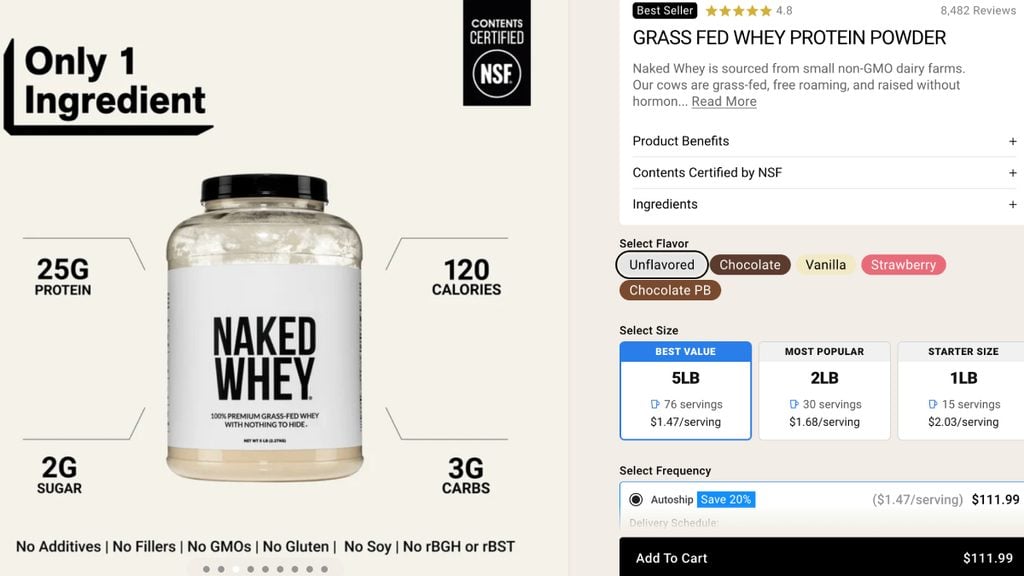
Naked Whey’s Unflavored formula is 100% grass-fed whey protein concentrate, providing 25 g protein and 5.9 g BCAAs per serving.
Naked says it contains no additives, artificial sweeteners, flavors, or colors. Its current product page also states that it’s screened for contaminants including heavy metals and pesticides.
Naked Whey also has unusually substantial consumer feedback, with a 4.8/5 rating from roughly 8,300 reviews at the time of our check.
There is independent editorial support too. BarBend’s expert-reviewed 2026 assessment praised the short ingredient list and unflavored versatility and reported third-party testing, including Informed Choice and heavy-metal testing.
Note that NSF certifies the product under its functional-food/content program, but it isn’t NSF Certified for Sport. NSF currently lists Naked Whey under Certification Guideline 229.
3. Momentous Whey Protein Isolate Unflavored
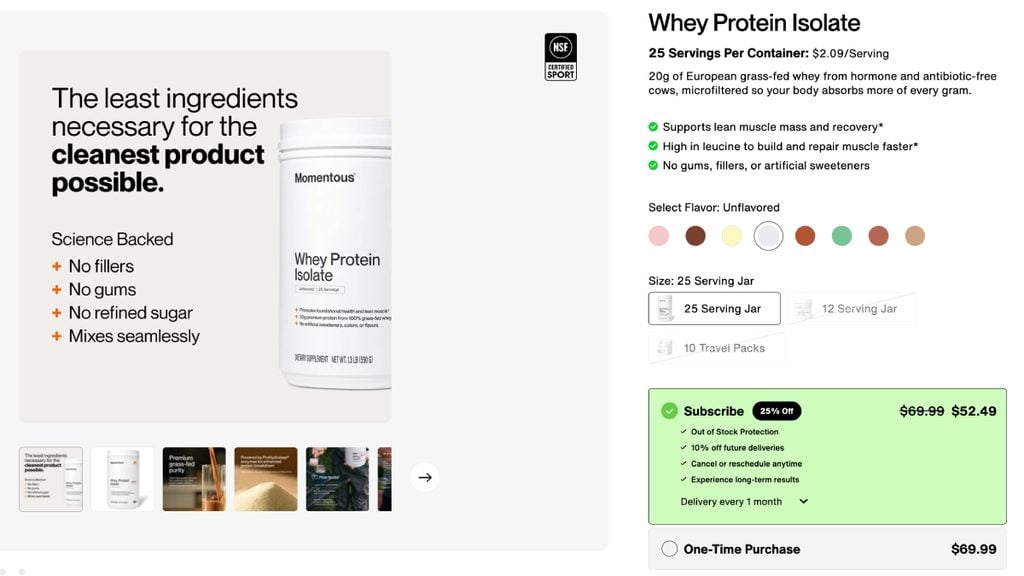
The MomentousUnflavored formula uses grass-fed whey protein isolate plus ProHydrolase and provides 20 g of protein.
The important qualifier is the variant. Momentous Chocolate and Vanilla currently use monk fruit and stevia, whereas Unflavored does not.
Every finished batch is NSF Certified for Sport, and Momentous publishes third-party testing information and makes batch Certificates of Analysis available. Its current product page shows about 4.7/5 from more than 3,200 reviews.
NSF independently lists the unflavored whey as a current Certified for Sport product.
BarBend has independently tested and reviewed it, praising the third-party certification and formulation while noting its premium price.
The drawback is only 20 g protein per serving versus 24–28 g for most of the other picks. NSF confirms the current Unflavored product at 20 g.
4. Promix One Ingredient Whey
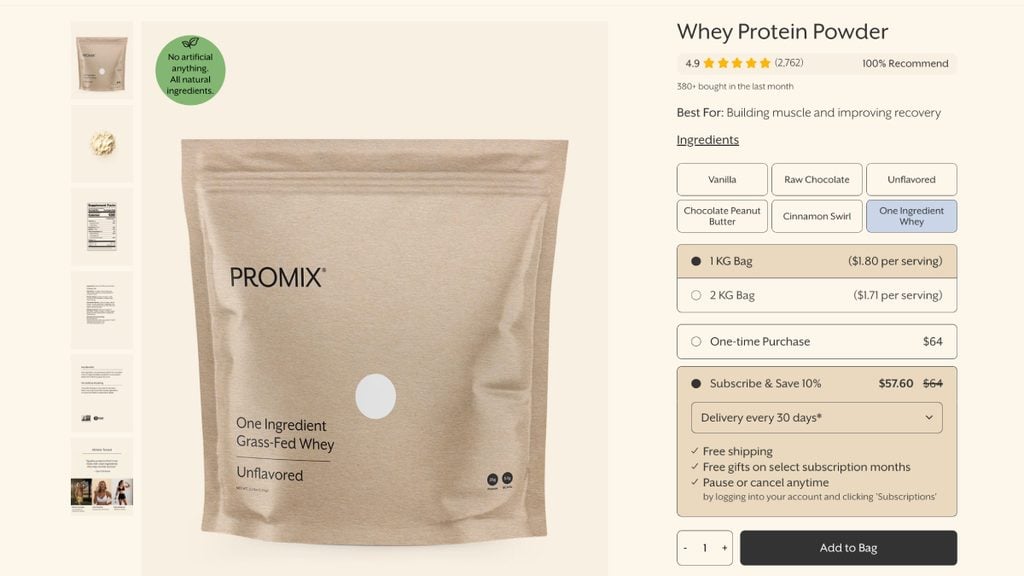
Its One Ingredient Whey really does contain one ingredient, comes from certified grass-fed cows, provides 25 g protein, is unsweetened, and has farm-to-bag traceability. Promix explicitly states that it uses no gums, fillers, GMOs, soy, or “artificial anything.”
Its biggest strength is verification rather than a sport-certification badge. Promix lets buyers enter the lot number from their product and see independent laboratory testing for heavy metals, gluten, soy, glyphosate, and AMPA.
The company states that testing is performed by independent third-party laboratories and that its products are manufactured in GMP-certified facilities.
The current One Ingredient Whey product also carries a 4.9 rating on Promix’s site.
It has excellent lot-level testing, but the only downside is that it doesn’t bring the same banned-substance sport certification as Momentous or Heart & Soil.
5. Transparent Labs Grass-Fed Whey Protein Isolate Unflavored
Transparent Labs makes the cut because it combines a high protein dose, grass-fed sourcing, extensive third-party testing, and considerable market validation.
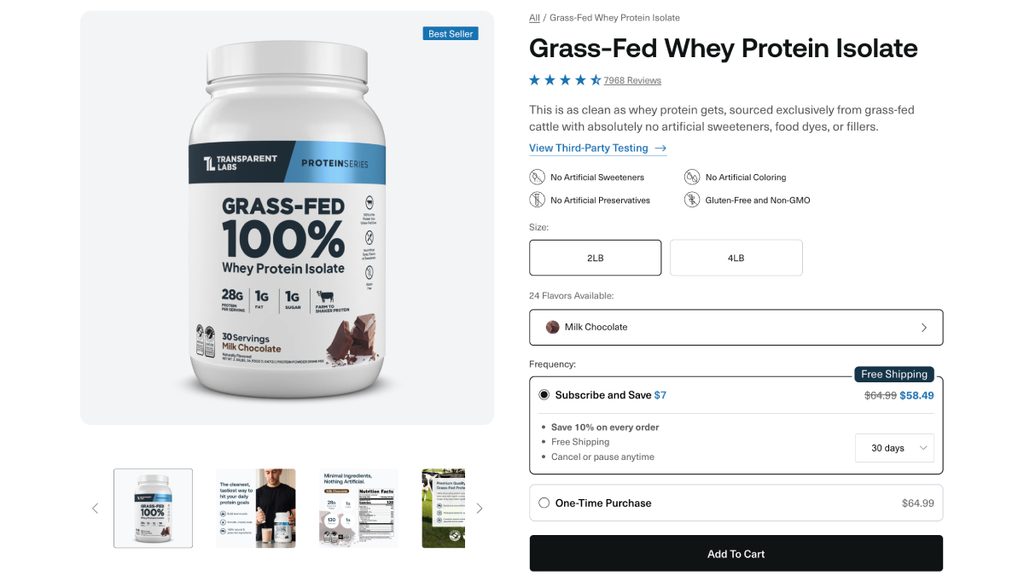
Its Grass-Fed Whey Isolate provides 28 g protein per serving, comes from grass-fed cattle, and is formulated without artificial sweeteners, dyes, or fillers. An Unflavored version is available for buyers wanting the stricter no-sweetener option.
There is also stronger sport-certification evidence than we originally gave it credit for. Transparent Labs Grass-Fed Whey Protein Isolate Unflavored has a current NSF Certified for Sport listing covering specific lots.
There is unusually substantial consumer proof here too: the current whey page shows roughly 7,900 reviews.
And BarBend’s current whey-isolate roundup places the product among its leading isolate options after evaluating factors including third-party testing, formulation, taste, and solubility.
One thing to know: Transparent Labs uses whey isolate rather than concentrate. That makes it a different product from the less-refined whey concentrates from Heart & Soil and Naked Whey.
What Counts as an Artificial Sweetener in Protein Powder?
Artificial sweeteners commonly found in protein powder include sucralose, acesulfame potassium (Ace-K), aspartame, and saccharin. Stevia and monk fruit belong to a different category because they are derived from plants or fruit rather than synthesized artificial sweeteners.
|
Type |
Examples |
What it means on a protein label |
|
Artificial high-intensity sweeteners |
Sucralose, Ace-K, aspartame, saccharin |
Provide sweetness in very small amounts and are regulated by FDA as food additives. |
|
Plant-derived high-intensity sweeteners |
Stevia, steviol glycosides, Reb A, monk fruit |
Derived from plant or fruit sources, but still used to create intense sweetness with little or no sugar. |
|
Conventional caloric sweeteners |
Honey, maple syrup, maple syrup powder, cane sugar |
Add sweetness along with sugar and carbohydrates. |
|
No added sweetener |
Unsweetened protein powder |
No ingredient has been added specifically to sweeten the product. |
A “no artificial sweeteners” claim does not mean the powder is unsweetened. It may still contain stevia, monk fruit, maple syrup, honey, or another sweetening ingredient.
Is Stevia an Artificial Sweetener?
Stevia is plant-derived, but the sweetener used in protein powder is usually a highly purified steviol glycoside such as Reb A, not whole stevia leaf. FDA has accepted GRAS notices for high-purity steviol glycosides, while whole-leaf and crude stevia extracts are not permitted as sweeteners in the U.S.
Is Monk Fruit an Artificial Sweetener?
Monk fruit sweetener comes from Siraitia grosvenorii fruit, but protein powders typically use concentrated extracts rich in mogrosides, especially mogroside V. These extracts can be roughly 100–400 times sweeter than sugar, so only a small amount is needed to sweeten a formula.
How Do You Find Protein Powder Without Sucralose or Stevia?
To find protein powder without sucralose or stevia, check the full Ingredients or Other Ingredients list for the sweetener’s actual name. FDA requires high-intensity sweeteners to appear in the ingredient list, even when the front label only says “naturally sweetened” or “no artificial sweeteners.”
Look beyond the obvious names
Sucralose is normally listed plainly, but other sweeteners can appear under less familiar names:
- Acesulfame potassium: acesulfame K, Ace-K
- Stevia: steviol glycosides, rebaudioside A, Reb A, stevioside, rebaudioside D
- Monk fruit: monk fruit extract, luo han guo extract
FDA specifically recognizes these names and forms in its sweetener guidance.
Read the whole ingredient list, not just the first few ingredients
Ingredients are listed in descending order by weight. High-intensity sweeteners are used in very small amounts, so they often appear near the end of the list rather than next to the protein source.
That means a label that begins with whey protein isolate, cocoa, natural flavors… can still contain stevia, monk fruit, or sucralose several ingredients later.
Check what provides sweetness instead
If the powder contains maple syrup powder, honey, cane sugar, or another conventional sugar, it can still be free from sucralose and stevia. It simply isn’t unsweetened.
And if you want no added sweetener at all, don’t rely on “unflavored.” Verify that the ingredient list contains no sweetening ingredient. An unflavored powder and an unsweetened powder aren’t automatically the same thing.
Is Unsweetened Protein Powder Better?
Unsweetened protein powder is not automatically healthier, but it gives you something a pre-sweetened formula cannot: control. You decide how sweet the final shake is, what provides that sweetness, or whether it needs to be sweet at all.
That has a few practical advantages.
First, you are not locked into the taste profile chosen by the manufacturer. Add banana, berries, honey, or maple syrup when you want sweetness. Leave it plain when you do not.
The same powder can also go into yogurt, oats, or savory recipes without bringing a dessert-like flavor with it.
Second, for people who dislike stevia’s aftertaste, unsweetened protein also removes a real sensory issue.
In a sensory study involving 126 consumers, rebaudioside A, a common stevia compound, produced substantially more bitterness. It was more often described as “chemical” than sucrose or newer steviol glycosides. Some stevia compounds also produced lingering sweetness after consumption.
So the advantage of unsweetened protein is practical rather than magical. You control the taste and what, if anything, gets added for sweetness.
Is Sucralose in Protein Powder Bad for You?
Current FDA and EFSA assessments do not establish sucralose as unsafe when consumed within approved intake levels. You may still prefer protein powder without sucralose because you want a simpler formula, dislike the taste of high-intensity sweeteners, or would rather control the sweetness yourself.
What does the FDA say about sucralose?
FDA permits sucralose as a high-intensity sweetener and sets an acceptable daily intake (ADI) of 5 mg per kilogram of body weight per day. An ADI is a safety threshold for long-term exposure, not a recommended amount to consume.
So the evidence does not support saying that a scoop of protein powder containing sucralose is inherently toxic or unsafe.
What did EFSA conclude in 2026?
EFSA completed a major re-evaluation of sucralose in February 2026 and concluded that it remains safe at its currently authorized uses.
The agency retained its existing ADI of 15 mg/kg of body weight per day and found estimated European dietary exposures remained below that level.
The FDA and EFSA use different ADIs, but both currently consider sucralose acceptable within their respective authorized conditions of use.
What about the WHO recommendation on non-sugar sweeteners?
WHO recommended in 2023 that people avoid relying on non-sugar sweeteners as a long-term strategy for controlling body weight or reducing the risk of diet-related chronic disease.
That recommendation is sometimes reported as evidence that sweeteners such as sucralose are unsafe.
WHO explicitly says otherwise. Its guideline was not a toxicological safety assessment and was not intended to replace established acceptable-intake limits from food-safety authorities.
Which Protein Powder Without Artificial Sweeteners Should You Choose?
All five products in this guide give you an unsweetened option without sucralose, stevia, or monk fruit. The meaningful differences are what comes next.
- Heart & Soil Grass-Fed Whey Unflavored: One-ingredient grass-fed whey concentrate with NSF Certified for Sport verification.
- Naked Whey Unflavored: Another straightforward grass-fed whey concentrate with a long track record and minimal formulation.
- Momentous Whey Protein Isolate Unflavored: The stronger choice for someone who wants whey isolate plus sport certification.
- Promix One Ingredient Whey: Particularly compelling if you want to look up independent testing tied to the product lot.
- Transparent Labs Grass-Fed Whey Isolate Unflavored: A higher-protein isolate and NSF Certified for Sport coverage for specific listed lots.
There’s no need to make the decision more complicated than that.
FAQs
What protein powder has no artificial sweeteners?
Protein powders with no artificial sweeteners include Heart & Soil Grass-Fed Whey Unflavored, Naked Whey Unflavored, Momentous Whey Protein Isolate Unflavored, Promix One Ingredient Whey, and Transparent Labs Grass-Fed Whey Isolate Unflavored. These specific versions do not use sucralose, aspartame, Ace-K, or saccharin.
What is the best unsweetened protein powder?
The strongest unsweetened protein powders combine no added sweetener with transparent sourcing and independent quality verification. Heart & Soil and Naked Whey stand out for minimalist whey-concentrate formulas, Promix for lot-level testing, Momentous for NSF Certified for Sport verification, and Transparent Labs for a higher-protein whey-isolate option.
Is unflavored protein powder always unsweetened?
No. “Unflavored” describes flavoring, while “unsweetened” means no sweetening ingredient has been added. An unflavored powder can still contain other ingredients, so check the full ingredient list rather than assuming the word “unflavored” guarantees that sucralose, stevia, monk fruit, or sugar is absent.
Which unsweetened protein powder is best for athletes?
For athletes who prioritize sport certification, Heart & Soil Grass-Fed Whey Unflavored and Momentous Whey Protein Isolate Unflavored are strong options with NSF Certified for Sport verification. Transparent Labs Grass-Fed Whey Isolate Unflavored also has current NSF Certified for Sport coverage for specific listed lots, so check the lot number before relying on the certification.
Which unsweetened protein powder is best if you want whey isolate?
Momentous Whey Protein Isolate Unflavored and Transparent Labs Grass-Fed Whey Isolate Unflavored are the strongest isolate options here. Momentous has NSF Certified for Sport verification, while Transparent Labs provides 28 g of protein per serving and also has NSF Certified for Sport coverage for specific Unflavored lots.
What protein powder without artificial sweeteners is dairy-free?
Naked Egg is a dairy-free protein powder with no artificial sweeteners. It uses egg white protein from non-GMO U.S. eggs, provides 25 g of protein per serving, contains zero sugar, and lists only egg white protein and sunflower lecithin as ingredients. Naked also reports independent heavy-metal testing.
Subscribe to future articles like this:
