


Twenty grams of collagen and 20 grams of whey can both show up as 20 grams of protein on a label.
Biologically, that does not make them interchangeable.
One gives you a large dose of essential amino acids. The other is unusually rich in the amino acids found throughout collagen-rich connective tissues.
Both are protein. Both can have a place in an animal-based diet.
But if you only look at the protein number on the front of the bag, you miss most of the story.
Table of Contents
What Is the Difference Between Collagen and Protein Powder?
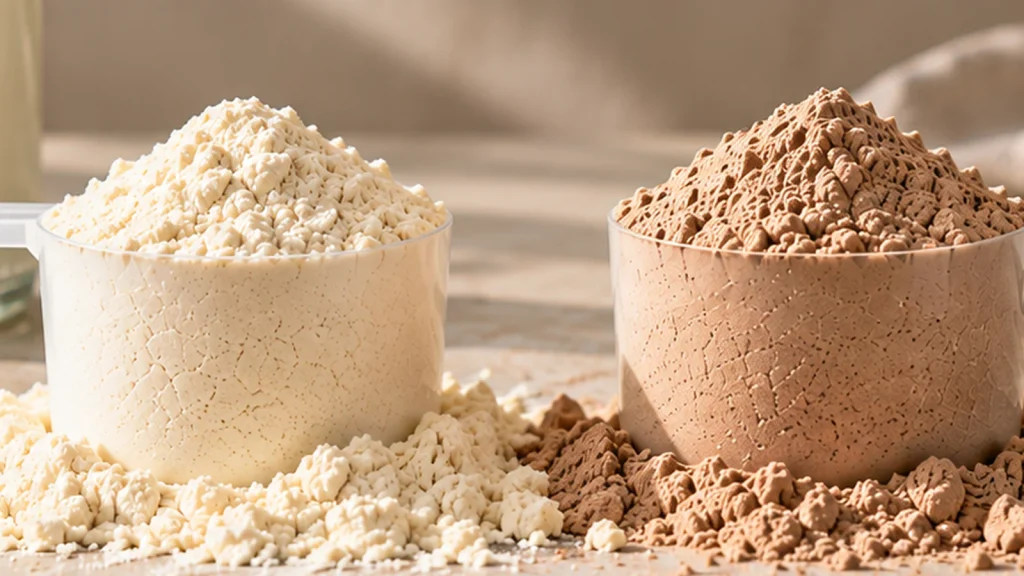
Collagen has a very different amino acid profile from complete proteins such as whey. It is rich in glycine, proline, and hydroxyproline, but contains far fewer essential amino acids and no tryptophan. Whey supplies all nine essential amino acids and considerably more leucine.
We have a great head-to-head experiment that makes this obvious.
In a randomized trial, researchers gave healthy older women either 30 grams of whey protein or 30 grams of collagen peptides.
Same amount of protein on paper. Look at what was actually in it.
|
In the 30 g study serving |
Collagen peptides |
Whey protein |
|
Essential amino acids |
5.6 g |
15.4 g |
|
Leucine |
0.9 g |
4.3 g |
|
Tryptophan |
0 g |
0.7 g |
|
Complete protein |
No |
Yes |
|
Particularly rich in |
Glycine, proline, hydroxyproline |
Essential amino acids, including leucine |
The whey provided almost three times as many essential amino acids and nearly five times as much leucine.
Collagen went in the other direction. It provided far more glycine, proline, and hydroxyproline.
This is why collagen is classified as an incomplete protein under conventional protein-quality systems. Pure collagen lacks tryptophan, one of the nine essential amino acids humans have to obtain from food.
“Incomplete” sounds like an insult. It isn’t. It describes the amino acid profile.
That profile becomes very important when we start asking what collagen can replace, what it can’t replace, and why you might want it in the first place.
Can Collagen Replace Protein Powder?
Collagen can contribute to your total daily protein intake, but I would not use it as a gram-for-gram replacement for complete protein when you are relying on that protein to supply essential amino acids.
Think about the rest of the diet.
Someone eating eggs at breakfast, beef at lunch, dairy, seafood, and another complete protein at dinner is in a very different position from someone using several large servings of collagen powder to hit a daily protein target.
A 2019 paper modeled this question using the amino acid composition of the standard American diet.
The researchers calculated that collagen peptides could replace as much as 36% of total dietary protein while the overall diet still met indispensable amino acid requirements and maintained a PDCAAS of 1.0.
That number needs context.
This was a dietary modeling study, not a feeding trial, and it was not telling people to get 36% of their protein from collagen. The calculation worked because the rest of the modeled diet supplied enough essential amino acids to cover what collagen did not.
So yes, collagen counts as protein.
But we would not use collagen simply to make a protein number on an app go up.
Get plenty of high-quality animal protein from foods such as meat, eggs, dairy, and seafood. Then collagen can sit alongside that foundation rather than crowding it out.
Collagen vs Whey for Muscle: What Does the Research Actually Show?
If your specific goal is maximizing skeletal muscle protein synthesis, whey has the stronger direct evidence. Collagen can still be part of a productive resistance-training diet, but the head-to-head experiments favor whey for the muscle-building response.
And this is where the research gets interesting.
Direct Muscle Protein Synthesis Studies Favor Whey
Remember the older women from the first study?
The researchers did not just measure what was inside the powders. They measured what happened to muscle protein synthesis.
The 22 healthy older women consumed 30 grams of whey or collagen twice daily for six days and performed unilateral resistance exercise during the experiment.
Whey increased muscle protein synthesis more than collagen both at rest and following exercise. Over the longer six-day measurement period, whey still produced the stronger response.
A second randomized trial published in 2024 gives us another useful comparison.
Thirty-one healthy older men, averaging about 72 years old, first ate a controlled diet containing protein at the RDA. Researchers then added 50 grams per day of whey, pea, or collagen protein for eight days.
Integrated myofibrillar protein synthesis increased with whey.
It increased with pea protein too. It did not significantly increase with collagen.
That last part is worth looking at closely. The pea protein worked.
So this was not simply animal protein beating plant protein. Collagen itself had a very different effect despite still being an animal-derived protein.
We break down the broader differences between plant-based vs animal-based protein powder here.
Matching Leucine Still Did Not Make Collagen Perform Like Whey
You could reasonably ask whether this just comes down to leucine.
Whey contains much more of it, and leucine plays an important role in initiating the signaling involved in muscle protein synthesis.
Researchers have actually tested this.
In a 10-week resistance-training trial, 22 young adults received either:
- 35 grams of whey containing 3 grams of leucine
- 35 grams of collagen containing 1 gram of leucine, with another 2 grams of free leucine added
Now the leucine was matched.
The whey group still gained more muscle thickness.
Vastus lateralis thickness increased by about 8.4% with whey versus 5.6% with collagen, while biceps thickness increased by about 10.1% versus 6.0%. Strength and power improved similarly between groups.
They matched the leucine and whey still produced more muscle growth.
Leucine clearly matters. But you cannot reduce the nutritional quality of a protein to one amino acid. Building new muscle also requires the rest of the essential amino acid pool.
But Collagen Can Still Show Up in Successful Training Studies
Now we get to an apparent contradiction.
A 2026 network meta-analysis pooled 78 studies involving 4,755 participants undergoing resistance training. Both whey and collagen produced statistically significant improvements in strength and fat-free mass compared with placebo, and collagen actually ranked above whey in the network analysis.
That sounds very different from the direct muscle-protein-synthesis studies.
And it is.
A network meta-analysis combines evidence across many different studies and interventions. A high network ranking is not the same thing as putting whey and collagen head-to-head under the same conditions and watching collagen outperform whey.
So we would not turn that paper into the claim that collagen is a better muscle-building protein than whey.
The direct trials do not establish that.
What the longer-term literature does tell us is that taking collagen does not stop somebody from gaining muscle, strength, or fat-free mass while training.
That makes sense. Resistance training itself is an enormous signal. The rest of the person’s diet matters. Total protein matters. And collagen may be contributing to tissues that are not adequately captured by a simple muscle-protein-synthesis measurement.
Which brings us to what collagen is actually interesting for.
What Is Collagen Actually Good For?

Collagen is especially interesting for collagen-rich connective tissues such as tendons. Exercise studies show some promising changes in tendon morphology and collagen synthesis, although the evidence is not strong enough to say that taking collagen simply “repairs your joints.”
A tendon is not a small muscle.
A huge part of its structure is a collagen-rich extracellular matrix. Loading that tissue through exercise gives it a reason to remodel.
So researchers have started asking what happens when collagen is added to that mechanical stimulus.
A 2024 systematic review and meta-analysis looked at 19 randomized trials involving 768 people using collagen peptides alongside physical training.
The pooled results favored collagen for several outcomes, including:
- fat-free mass
- tendon morphology
- muscle architecture
- maximal strength
- recovery of reactive strength after exercise-induced muscle damage
But the evidence was not equally convincing for every endpoint.
The review rated the evidence for tendon morphology and mechanical properties as very low certainty, and pooled measures such as tendon stiffness did not significantly improve.
So I would not say, “Take collagen and it repairs your tendons.”
The acute collagen-synthesis research is more specific.
One randomized crossover study took 10 resistance-trained young men and gave them 0, 15, or 30 grams of hydrolyzed collagen, each with 50 mg of vitamin C, before four hard sets of barbell back squats.
The 30-gram dose produced a greater rise in serum PINP, a marker used to estimate whole-body type I collagen synthesis, than either 15 grams or placebo.
The 15-gram dose did not significantly beat placebo on that endpoint.
And there is an important detail here. The researchers measured a circulating marker of whole-body collagen synthesis. They did not take tendon biopsies and prove that 30 grams rebuilt somebody’s patellar tendon. The authors explicitly list that indirect measurement as a limitation.
That is much more useful than claiming collagen is a magical joint powder.
We have a biologically plausible tissue target, a distinctive amino acid profile, some encouraging training data, and still plenty left to learn.
For a deeper look at cartilage, collagen, and the clinical evidence, see what the research says about collagen and joint supplements.
Should You Take Collagen, Whey, or Both?
You do not have to choose between them. Whey makes sense when you want a concentrated source of complete protein. Collagen can add a different set of amino acids and peptides on top of a diet that already supplies plenty of essential amino acids.
Think about how we eat an animal.
A ribeye is not nutritionally identical to slow-cooked oxtail, bone broth, skin, cartilage, or a connective-tissue-rich cut.
That does not mean one of them has to lose. They are different parts of the animal.
Protein supplements can work the same way. If you need more complete protein, whey is extremely useful.
If your diet is already rich in complete animal protein and you want more collagen-derived peptides and collagen-rich amino acids, collagen can fit there.
And if you want both, there is no nutritional rule saying they need to come from separate tubs.
That is also the logic behind how Heart & Soil formulated its two protein products.
Why Heart & Soil Uses Whey and Collagen Differently
Heart & Soil Grass-Fed Whey uses whey as the entire protein source. Animal Based Protein also starts with grass-fed whey concentrate, then adds specific amounts of collagen and colostrum rather than using collagen as the main protein.
That difference is deliberate.
Heart & Soil Grass-Fed Whey is the stripped-down version.
The current Unflavored formula contains one ingredient: grass-fed whey protein concentrate. A serving provides 24–25 grams of complete protein, all nine essential amino acids, and 2.5 grams of leucine. It is also NSF Certified for Sport.
Heart & Soil Animal Based Protein is built differently.
Whey concentrate is still the protein foundation, but the formula also contains 2 grams of bovine colostrum and 2 grams of collagen per serving. Heart & Soil sources collagen from scapular and tracheal cartilage. Total protein is 19 grams per serving.
|
Grass-Fed Whey |
Animal Based Protein | |
|
Main protein source |
Grass-fed whey concentrate |
Grass-fed whey concentrate |
|
Total protein |
24–25 g |
19 g |
|
Collagen |
No added collagen |
2 g |
|
Colostrum |
No |
2 g |
|
Leucine disclosed |
2.5 g |
Not currently listed as a specific serving amount |
|
Unflavored ingredients |
1 |
3 |
|
Best fit |
More complete protein per scoop |
Whey + collagen + colostrum |
This is an important formulation detail after everything we just looked at.
The 2 grams of collagen in Animal Based Protein is not there to turn collagen into the primary protein source.
And we do not need to pretend that 2 grams is the same thing as the 15- or 30-gram collagen doses used in some connective-tissue studies.
It isn’t.
Animal Based Protein is an all-in-one formula built around whey, with collagen and colostrum added alongside it.
Grass-Fed Whey is for somebody who wants the simpler, higher-protein option. Animal Based Protein gives you a broader range of animal-derived ingredients in the same scoop.
Here’s our deeper guide to what to look for in a grass-fed whey protein powder.
Is Collagen the Same as Beef Protein?
No. Beef protein and collagen can both come from cattle, but the words do not guarantee the same tissue source or amino acid profile. Some beef protein powders are far more collagen-heavy than the term “beef” might make you expect.
Muscle meat contains all nine essential amino acids, including tryptophan.
Collagen is concentrated in connective tissues and has a radically different amino acid distribution.
Protein powder labels make this more confusing because manufacturers can start with different bovine raw materials and still use language such as beef protein, beef isolate, or hydrolyzed beef protein.
So I would not stop reading when I see a cow on the front of the tub.
Look for an amino acid profile:
- Is leucine relatively high?
- Is glycine extremely high?
- What about proline?
- Does the product disclose tryptophan?
If glycine and proline dominate, leucine is modest, and tryptophan is absent or close to it, the protein is behaving much more like collagen than the protein in a steak.
That is useful information, especially when somebody is buying “beef protein” because they expect it to act as a complete alternative to whey.
The Bottom Line
A Nutrition Facts panel reduces protein to a number. Your biology does not.
Twenty grams of whey, 20 grams of collagen, and 20 grams from a collagen-heavy beef protein powder can all contribute 20 grams to your protein total while delivering very different amounts of leucine, tryptophan, glycine, proline, and the other amino acids.
So look past the front of the bag. Look at the source. Look at the amino acids.
Then decide what you actually want that protein to contribute to your diet.
Frequently Asked Questions
Is collagen a protein?
Yes. Collagen is a protein. It is the major structural protein in connective tissues such as skin, tendons, cartilage, and bone. Dietary collagen therefore contributes to your total protein intake, but its amino acid profile is very different from complete proteins such as whey, eggs, meat, or dairy.
Is collagen a complete protein?
No. Collagen is not a complete protein because it does not contain all nine essential amino acids. Standard collagen lacks tryptophan and contains relatively small amounts of several other essential amino acids. That does not make collagen useless. It simply means you should not rely on it alone to cover essential amino acid needs.
Can collagen replace whey?
Collagen should not replace whey gram-for-gram when you are using whey to get complete protein and essential amino acids. Whey contains all nine essential amino acids and substantially more leucine. Collagen can complement a protein-rich diet, but nutritionally it is doing something different from whey.
Is whey better than collagen for building muscle?
Yes, when the specific goal is stimulating skeletal muscle protein synthesis, whey has stronger direct evidence than collagen. Head-to-head trials have found greater muscle protein synthesis with whey, and a leucine-matched training study still produced greater muscle-thickness gains with whey than with collagen. Pasted markdown
Does collagen count as protein?
Yes. Collagen counts toward total dietary protein, but total protein grams do not tell you the whole story. Thirty grams of collagen and 30 grams of whey both contribute protein, yet they provide very different amounts of essential amino acids, leucine, glycine, proline, and tryptophan. Pasted markdown
Can I take collagen and whey together?
Yes. Whey and collagen can be taken together because they provide different amino acid profiles. Whey supplies complete protein and plenty of essential amino acids, while collagen adds more collagen-rich amino acids such as glycine and proline. There is no nutritional requirement to take them separately.
Does collagen help tendons?
Collagen may support tendon remodeling when it is combined with exercise, but the evidence is still developing. A 2024 review found some promising changes in tendon morphology, while evidence certainty was low and pooled tendon stiffness did not significantly improve. Collagen should not be described as proven to “repair” tendons. Pasted markdown
Is collagen better for joints than whey?
There is not good evidence for a simple “collagen beats whey for joints” conclusion. Whey has much stronger research for muscle protein synthesis. Collagen is studied more often for collagen-rich tissues such as tendons and cartilage, but results vary by tissue, outcome, dose, and type of exercise.
Does Animal Based Protein contain collagen?
Yes. Heart & Soil Animal Based Protein currently contains 2 grams of collagen per serving. The formula also provides grass-fed whey concentrate and 2 grams of bovine colostrum, with 19 grams of total protein. The collagen is an added part of the formula rather than its primary protein source.
Subscribe to future articles like this:
