


Two vitamin bottles can have the same nutrient name on the front and still contain different forms inside. When you see ‘natural’ on one label and ‘synthetic’ on the other, you might assume the choice is obvious before you’ve checked either ingredient list. But your body uses the nutrient form, not the marketing language.
Some manufactured vitamins are chemically identical to what you find in food, while others differ in how they’re absorbed or used. That makes the ingredient details worth reading. Even when an isolated vitamin works well, though, it can’t give you everything you get from liver, including vitamin A, B12, copper, heme iron, protein, and more. We put whole foods first because they offer that broader nutritional mix.
Knowing the form helps you compare supplements for what they actually provide, while eating nutrient-dense foods brings a wider range of nourishment than one vitamin at a time.
Disclaimer: The information in this blog is for educational purposes only. It is not a substitute for professional medical advice. Consult your healthcare provider if you’re seeking medical advice, diagnosis, or treatment. These statements have not been evaluated by the Food and Drug Administration. Our products are not intended to diagnose, treat, cure, or prevent any disease.
Table of Contents
What Is the Difference Between Natural and Synthetic Vitamins?
Natural vitamins are vitamin compounds found in foods or extracted from biological materials. Synthetic vitamins are produced through chemical or industrial processes to supply a particular nutrient form. Depending on the vitamin, those forms may be chemically identical or have meaningful structural differences.
Then there are whole-food supplements, like our freeze-dried liver. The capsule contains actual organ tissue with its naturally occurring nutrients. That’s different from a powder marketed as ‘whole food’ simply because someone added isolated vitamins to a plant-based carrier.
If you’re buying a single vitamin, check its form and dose. If you’re buying a whole-food supplement, look for the actual food on the ingredient list and find out how it was processed.
Can Your Body Tell the Difference Between Synthetic and Natural Vitamins?
Your body deals with chemical structures, not the words ‘natural’ and ‘synthetic’ on a label. When two vitamin molecules have the same structure, they can participate in the same processes. Different structures, however, may affect absorption, conversion, or retention.
Vitamin E shows why the structure of a vitamin matters. Vitamin C provides a different example because manufactured ascorbic acid has the same core chemical structure as the ascorbic acid found in fruit. That doesn’t make an orange nutritionally equivalent to a pill, since the fruit contains much more than vitamin C alone.
How much you absorb, how the vitamin works, and what else the food provides are separate questions. A vitamin can be absorbed efficiently from a capsule while the food that naturally contains it contributes many other useful components.
Are Natural Vitamins More Bioavailable Than Synthetic Vitamins?
Not necessarily. Natural vitamin E has greater biological activity than a common synthetic form, while manufactured folic acid is generally more bioavailable than folate in food. The answer depends on which vitamin you’re talking about and how your body uses that particular form.
Vitamin E: Natural and Synthetic Forms Behave Differently
Naturally occurring vitamin E includes the RRR form of alpha-tocopherol. Common synthetic alpha-tocopherol preparations contain a mixture of stereoisomers, and they aren’t all handled the same way by the body. National Academies guidance recognizes the difference in biological activity between natural RRR and synthetic all-rac alpha-tocopherol.
So if you’re comparing vitamin E supplements, read the alpha-tocopherol form on the label. ‘Natural’ or ‘synthetic’ means far less without that detail.
Folate vs Folic Acid: Synthetic Can Be More Bioavailable
Folate is found naturally in foods such as liver and some fruits and vegetables. Folic acid is a manufactured form widely used in supplements and fortified foods, and it’s generally more bioavailable than food folate. In the NIH folate fact sheet, researchers explain why recommended intakes use dietary folate equivalents rather than treating every microgram as interchangeable.
That’s why folic acid has an established role in recommendations around conception and early pregnancy. Here, a manufactured vitamin has a well-supported use, and there’s no reason to downplay it.
B Vitamins: Source May Not Always Change Absorption
B vitamins also come in different forms. For example, B12 supplements may contain cyanocobalamin or methylcobalamin, and your body processes them differently. Neither a ‘synthetic’ label nor a fashionable form name is enough to judge whether a supplement suits your needs.
Meanwhile, liver, beef, eggs, and seafood give you B vitamins alongside protein and other nutrients. That’s the food-first advantage we care about, regardless of which B12 capsule someone prefers.
Vitamin C and Other Nutrients

Ascorbic acid from a supplement and ascorbic acid in fruit are the same chemical compound. An orange, however, also brings water, other plant compounds, and additional nutrients, so eating the whole fruit offers more than a vitamin C molecule on its own.
Why Whole Foods Are Different From Isolated Vitamins
Cut into a piece of liver and you won’t find vitamin A in one corner and copper in another. They’re part of the same food, alongside B12, protein, fats, and other nutrients. Eggs, seafood, and dairy have their own combinations. A list of isolated ingredients doesn’t reproduce that whole-food combination.
Those nutrients also have related jobs. Copper helps with normal iron metabolism, B12 and folate support red blood cell production, and fat can help your body absorb fat-soluble vitamins. Those relationships don’t show up in a column of percentages on a supplement label.
That’s why we encourage nose-to-tail eating. Muscle meat gives you a strong foundation, but liver and other organs add a different concentration and range of naturally occurring nutrients. We make our Beef Organs from five freeze-dried organs so that variety is easy to include when fresh organs aren’t on your weekly menu.
Does the Form of a Vitamin Matter?
Yes. A vitamin’s form can affect how your body absorbs and uses it. Those unfamiliar chemical names can matter when you’re comparing targeted supplements.
| Nutrient | Forms readers may see | Practical distinction |
| Vitamin A | Retinol, retinyl palmitate, beta-carotene | Preformed vitamin A differs from carotenoids that require conversion |
| Folate (B9) | Food folate, folic acid, 5-MTHF | Bioavailability, metabolism, and labeling equivalence differ |
| Vitamin B12 | Cyanocobalamin, methylcobalamin, adenosylcobalamin | The body processes these forms differently, and no single form is universally superior |
| Vitamin E | RRR-alpha-tocopherol, all-rac-alpha-tocopherol | Biological activity differs between natural and common synthetic forms |
| Vitamin K | K1, K2 forms | Different compounds have different food sources and physiological roles |
You don’t need to memorize these chemical names to choose a good dinner, but they matter when you’re buying a supplement for a particular nutrient. That’s when it’s worth checking the form on the label rather than relying on a ‘natural’ badge.
Synthetic Vitamins vs Whole-Food Vitamins
An isolated vitamin provides a defined amount of a selected nutrient. Whole-food preparations contain several naturally occurring nutrients, although the amounts can vary with the source and portion.
| Feature | Synthetic or isolated vitamin | Whole-food nutrient source |
| Primary purpose | Supply selected nutrient forms | Contribute nutrition within a food |
| Dose | Often precisely standardized | Naturally varies with the food and portion |
| Nutrient diversity | Whatever the manufacturer includes | Multiple naturally occurring nutrients |
| Food matrix | Usually absent or limited | Present |
| Bioavailability | Depends on form and formulation | Depends on the nutrient and food context |
| Best fit | A specific need, when appropriate | Everyday dietary foundation |
Meat, organs, eggs, seafood, fruit, and dairy when tolerated bring a wide range of vitamins and minerals into ordinary meals. A whole-food supplement makes less familiar foods easier to include, but it still complements those meals.
Why More Isn’t Always Better With Vitamins
A concentrated vitamin capsule can deliver far more of one nutrient than you’d normally get from food. That can be useful for a specific deficiency, but high doses of certain vitamins and minerals can also cause harm or interact with medicines. For those upper intake levels, see the NIH supplement guidance.
With supplements, the amount, form, and your circumstances matter more than a blanket warning about vitamins. Ordinary servings of nutrient-dense foods aren’t the same exposure as high-dose isolated preparations, and needing more of one nutrient doesn’t automatically mean you need twenty others at megadose levels.
Pregnancy, diagnosed deficiencies, and certain medications can call for a precise form or dose that food alone may not supply consistently. That’s where targeted supplementation has a clear purpose.
Food First: Where to Get Vitamins Naturally
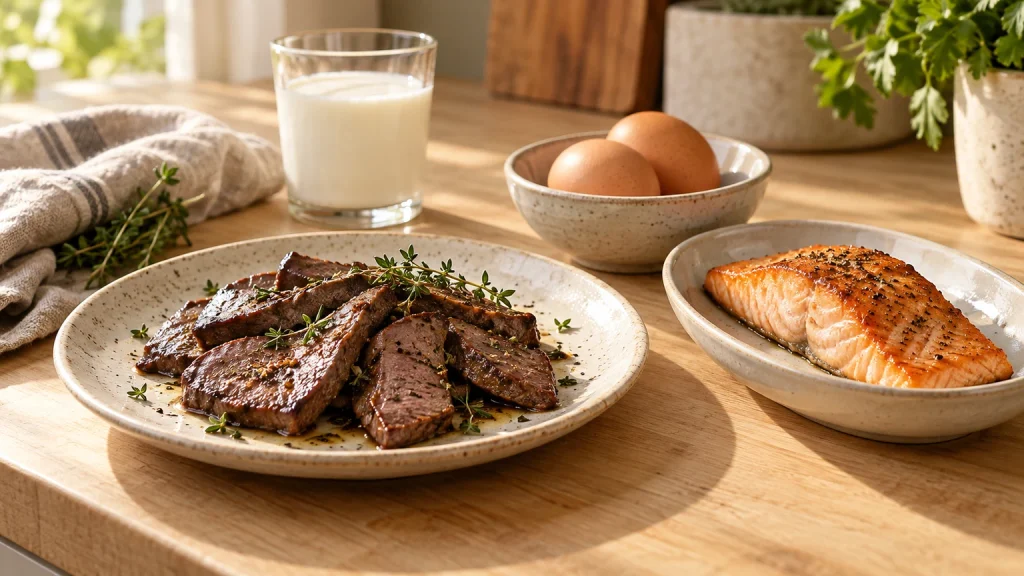
Beef gives you B12, zinc, iron, and complete protein, while eggs bring protein and choline. Fish and shellfish add their own minerals, and some fish also provide omega-3 fats and vitamin D. Dairy brings another useful set of nutrients if you tolerate it. Together, those foods give you a better starting point than shopping for individual vitamins before looking at your meals.
Organs add a particularly concentrated layer. Beef liver supplies preformed vitamin A, B12, copper, folate, and riboflavin, while kidney, heart, spleen, and pancreas have their own strengths. Together, those foods provide a wide range of micronutrients without requiring a separate supplement for every one.
Our beef liver nutrition breakdown details the vitamins and minerals behind liver’s reputation.

What About Whole-Food Supplements?
Most people are comfortable cooking beef, but far fewer regularly prepare liver, heart, or kidney. Freeze-drying makes those organs easier to include without turning them into a synthetic vitamin blend.
That’s the distinction behind our Pure American Liver and Beef Organs. We freeze-dry actual organ tissue instead of assembling isolated vitamin powders. Pure American Liver contains liver alone, while Beef Organs contains five organs for broader nose-to-tail variety. Both make those foods more convenient without losing sight of where the nutrients come from.
What the Synthetic vs Natural Vitamins Debate Misses About Real Food
Some synthetic vitamins work exactly as intended, while others differ in form or bioavailability from nutrients in food. Even when the molecule is identical, though, a capsule of that one nutrient can’t stand in for the rest of the food that contains it.
We make Pure American Liver and Beef Organs from freeze-dried organs because those tissues naturally contain nutrients together. We didn’t invent liver’s nutrient profile. We just made it easier to eat.
Frequently Asked Questions About Synthetic vs Natural Vitamins
What’s the difference between synthetic and natural vitamins?
Natural vitamins occur in food or are obtained from biological sources, while synthetic vitamins are made through manufacturing processes. The chemical forms can be identical or different, depending on the vitamin. Whole-food supplements differ again because they contain concentrated food or tissue rather than one isolated vitamin added to a formula.
Are natural vitamins better than synthetic vitamins?
Not across the board. Natural RRR-alpha-tocopherol has greater biological activity than common synthetic all-rac vitamin E, while folic acid is generally more bioavailable than folate naturally found in foods. The right comparison depends on the nutrient and the outcome being measured, rather than a blanket label.
Does the body absorb food-based vitamins better?
Sometimes, but not reliably for every vitamin. Absorption depends on the chemical form, dose, digestive conditions, and other nutrients present. Whole foods still provide protein, fat, minerals, and other compounds that a single vitamin tablet isn’t designed to supply.
What are whole-food vitamins?
The phrase usually refers to vitamins consumed in food or in food-derived preparations. A freeze-dried liver supplement, for instance, contains the nutrients naturally present in liver tissue. However, “whole food” is also used loosely in marketing, so check whether a product actually contains the claimed food or isolated vitamins added to a carrier.
Are synthetic vitamins less bioavailable?
Not necessarily. Some synthetic forms are less biologically active, some perform similarly to natural forms, and others are absorbed more efficiently. Folic acid is an important example of effective synthetic nutrient delivery. That’s why specific nutrient forms and doses matter more than the word “synthetic” alone.
Subscribe to future articles like this:
