
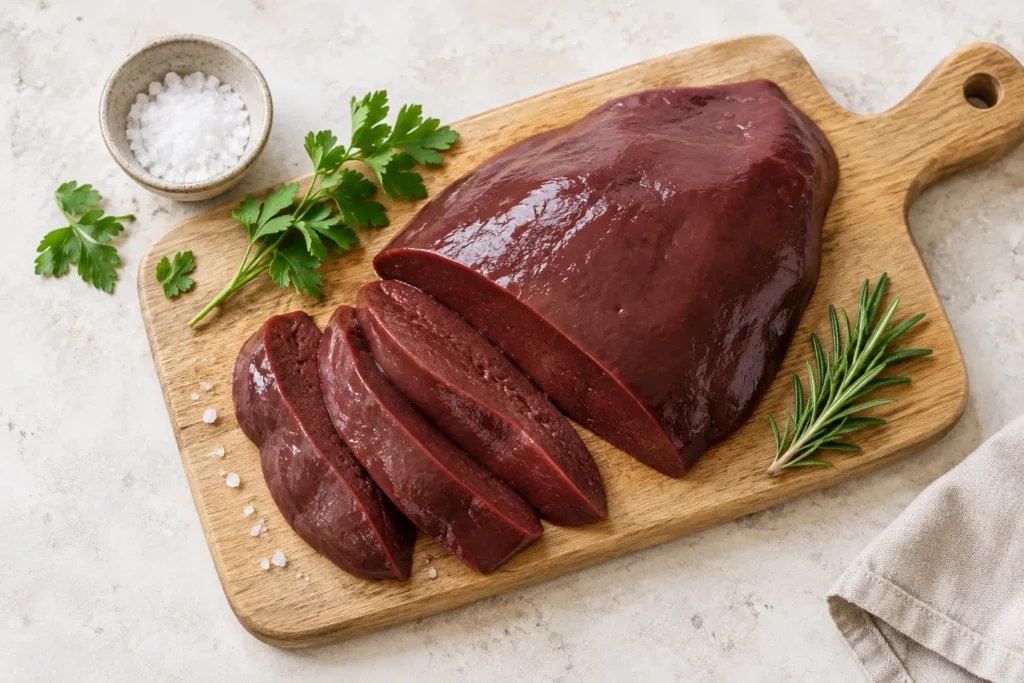
Yes, beef liver is one of the most nutrient-dense foods you can eat.
It packs preformed vitamin A, vitamin B12, copper, riboflavin, folate, heme iron, choline, selenium, complete protein, and other nutrients into a remarkably small amount of food.
And that’s exactly why liver deserves another look.
Most of us think of meat as steak, ground beef, chicken breast, or whatever is sitting in the meat case at the grocery store. Those foods bring plenty to the table. But muscle meat is only one part of the animal.
Organs bring something different.
Liver is particularly concentrated in nutrients that ordinary muscle meat contains in much smaller amounts. Heart & Soil sees the two as complementary:
Muscle meat provides the foundation, while organs add a different range and concentration of micronutrients.
Here’s what liver actually provides, why those nutrients matter, where fresh and freeze-dried liver differ, and when a little extra care makes sense.
Table of Contents
What Makes Beef Liver So Nutrient-Dense?
Beef liver is so nutrient-dense because it stores and processes nutrients for the body, which leaves the tissue naturally concentrated in vitamins, minerals, and other essential compounds relative to its size and calorie content.

Muscle meat is great food. It’s rich in protein, zinc, iron, creatine, B vitamins, and other nutrients. But it doesn’t give you everything liver does in the same concentrations.
Liver is especially rich in nutrients like vitamin A, B12, riboflavin, folate, and copper. That’s why thinking about organs and muscle meat as competitors misses the point.
They complement each other.
For most of human history, eating an animal didn’t mean picking three cuts of muscle meat and throwing the rest away. Organs were part of the food. Heart & Soil’s nose-to-tail philosophy is really just a return to that simple idea:
Eat more of the animal and get the different nutrients those foods naturally provide.
That’s why liver has a foundational place in an animal-based diet.
Does liver contain every nutrient you need? Of course not. No food does. It isn’t a meaningful source of calcium, it contains no fiber, and it doesn’t replace seafood for nutrients like long-chain omega-3 fats.
But that’s not the argument for liver.
The argument is that very few foods pack this many essential micronutrients into such a small amount of real food. You don’t need to turn nutrition into a complicated stack of isolated nutrients when foods like liver already bring so much to the table.
Beef Liver Nutrition at a Glance
| Nutrient | What your body uses it for | Why liver stands out |
| Vitamin A | Vision, immune function, and normal cell development | Provides preformed vitamin A in exceptionally high concentrations |
| Vitamin B12 | Red blood cell formation, DNA synthesis, and nervous-system function | One of the richest commonly eaten food sources |
| Riboflavin | Energy metabolism and antioxidant systems | Far more concentrated than in most muscle meat |
| Folate | DNA synthesis and red blood cell formation | Unusually rich for an animal food |
| Copper | Iron metabolism, connective tissue formation, and nervous-system function | Exceptionally concentrated |
| Heme iron | Hemoglobin formation and oxygen transport | Provides the highly bioavailable form of iron found in animal foods |
| Choline | Cell membranes, acetylcholine production, and fat metabolism | Packs a meaningful amount into a small serving |
| Selenium | Antioxidant enzymes and normal thyroid function | Adds another essential trace mineral to the mix |
| Protein | Building and maintaining muscle and other tissues | Complete protein containing all essential amino acids |
And the actual numbers are hard to ignore.
The NIH Office of Dietary Supplements lists 3 ounces of pan-fried beef liver at 6,582 mcg RAE of vitamin A, or 731% of the Daily Value.
Liver is also one of the richest food sources of vitamin B12 and brings substantial riboflavin, folate, copper, and heme iron along with it.
And this is where the nose-to-tail argument starts to make sense.
Exact nutrient amounts change with the animal, cut, and preparation method, so USDA FoodData Central is a good place to look when you need a precise number.
But getting lost in decimal points can obscure the obvious:
Liver puts a remarkable amount of nutrition into a very small amount of food.
What Are the Benefits of Eating Beef Liver?
One of the clearest benefits of eating beef liver is micronutrient coverage. A small amount can contribute substantially to nutrients involved in blood formation, oxygen transport, nervous-system function, cell membranes, immune function, and vitamin A status.
But the bigger point is what that means in practice.
In a study of nearly 40,000 U.S. adults, researchers found that vitamin A and choline were among the nutrients Americans continued to underconsume, even after supplements were included.
At the same time, we’ve largely stopped eating one of the foods that naturally concentrates those nutrients.
That’s liver.
A recent analysis of retail U.S. beef organs found liver to be an excellent source of retinol, B12, riboflavin, B6, copper, iron, protein, and several other nutrients. A separate 2024 review of 247 publications concluded that edible organs often match or surpass skeletal muscle for key micronutrients.
So perhaps the interesting question isn’t what miracle liver performs. It’s what disappears from the diet when we stop eating organs altogether.
Liver Gives You Preformed Vitamin A
This is one of the most meaningful differences between liver and many plant sources of vitamin A activity.
Plants such as carrots and sweet potatoes provide provitamin A carotenoids, particularly beta-carotene. Your body then has to absorb and convert those carotenoids into retinol.
Liver gives you preformed vitamin A.
That conversion difference is far from trivial. Reviews of human isotope studies found enormous variation in how efficiently dietary beta-carotene becomes retinol, with reported conversion ratios ranging from roughly 3.6:1 to 28:1 by weight. Food matrix, dietary fat, vitamin A status, and genetics can all influence the process.
That doesn’t make carrots useless. Far from it.
It means vitamin A on paper doesn’t always tell you how the nutrient reaches the body.
For Heart & Soil, animal and plant foods don’t have to be nutritionally identical to both belong in the diet.
Blood Formation Takes More Than Iron
Here’s another place modern nutrition can become too reductionist. Mention “blood,” and most people think “iron.”
But red blood cell production is a system.
Your developing red blood cells need folate and B12 for DNA synthesis. They need iron to make hemoglobin. Vitamin B6 participates in hemoglobin formation. Copper helps your body handle iron.
Liver happens to bring several of those nutrients together. That’s more interesting than calling it “iron food.”
It also illustrates something Paul Saladino, our founder, returns to again and again. We tend to isolate one compound, give it one job, and then look for a pill that contains it. Food is rarely that simple.

That doesn’t prove liver is superior to an appropriately prescribed iron, B12, or folate supplement. Sometimes targeted supplementation is exactly what’s needed.
But if you’re talking about everyday nutrition rather than treating a diagnosed deficiency, starting with foods that provide multiple pieces of the system at once is a pretty reasonable idea.
Choline Is a Good Example of What We’ve Overlooked
Choline isn’t nearly as famous as vitamin C or iron. Your body still needs it, though.
It’s required to make phosphatidylcholine and sphingomyelin. These are major components of cell membranes, and acetylcholine, a neurotransmitter involved in memory, muscle control, and other nervous-system functions.
And intake is surprisingly low.
A 2024 analysis of nearly 40,000 U.S. adults found that choline remained underconsumed across the population, even when dietary supplements were counted.
That doesn’t imply everyone’s clinically deficient. But it does make choline another reason to talk about foods like liver.
Is Beef Liver More Nutritious Than Muscle Meat?
For several important micronutrients, yes. Beef liver is substantially more concentrated than skeletal muscle in nutrients such as vitamin A, B12, riboflavin, folate, and copper. But “more nutritious” isn’t quite the right way to think about the comparison.
A liver and a steak are different tissues doing completely different jobs in the animal. It shouldn’t be surprising that their nutritional profiles are different too.
And the research bears that out.
A 2024 review of 247 publications found that edible organs frequently contain concentrations of vitamins, minerals, and other nutrients that match or exceed those found in skeletal muscle. The authors also pointed out that despite its nutritional value, offal has historically received relatively little attention in dietary guidance.
Another analysis looking specifically at the density of commonly lacking micronutrients ranked organs among the highest-density foods studied. Liver stands out for vitamin A, folate, B12, and iron.
So maybe the assumption worth questioning is how muscle became synonymous with meat in the first place.
In the United States, steak, brisket, and ground beef are normal. Liver is something many people won’t touch. Yet a 2024 analysis of U.S. beef offal notes that the majority of beef liver produced here is exported overseas, despite its remarkable nutrient density.
Heart & Soil wants to help bring liver back to the American table. Not as a novelty, but as a part of the animal that deserves to be eaten again.
| Nutrient | Beef liver | Typical beef muscle meat |
| Vitamin A | Exceptionally high in preformed vitamin A | Very low |
| Vitamin B12 | Exceptionally high | Rich source, but far less concentrated than liver |
| Riboflavin | Exceptionally high | Good source, but much lower than liver |
| Folate | Unusually high for an animal food | Low |
| Copper | Exceptionally high | Much lower |
| Iron | Higher in total iron; contains both heme and non-heme iron | Lower in total iron on average, but a larger proportion is heme iron |
| Protein | Complete protein | Complete protein; typically eaten in larger amounts |
Why Is Liver Called One of the Most Nutrient-Dense Foods?
Liver is called one of the most nutrient-dense foods because it delivers a large amount of micronutrition relative to the amount of food and energy you have to eat. That concentration is closely tied to what the organ does inside the animal.
A liver is one of the body’s metabolic hubs.
Nutrients absorbed from food pass through it. The liver transforms and redistributes them, manages amino acids and fats, produces important proteins, and stores nutrients the body may need later.
Specialized hepatic stellate cells serve as the body’s major retinoid reservoir. Reviews of liver physiology estimate that roughly 50–80% of the body’s vitamin A can be stored in these cells in mammals.
So liver isn’t nutrient-rich by accident. Its biology helps explain its nutrition.
That’s an important distinction because we’ve gotten used to judging animal foods primarily by calories, protein, and fat; the things printed on a nutrition label.
View things only through that lens and liver can seem like an unusual cut of meat. Focus on the micronutrition you get for the amount of food eaten, and the picture changes completely.
The deeper point is that one of the parts of the animal we’ve pushed furthest from the modern plate is biologically specialized to handle and store nutrients, and its food composition reflects that.
Can You Eat Beef Liver Every Day?
Yes. Heart & Soil generally recommends about 0.5–1 ounce of beef liver per day. This is enough to make liver a regular part of an animal-based diet without turning it into the main event.
Liver is concentrated food, so you don’t need much. A 3-ounce serving provides about 6,582 mcg RAE of preformed vitamin A, more than twice the adult tolerable upper intake level of 3,000 mcg RAE.
That isn’t a reason to fear liver. It’s a reason to respect how much nutrition is packed into it.
And remember that your body doesn’t care whether vitamin A, copper, and iron came from fresh liver, liver capsules, cod liver oil, beef organs, or a multivitamin. It all counts.
So keep it simple. Eat a small amount regularly and look at the rest of what you’re taking.
Who Should Be Careful With Beef Liver?
Most people can include liver as part of a nutrient-dense diet, but a few situations deserve more attention.
- Pregnancy and trying to conceive. Preformed vitamin A is essential, but too much during pregnancy can be harmful. NIH guidance lists an upper intake level of 2,800 mcg RAE per day for ages 14–18 and 3,000 mcg RAE for ages 19–50. If you are pregnant or planning a pregnancy, factor liver and supplements into your total intake.
- Iron-storage disorders. Liver contains heme iron, so people with hemochromatosis or similar conditions need individualized guidance. NIDDK explains that excess iron can accumulate and damage organs over time.
- Copper-metabolism disorders, gout, liver disease, or kidney disease. Liver is rich in copper and contains purines, so intake may need to be adjusted around the condition.
- Overlapping similar supplements. This is the easy one to miss. Liver plus cod liver oil, liver capsules, a beef organ blend, separate vitamin A, iron or copper, a multivitamin, or a prenatal can stack the same nutrients quickly.
The goal is to make liver a regular part of the diet in a sensible amount and account for the rest of your nutrient intake.
Fresh Liver vs Freeze-Dried or Desiccated Liver
Fresh liver comes first.
It gives you the whole food as it is: protein, calories, water, vitamins, minerals, and the rest of the natural organ matrix. If you enjoy liver and can source and prepare it regularly, that’s the simplest way to include it.
- Freeze-dried liver makes the same food much easier to use consistently. It removes most of the water, keeps the product shelf-stable, and avoids the taste and prep that put a lot of people off fresh liver.
- Freeze-drying is useful because it preserves more of the original tissue than many high-heat drying methods. Research on freeze-drying supports its ability to preserve structure, quality, and some bioactive compounds.
- A good desiccated liver supplement should still tell you how much liver is in each serving, where it comes from, how it was processed, and what quality testing was done. “Freeze-dried” matters, but sourcing and transparency matter too.
Heart & Soil Pure American Liver
Pure American Liver is exactly what the name says: 100% American beef liver, freeze-dried and put into capsules.
The liver comes from grass-fed, pasture-raised cattle raised on American family farms. Each capsule contains 500 mg of freeze-dried liver, with 180 capsules per bottle.
It’s real liver in a form that makes consistency easier.
You still get the nutrients naturally present in the organ, including vitamin B12, copper, riboflavin, selenium, vitamin B6, biotin, and other liver-derived compounds. Freeze-drying simply makes liver easier to store and use.
The goal of Pure American Liver isn’t to reinvent liver. We just made it easier to eat.
Pure American Liver vs Beef Organs
Pure American Liver is for going deeper on liver. Beef Organs is for going broader across the animal.
Pure American Liver contains one thing: beef liver. If you want to make it a more regular part of your diet, this is the simplest place to start.
Beef Organs takes the nose-to-tail idea further, combining liver with heart, pancreas, spleen, and kidney. Instead of concentrating on one organ, you get several nutritional profiles into one.
And they don’t have to be mutually exclusive. If you use both, just remember that liver is already part of Beef Organs when deciding how much fits into your routine.
Beef Liver vs a Multivitamin
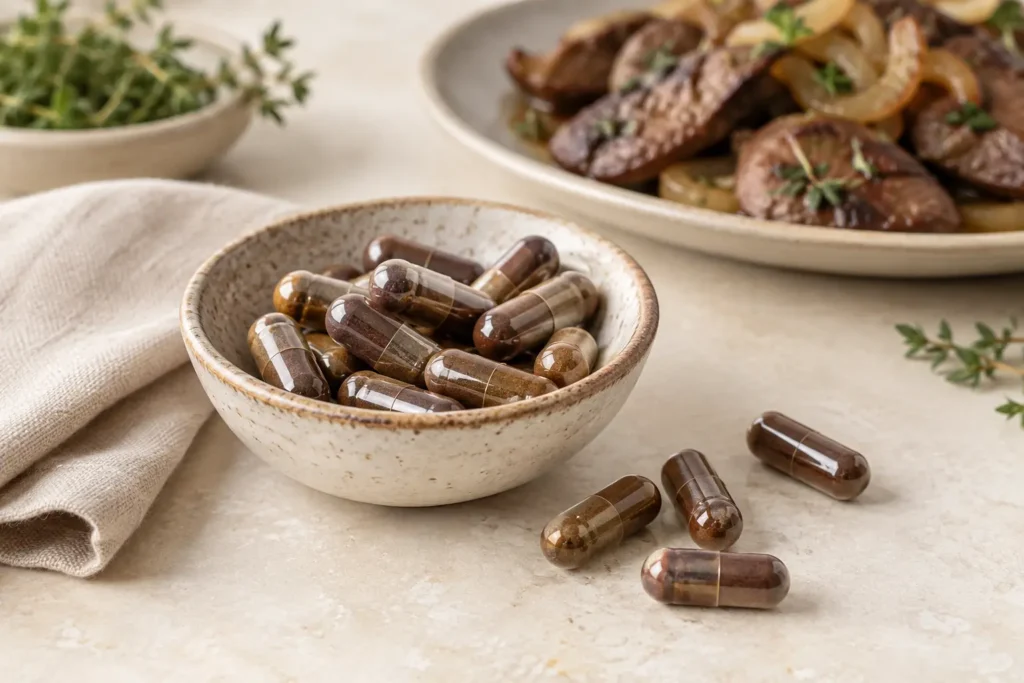
Beef liver and a multivitamin can both contribute micronutrients, but they approach nutrition from opposite directions. One starts with food, the other starts with isolated nutrients.
Beef liver comes with its nutrients already packaged together in a whole food. A multivitamin selects individual vitamins and minerals and delivers them in predetermined amounts.
That is where the nickname “nature’s multivitamin” comes from. And it raises a very Heart & Soil question:
Why try to reconstruct nutrition from individual ingredients before looking at what real food already provides?
That doesn’t make multivitamins useless. Far from it. Targeted supplementation can make sense when there’s a specific need.
But Heart & Soil starts with food first. Before you try to rebuild nutrition one vitamin at a time, start with foods that already come with the nutrients built in.
Does Beef Liver Help With Energy and Exercise?
Yes, beef liver can be especially useful for active people whose diets are low in iron or whose iron stores are depleted. It provides about 5 mg of iron per 3-ounce serving, alongside nutrients needed for red blood cell production and oxygen delivery.
Athletes have good reason to pay attention to iron. A systematic review and meta-analysis covering 17,519 collegiate athletes across 62 sports found that 23% met criteria for absolute iron deficiency.
When iron stores fall far enough, performance can fall with them. A review of 23 studies in high-level female athletes found iron deficiency was associated with roughly a 3–4% drop in endurance performance, while restoring iron in deficient athletes improved endurance in several studies.
This is where Paul’s philosophy fits naturally. He doesn’t treat performance as something you manufacture with one pre-workout, powder, or biohack. His foundation is much simpler. Get enough nutrients from food, train, sleep well, recover, and get outside.
Liver belongs in that foundation. If training asks more of your body, make sure your food is giving it something to work with.
How to Cook Beef Liver If You Want the Whole Food
Beef liver tastes best when you keep it simple. Slice it thin, cook it quickly, and don’t overdo it.
A hot skillet, butter or tallow, salt, and a quick sear can completely change the experience. Overcooked liver gets dry, grainy, and much stronger tasting. Cook it gently and it stays softer and richer.
If you’re easing into liver, you don’t have to start with a whole plate of it. Mix a little into ground beef for burgers or meatballs, fold it into meatloaf, or make pâté and eat it with fruit or alongside a meal.
There’s no prize for forcing down a giant piece of liver you hate. Start with an amount you enjoy.
And treat liver like any other meat in the kitchen. Keep it cold, avoid cross-contamination, and cook it safely. USDA recommends cooking beef liver and other organ meats to 160°F.
You can read more about eating liver safely if you want a deeper breakdown.
How to Choose the Best Grass-Fed Beef Liver Supplement
Choose a beef liver supplement that stays as close to the original food as possible: well-sourced liver, freeze-dried at low temperatures, clearly labeled, free from unnecessary additives, and independently tested.
Paul Saladino’s preference has always been fresh organs when you can get them. The point of a liver supplement is to make a good liver easier to get consistently.
What to Look For
- Know where the liver came from. Look for clearly identified cattle sourcing and meaningful farming standards such as grass-fed and pasture-raised.
- Know exactly what’s in the bottle. If it’s pure liver, the label should say liver. If it contains several organs, those organs should be named rather than buried inside a proprietary blend.
- Look for freeze-drying. Removing water at low temperatures avoids much of the heat exposure involved in conventional drying and helps preserve the nutritional characteristics of the original food.
- Skip the unnecessary extras. Liver doesn’t need artificial flavors, fillers, or a long ingredient list.
- Look for real testing. At minimum, you should be able to see whether the product is tested for contaminants such as heavy metals, pesticides, and microbes. Heart & Soil publishes this testing for its products.
Most importantly, don’t engineer something complicated when the thing you wanted was real food in the first place.
Final Takeaway
Beef liver doesn’t need another superfood label. It doesn’t need to be turned into a hack, a protocol, let alone a miracle.
It’s food.
Eat it fresh if that works for you. Pure American Liver makes the same organ easier to keep in your routine when fresh liver isn’t the easiest option. Either way, the point is to stop treating one of the most valuable parts of the animal like it doesn’t belong on the menu.
Heart & Soil exists, in part, to help change that.
Maybe eating liver isn’t the radical idea. But forgetting it was food in the first place is.
FAQ
Is beef liver good for you?
Beef liver is good for you because it delivers an unusually high concentration of essential nutrients in a small amount of real food. Heart & Soil generally recommends about 0.5 to 1 ounce per day, making liver a small but nutrient-dense part of an Animal-Based diet.
What are the benefits of eating beef liver?
The main benefit of eating beef liver is getting broad micronutrient coverage from a relatively small amount of food. Liver provides nutrients involved in red blood cell formation, oxygen transport, vision, nervous-system function, cellular metabolism, and immune function without having to assemble them from several separate foods or supplements.
Why is beef liver so nutrient-dense?
Beef liver is so nutrient-dense because the liver is a metabolically active organ that processes, stores, and redistributes nutrients throughout the body. Its biological role helps explain why the food contains such concentrated amounts of micronutrients compared with many other parts of the animal.
Is beef liver more nutritious than steak?
Beef liver is more concentrated than steak in several micronutrients, while steak is better suited to providing larger amounts of protein and calories. Liver stands out for vitamin A, B12, riboflavin, folate, and copper. They serve different nutritional roles, which is one reason nose-to-tail eating includes both.
Does beef liver contain iron?
Yes, beef liver contains iron, including heme iron. A 3-ounce serving of pan-fried beef liver provides about 5 mg of iron, or roughly 28% of the Daily Value. That makes liver a particularly concentrated whole-food source of iron compared with many foods eaten in similar amounts.
Does beef liver provide vitamin B12?
Yes, beef liver is one of the richest natural food sources of vitamin B12. A 3-ounce serving of cooked beef liver provides about 70.7 mcg of B12, or 2,944% of the Daily Value, which is one reason even relatively small servings contribute substantial amounts.
Can you eat beef liver every day?
Yes, beef liver can be eaten every day when the portion stays modest. Heart & Soil generally recommends about 0.5 to 1 ounce daily rather than treating liver like a large steak. Liver is concentrated food, so making it regular doesn’t mean making the serving large.
Does beef liver help with energy and exercise?
Beef liver can support energy and exercise by helping provide nutrients needed for oxygen transport and red blood cell production, particularly iron and vitamin B12. This can matter for active people because athletes have higher rates of low iron stores, especially in endurance-heavy sports.
Is desiccated liver as good as fresh liver?
Desiccated liver gives you real liver in a more convenient form, but fresh and freeze-dried liver are not identical servings. Fresh liver provides more food volume, protein, and calories, while freeze-dried liver makes the organ easier to store, travel with, and keep consistently in your diet.
What is Heart & Soil Pure American Liver?
Heart & Soil Pure American Liver is 100% American beef liver that has been freeze-dried and put into capsules. It comes from grass-fed, pasture-raised cattle raised on American family farms and provides 500 mg of liver per capsule, with 180 capsules in each bottle.
Is Pure American Liver the same as Beef Organs?
No. Pure American Liver contains beef liver only, while Beef Organs combines liver, heart, pancreas, spleen, and kidney. Choose Pure American Liver when you specifically want liver, or Beef Organs when you want a broader nose-to-tail mix of several different organs.
Want more on this? Join the Radical Health Newsletter for more straight-talk nutrition guidance, or reach out to our team if you have questions about which products fit your routine.
Subscribe to future articles like this:
