
The information in this blog is for educational purposes only. It is not a substitute for professional medical advice. Consult your healthcare provider if you’re seeking medical advice, diagnoses, or treatment. These statements have not been evaluated by the Food and Drug Administration. Our products are not intended to diagnose, treat, cure, or prevent any disease.
“Clean.” “Grass-fed.” “Organic.” They all sound reassuring on a protein tub. None of them tell you what a lab actually found.
What matters is how much heavy-metal exposure the finished protein powder delivers per serving, backed by current testing you can verify.
Some powders test surprisingly low. Others don’t. The interesting part is figuring out why.
Table of Contents
Can Protein Powder Be Completely Free of Heavy Metals?
No. You cannot prove that a protein powder contains literally zero heavy metals. A lab can tell you what it measured and whether a metal fell below that test’s detection limit. That is different from proving the metal does not exist at all.
This isn’t unique to protein powder.
Lead, cadmium, arsenic, and mercury are already present in the environment. The FDA explains that they can enter food through the soil, water, and air where plants and animals are grown, raised, or processed.
And labs are getting very good at finding tiny amounts. FDA’s current elemental-analysis method can measure lead and cadmium down to about 3 parts per billion in food.
So “nothing detected” and “nothing there” are not the same claim.
For protein powder, these are the four facts worth knowing:
|
Element |
What matters |
|
Lead |
A widespread environmental contaminant. The amount per serving matters far more than simply whether a lab detects it. |
|
Cadmium |
Can move from soil into plants and animals. The body clears it slowly, so repeated exposure matters. |
|
Arsenic |
Can enter food through soil and water. The form matters too, because inorganic arsenic is the greater toxicological concern. |
|
Mercury |
Occurs naturally and through pollution. Food testing commonly includes it alongside lead, cadmium, and arsenic. |
Here’s the part that often gets lost in headlines.
Finding a metal isn’t the same thing as finding a dangerous dose.
FDA makes that point explicitly for cadmium. A food testing positive for cadmium does not automatically mean you should avoid it. Concentration, how much you eat, how often you eat it, and the rest of your diet all affect total exposure.
Which Protein Powders Tested Lower for Heavy Metals?
The clearest recent product-level results come from Consumer Reports. In its 2025–2026 testing, several powders came back with relatively low lead, including products from Clean Simple Eats, Equate, Premier Protein, Truvani, Optimum Nutrition, BSN, Momentous, and Transparent Labs.
Heart & Soil Grass-Fed Whey is independently tested for heavy metals, pesticides, and impurities and is currently NSF Certified for Sport, with specific certified lots listed in NSF’s public database.
If you want names and numbers rather than another “clean protein” claim, this is where the data get useful.
What Consumer Reports Found in 2025 and 2026
In its 2025 protein powder investigation, Consumer Reports bought 23 protein powders and ready-to-drink shakes and tested samples from multiple lots. More than two-thirds contained more lead per serving than CR’s own daily level of concern of 0.5 micrograms.
Then, in January 2026 follow-up testing, CR tested five more chocolate protein powders across multiple lots.
|
Protein powder tested by CR |
Protein source |
Lead per serving |
|
Clean Simple Eats Chocolate Brownie Batter |
Whey |
0.21 µg |
|
Equate Rich Chocolate |
Whey |
0.27 µg |
|
Premier Protein Chocolate Milkshake |
Whey |
0.38 µg |
|
Truvani Chocolate |
Pea |
0.46 µg |
|
Ritual Essential Protein Daily Shake Chocolate |
Pea |
0.53 µg |
The first four came in below CR’s 0.5 µg daily level of concern. Ritual landed just above it at 0.53 µg.
Across its broader 2025 and 2026 testing, CR also identified relatively low-lead samples from Optimum Nutrition, BSN, Momentous, Transparent Labs, and several others. You can see its current comparison of lower-lead protein powders and shakes for the exact products and flavors.
Note that these results describe the specific samples and lots CR bought. Consumer Reports explains in its testing methodology and FAQ that results can change as ingredients, suppliers, and production lots change.
Clean Label Project’s 2025 protein powder study looked at 160 products from 70 brands and found broad differences by protein source and formulation.
Its public report is most useful for spotting category-level patterns, while Consumer Reports gives more useful product-by-product numbers for the specific powders it tested.
What Does the 0.5 µg Number Actually Mean?
This number gets misquoted constantly.
The 0.5 µg per day figure comes from California’s Proposition 65 reproductive-toxicity safe-harbor level for lead. You can verify it directly on California OEHHA’s lead page.
Consumer Reports chose that figure as its own daily level of concern when evaluating the powders it tested.
But it’s not an FDA protein-powder limit.
And Consumer Reports itself warns that its test results should not be interpreted as a determination of Proposition 65 compliance.
Are Some Types of Protein Powder More Likely to Test Higher?
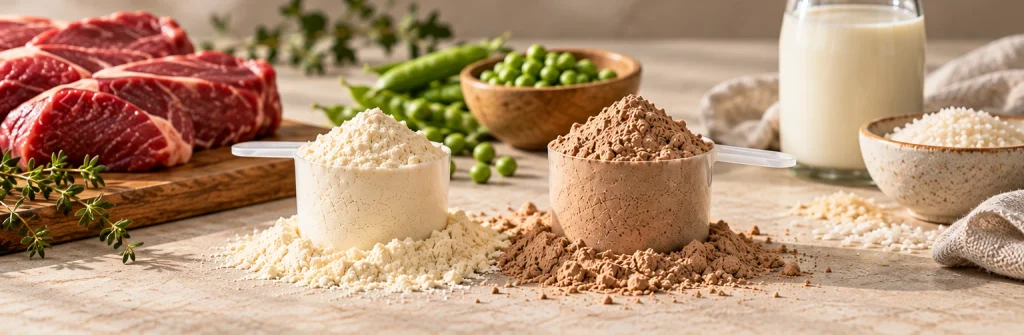
Yes, but different protein sources can test higher for different metals. Recent peer-reviewed research found more cadmium in plant-based powders, while more lead was found in animal-based powders. Cocoa adds another variable, while grass-fed and organic labels do not predict the final test result.
Here’s what the strongest recent data actually show.
|
Protein type or label |
What current testing shows |
|
Beef vs. whey |
Consumer Reports found dairy-based powders lower in lead on average than both plant and beef products in its sample |
|
Grass-fed |
Describes how the animal was fed, not what a heavy-metal test found |
|
Organic |
Organic production standards do not certify low heavy-metal levels |
|
Chocolate vs. vanilla |
Some datasets show much higher metals in chocolate; others show little lead difference |
Plant vs. Animal Protein Is More Complicated Than It Looks
A 2025 study of 90 protein supplements sold in Europe found that the pattern changed depending on the metal.
Lead was higher on average in the animal-based powders. Cadmium was higher in the plant-based powders.
The averages were:
- Lead: 0.05 mg/kg in animal-based protein vs. 0.03 mg/kg in plant-based protein
- Cadmium: 0.04 mg/kg in plant-based protein vs. 0.02 mg/kg in animal-based protein
There wasn’t one protein source that won every contaminant comparison.
A separate 2025 study of 56 plant-based protein supplements measured an average of 0.07 mg/kg lead and 0.09 mg/kg cadmium. Yet at the researchers’ standard 30-gram daily serving, exposure to those potentially toxic elements remained below the reference intake limits they evaluated.
So two things can be true at once:
Plant proteins can carry more cadmium, and that does not automatically make a normal serving unsafe.
If you’re comparing plant and animal protein for reasons beyond contaminant testing, our guide to plant-based vs. animal-based protein powder goes deeper into the nutritional differences.
“Organic” Doesn’t Mean Lower Heavy Metals
Organic certification tells you how a food was produced but lead or cadmium can still end up in it.
A 2024 study that followed 72 cocoa and dark-chocolate products sold in the U.S. across several testing years found that organic certification did not correspond to lower lead, cadmium, or arsenic.
In fact, the organic products were associated with higher cadmium, and some analyses also found higher lead concentrations.
That study looked at cocoa products, not protein powder, so we shouldn’t pretend it answers the protein question directly.
But it does make one point that an organic badge is not a contaminant test.
A crop can be organically grown and still take up naturally occurring metals from the soil.
Chocolate Adds Another Variable
Cocoa deserves extra attention, especially for cadmium.
But “chocolate” still isn’t a useful contaminant number by itself.
A 2025 review in Food Chemistry found that the chemical and contaminant profile of cocoa changes with plant variety, geographical origin, cultivation conditions, and production methods.
That means two chocolate protein powders can use cocoa from completely different places and end up with very different results.
What About Grass-Fed Whey?
There’s no good peer-reviewed evidence showing that a grass-fed label by itself predicts lower lead, cadmium, arsenic, or mercury in the finished whey powder.
Grass-fed tells you something important about how the animal was raised and fed.
It doesn’t tell you what a mass spectrometer found in the tub.
We care about grass-fed sourcing for reasons that go well beyond heavy metals, which we cover in our guide to how to choose grass-fed whey protein powder.
But when the question is heavy metals, sourcing and testing are two separate pieces of information.
There isn’t one universally “cleanest” protein source. Different ingredients bring different contaminant patterns. Plant proteins deserve more attention for cadmium. Cocoa adds another variable. Organic and grass-fed labels answer different questions entirely.
How Do You Know if Your Protein Powder Has Heavy Metals?
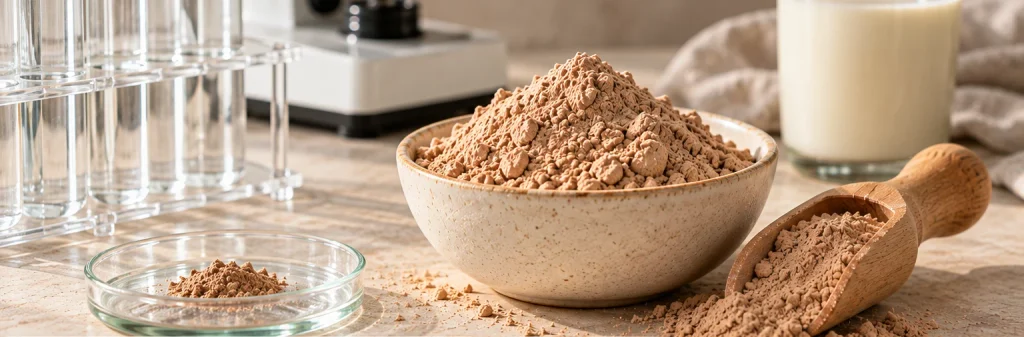
Look for a current COA tied to the product and lot you’re actually buying. It should show numerical results for lead, cadmium, arsenic, and mercury, not just a “tested for heavy metals” badge.
Here’s what to check.
1. Make Sure the Finished Powder Was Tested
Testing individual ingredients is useful, but you drink the finished formula.
A protein powder may combine whey or pea protein with cocoa, flavorings, minerals, sweeteners, and ingredients from several suppliers. Testing the final blend tells you what actually ended up in the tub.
Best case, the company does both:
raw-material testing on the way in + finished-product testing before release.
2. Look for All Four Heavy Metals
At minimum, look for results for:
- Lead
- Cadmium
- Arsenic
- Mercury
And look for actual numbers or clearly defined detection limits, not simply PASS.
The FDA’s Elemental Analysis Manual includes methods for measuring these elements in food.
3. Check Who Ran the Test and How
A useful COA names the laboratory and the analytical method.
If the lab is accredited to ISO/IEC 17025, it has been assessed against an international standard for laboratory competence and consistent testing. Ideally, its accredited scope should actually include the type of elemental analysis used.
A2LA explains that accreditation scopes can identify specific methods and measurement capabilities.
For heavy metals, you will often see ICP-MS, or inductively coupled plasma mass spectrometry. FDA uses ICP-MS in its own food-testing methods for heavy metals.
The point isn’t to memorize laboratory acronyms but to know who ran the test and whether they used a credible method.
4. Match the COA to Your Tub
Look for four things:
- Product
- Flavor
- Lot or batch
- Test date
A chocolate formula is not the same sample as an unflavored formula. Neither is a batch made two years ago the same as the one you’re buying today.
The closer the report is to your actual lot, the more useful it is.
5. Convert Concentration Into What You Actually Consume
Labs often report heavy metals in ppm or ppb. Those tell you concentration, not how much ends up in one serving.
For ppm:
µg per serving = ppm × serving size in grams
So:
0.01 ppm × 30 g = 0.3 µg per serving
For ppb:
µg per serving = ppb × serving size in grams ÷ 1,000
This matters because two powders with the same concentration can give you very different exposures if one serving is 25 grams and the other is 100 grams.
6. If It Says “ND,” Find the Detection Limit
ND does not mean zero.
It means the amount was below what that testing method could detect.
The limit of detection (LOD) is the lowest concentration the method can reliably detect. The limit of quantification (LOQ) is the lowest concentration it can measure accurately enough to report as a number.
Compare:
- Lead: ND
- Lead: ND, LOD = 0.002 ppm
The second report tells you how low the lab could actually see. The first doesn’t.
What a Useful Protein Powder COA Should Show
|
COA field |
What you want to see |
|
Product |
Exact protein powder and flavor |
|
Lot/batch |
A lot that matches or closely reflects current production |
|
Test date |
Recent enough to be relevant |
|
Laboratory |
Named independent laboratory |
|
Lab accreditation |
Ideally ISO/IEC 17025 for the relevant testing scope |
|
Lead |
Numerical result or ND with a detection limit |
|
Cadmium |
Numerical result or ND with a detection limit |
|
Arsenic |
Numerical result or ND with a detection limit |
|
Mercury |
Numerical result or ND with a detection limit |
|
Units |
ppm, ppb, µg/g, or µg/serving |
|
LOD/LOQ |
Enough information to interpret “not detected” |
|
Method |
Ideally a recognized method such as ICP-MS for elemental analysis |
You do not need a PhD to read this stuff.
Match the report to your tub. Find the four metals. Check the numbers. Check the serving size. Then make sure “ND” actually tells you how low the lab could see.
What Does Third-Party Testing Prove?
Third-party testing gives you independent evidence that a protein powder was analyzed instead of asking you to trust the brand’s own claims. A useful third-party test shows what was measured, what the lab found, and whether the product met the standard being used.
A single lab test gives you a snapshot of one sample or batch. A certification program goes further because it creates a repeatable system around that testing.
NSF supplement certification, for example, includes product testing, label verification, manufacturing audits, and ongoing monitoring. Its Certified for Sport program adds screening for more than 290 substances banned in sport.
So here’s the distinction:
Third-party testing gives you independent verification. Certification tells you the company has to keep meeting a defined standard over time.
For a protein powder you plan to buy again and again, that ongoing verification carries more weight than a one-time test sitting on a marketing page.
What Protein Powder Is Safest to Take Daily?
For a protein powder you use regularly, the amount per serving matters more as the servings add up. One scoop a day is 365 servings a year. Two scoops a day is 730. Even five servings a week comes out to roughly 260 a year.
That changes how I would evaluate a daily powder.
Imagine two products with the same contaminant measured at 0.2 µg and 1.0 µg per serving.
Over 260 servings, that’s:
52 µg versus 260 µg.
Same habit. Five times the total exposure.
Some heavy metals can also stick around in the body. The FDA explains that cadmium is eliminated very slowly and can accumulate after repeated exposure, while the World Health Organization notes that lead can be stored in bones and accumulate over time.
So for something you’re going to scoop hundreds of times a year, look for low measured exposure per serving and current testing that stays consistent as production lots change.
The more often you use it, the more those small numbers matter.
Protein powder can make hitting your protein target easier. It still shouldn’t carry your whole diet. Meat, eggs, dairy, seafood, and other whole foods should be doing most of that work.
How Heart & Soil Verifies Its Grass-Fed Whey
Heart & Soil verifies Grass-Fed Whey in two separate ways. We independently test the product for contaminants, and both current flavors are NSF Certified for Sport with specific certified lots listed in NSF’s public database.
Our Grass-Fed Whey Unflavored is made from 100% grass-fed Australian whey, has one ingredient, and is independently tested for heavy metals, pesticides, and impurities.
The current NSF listing confirms 24 g of protein per 30 g serving and shows the specific lots covered by the certification.
Chocolate Sea Salt Grass-Fed Whey goes through the same independent contaminant testing and carries the same NSF Certified for Sport certification.
NSF currently lists it separately, with its own batch numbers, serving information, and certification record.
So the proof stack looks like this:
|
What you can verify |
Grass-Fed Whey |
|
Source |
100% grass-fed Australian whey |
|
Independent contaminant testing |
Yes |
|
NSF Certified for Sport |
Yes |
|
Public NSF product listing |
Yes |
|
Specific certified lots visible |
Yes |
|
Unflavored ingredient count |
1 |
|
Protein per serving, Unflavored |
24 g per 30 g serving |
The NSF listing verifies the certification and covered lots. It’s not a public numerical contaminant COA.
Heart & Soil was not included in the Consumer Reports testing above, so we don’t assign Grass-Fed Whey a lead number or rank it against those products. Its case rests on its own independent contaminant testing and current NSF certification. Heart & Soil also publishes certificates of analysis for a number of its other products through its testing and COA page.
The Bottom Line
The real difference between protein powders is who has the tightest control over what ends up in the tub.
Ingredients change. Suppliers change. Crops change. Production lots change.
A company that tests once can show you a good result.
A company with strong sourcing, batch controls, finished-product testing, and ongoing verification is trying to make that result repeatable.
That’s the standard worth looking for. Not “zero.” Consistency.
Frequently Asked Questions
Can heavy metals build up if I use protein powder every day?
Some metals, including lead and cadmium, can accumulate in the body over time, which is why daily users should think in total exposure. Multiply the per-serving amount by how often you use the powder, choose products with current lot testing, and skip oversized servings you don’t need. Your diet as a whole counts too.
What does “ND” mean on a heavy-metal test?
ND stands for not detected. It means the amount of that metal fell below the lowest level the lab’s method could pick up, which falls short of proving the metal is absent. A good report lists the limit of detection next to the result, so you know exactly how low that particular test could see.
Is ppm or µg per serving more useful?
Micrograms per serving is more useful for judging what you actually take in, because it accounts for how much powder you consume. Parts per million only describes concentration. To convert, multiply the ppm result by the serving size in grams. A 30 g scoop at 0.01 ppm delivers 0.3 µg of that metal.
Should pregnant people be more cautious about heavy-metal exposure?
Extra care makes sense. California’s 0.5 µg daily lead figure was set specifically around reproductive toxicity, which shows how seriously regulators take exposure during pregnancy. If you’re pregnant or trying to conceive, choose powders with current, lot-specific testing and modest serving sizes, and walk through your supplement routine with your midwife or doctor.
How often should a protein powder be retested?
Ideally every production lot, since ingredients, suppliers, and growing conditions shift. At minimum, look for testing repeated on a regular schedule and a COA dated recently enough to match current production. Certification programs like NSF add ongoing monitoring, which gives you more to go on than a single report that never gets updated.
Subscribe to future articles like this:
