
Women hear plenty about losing strength after forty or fifty, sometimes as though the changes are inevitable and there’s little point trying to build muscle. But the body doesn’t stop responding to resistance training on a particular birthday, and getting enough protein still matters.
The harder part is often ordinary life rather than age itself. Breakfast might be coffee, lunch happens between errands, and by dinner you’ve barely had a proper serving of protein. That can become a problem when you want to keep lifting, hiking, and staying active for years to come.
You don’t need a complicated supplement routine to address that. You need meals that nourish you, a reason for your muscles to keep working, and a realistic way to get complete protein on days that don’t go according to plan.
That’s why we offer Grass-Fed Whey at Heart & Soil. It’s an easy way to add complete animal protein when the day’s meals come up short, although we still believe good food and strength training should do most of the work. We’ll compare the different protein sources so you can decide whether a scoop belongs in your routine.
Disclaimer: The information in this blog is for educational purposes only. It is not a substitute for professional medical advice. Consult your healthcare provider if you’re seeking medical advice, diagnosis, or treatment. These statements have not been evaluated by the Food and Drug Administration. Our products are not intended to diagnose, treat, cure, or prevent any disease.
Table of Contents
Key Takeaways
Getting older doesn’t mean you have to give up on strength, because muscles can still respond when you challenge and nourish them. The habits may take more attention over the years, but that’s a better starting point than assuming decline is inevitable.
- Women over 40 and 50 can continue building muscle. Age-related changes may influence how you train and eat, but they don’t eliminate the benefits of resistance exercise.
- Whey is a strong complete-protein option. Its essential-amino-acid and leucine content make it useful for muscle maintenance.
- Protein needs are individual. Body size, training, diet, energy intake, and medical circumstances matter more than reaching a particular birthday.
- Resistance training remains essential. Protein supports muscle adaptation, while training creates the stimulus.
- Collagen complements complete protein. Its amino-acid profile is different, so it shouldn’t replace whey or another complete protein when preserving muscle is the main goal.
You Can Still Build Strength After 50
Maybe you’ve noticed that the routine that worked at thirty doesn’t feel quite the same now. That’s normal enough to investigate, but it isn’t a verdict on your body’s future. Training and complete protein still matter, and understanding why can help you make the most of both.
Why Does Protein Matter More After 40 and 50?
Protein matters after forty and fifty because your muscles still need fuel for the work you ask of them. With age, smaller servings sometimes produce a weaker muscle-building response, but that doesn’t mean the body’s given up. It means the quality of your meals and the way you train deserve a little attention.
Does Menopause Cause Muscle Loss?
Menopause can change body composition, but it doesn’t decide how strong you get to be. Sleep, movement, food, age, and health all enter the picture, which is why two women can have completely different experiences. The useful response is to keep nourishing your body and giving it a reason to get stronger.
A 2026 analysis of resistance training in women found meaningful strength improvements in both premenopausal and postmenopausal groups. The relevant response is to keep giving muscle a progressive challenge and enough protein to support adaptation, rather than assuming menopause makes physical decline unavoidable.
What Is the Best Protein Powder for Women Over 50?
For a woman over fifty who wants to keep muscle, whey is a strong option if dairy agrees with her. It supplies complete protein and useful leucine without requiring a huge meal. Those familiar nutritional advantages matter more to us than any company claiming to have found a cure for aging.
A network meta-analysis in older adults reported favorable results for whey alongside resistance training, although outcomes differed by study and population. Egg-white protein can make more sense when dairy isn’t suitable, while some women already meet their needs through food. Choose the source that helps you consistently reach your protein target, not the one with the most dramatic healthy-aging promise.
Does Whey Protein Help Women Over 50 Build Muscle?
Yes, especially when you’re lifting or doing other resistance work. The training gives muscle a reason to adapt, and whey supplies essential amino acids that help support the rebuilding. You still have to do the work, but feeding yourself well makes the effort worthwhile.
In a trial involving older women, resistance training produced muscle-related improvements while extra isolated leucine added no clear benefit under the studied protein-intake conditions. That helps explain why we emphasize complete protein and training together. Once your diet already supplies enough essential amino acids, adding more of one amino acid isn’t automatically better.
What Is Anabolic Resistance?
Anabolic resistance sounds like something you need a specialist to explain, but the idea is simple. Older muscles may need a stronger training or protein stimulus to produce the same response. That doesn’t mean the door to strength has closed, and it certainly doesn’t mean you need a cupboard full of supplements.
Better Protein Habits Beat Magic Numbers
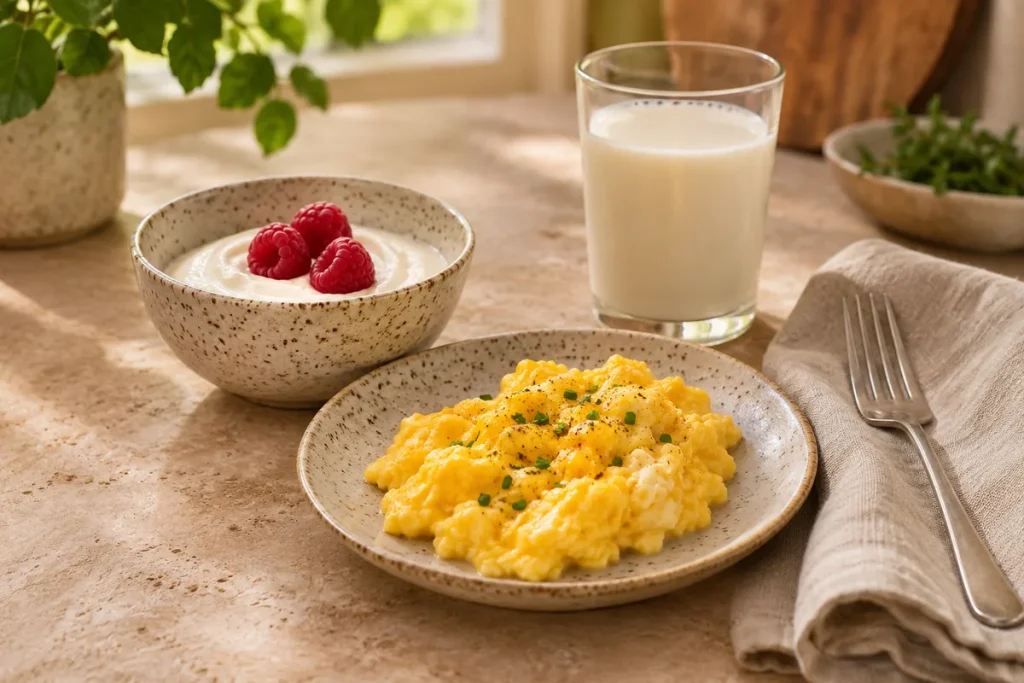
It’s easy to get lost in arguments over the perfect number of protein grams. The more useful question is whether you’re eating enough protein across the day, especially if almost all of it ends up at dinner. A target can guide you, but it can’t tell you what happened at breakfast.
How Much Protein Do Women Over 50 Need?
There’s no magic gram target that will suit every woman past fifty. Someone who lifts regularly has different needs from someone who’s less active, and body size and health matter too. The adult RDA is a useful reference point, but it isn’t automatically the target for an older woman working hard to maintain strength.
Sports-nutrition guidance commonly discusses higher intakes for exercising adults, including approximately 1.4–2.0 grams per kilogram per day, depending on circumstances. The International Society of Sports Nutrition position stand addresses this broader range. The table below shows how those different reference intakes would translate for a woman weighing 70 kilograms.
| Intake | Approximate Daily Protein |
| 0.8 g/kg | 56 g |
| 1.2 g/kg | 84 g |
| 1.6 g/kg | 112 g |
Someone with kidney disease or another condition affecting protein recommendations should obtain individualized medical guidance rather than applying a sports-nutrition target automatically.
Is 20 Grams of Protein Enough per Meal After 50?
Twenty grams at a meal can help, but look at the whole day before declaring breakfast a success or failure. A woman who eats eggs and dairy in the morning and meat later has a different starting point from someone whose first real protein arrives at dinner. The pattern is often more useful than a single number.
Sports-nutrition discussions often use roughly 20–40 grams of high-quality protein per meal as a practical range in different populations. Rather than scheduling an exact number every few hours, look at what breakfast, lunch, and dinner actually provide. If one meal is consistently low in protein, adding eggs, dairy, meat, or whey may be more useful than changing meals that already meet your needs.
Why Does Leucine Matter More With Age?
Leucine is one of the reasons we pay attention to complete protein. It helps signal muscle protein synthesis, but a signal alone can’t build anything. Your body still needs the rest of the essential amino acids, which is why a nourishing meal or complete protein serving makes more sense than chasing one isolated ingredient.
How Much Leucine Should Women Over 50 Look For?
A complete-protein serving naturally providing approximately 2–3 grams of leucine can be a useful muscle-oriented reference point, although it isn’t a universal threshold. Your response depends on age, body size, the rest of the meal, and the training you’re doing.
Our unflavored Grass-Fed Whey currently lists around 2.5 grams of leucine per serving as part of its complete amino-acid profile. That can contribute meaningfully to a muscle-focused diet, but there’s no reason to assume that adding increasingly large amounts of isolated leucine will produce proportionally greater benefits.
Menopause Changes the Context, Not the Possibility
Menopause can change the way your body feels and responds, which can be frustrating when you’re doing things you’ve always done. But the idea that your strength has an expiration date deserves to be challenged. You can still nourish muscle and give it work to do.
Best Protein Powder for Menopause Muscle Loss
If you’re worried about losing muscle through menopause, start with the pairing that actually makes sense. Give muscles a reason to work through resistance training, then bring enough complete protein to your meals. Whey can help with the second part when food alone is inconvenient.
Can Women Over 50 Still Build Muscle?
Absolutely, women can build muscle after fifty. If you’ve been told to expect less from your body every year, that’s a story worth questioning. Progress may take patience and good training, but strength isn’t reserved for people in their twenties.

Best Protein Powder for Women Over 40
Women over 40 generally benefit from the same complete-protein options as women over 50, although individual needs depend more on training and health than chronological age. A 42-year-old woman who lifts regularly may have different requirements from someone of the same age who’s sedentary or recovering from illness.
Which Protein Belongs in Your Routine?
You don’t need a menopause-branded powder to get complete protein. Whey, egg, and collagen each offer something different, and the useful choice depends on whether you tolerate dairy, how much protein your meals supply, and what you want the scoop to do.
Whey Protein Concentrate vs. Isolate After 50
Both concentrate and isolate are complete whey proteins, so there’s no need to crown one the winner for everyone over fifty. Isolate is filtered further and usually contains less lactose and fat, while concentrate keeps more of the original dairy components. Your digestion and preferences can help settle the choice.
What If Whey Upsets Your Stomach?
If a whey shake doesn’t agree with you, don’t force the issue just because it’s popular. It may be lactose, serving size, or another ingredient, while a milk allergy means whey is off the table altogether. Egg-white protein is another way to get complete animal protein without milk.
Is Collagen Enough for Women Over 50?
No, collagen shouldn’t carry the entire job of muscle-focused protein after fifty. It gives you glycine and proline, which are abundant in connective tissue, but it lacks the essential-amino-acid balance you get from meat, eggs, or whey. We like making room for both kinds of nourishment.
Whey vs. Collagen for Women Over 50
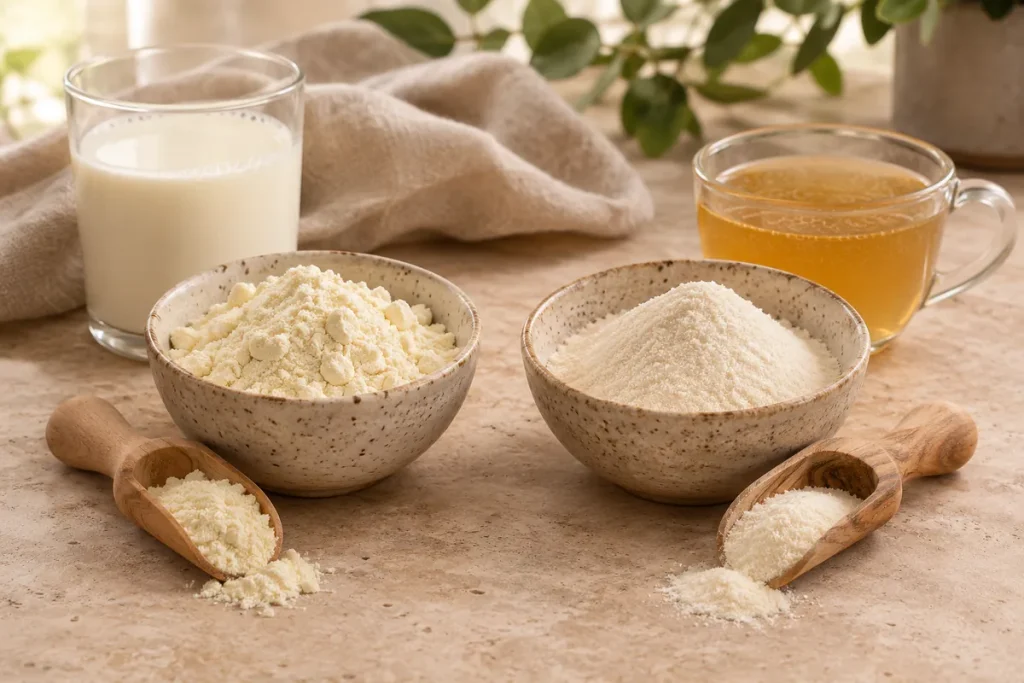
For muscle nutrition, whey has the advantage because it offers complete protein and more leucine. Collagen offers a different mix that reflects the animal tissues it comes from. You don’t have to choose one food to represent every part of the animal.
| Feature | Whey | Collagen |
| Complete protein | Yes | No |
| Essential amino acids | High | Lower |
| Leucine | High | Low |
| Muscle preservation | Strong fit | Weaker as a primary source |
| Strength-training nutrition | Strong fit | Complementary |
| Glycine and proline | Present | Especially abundant |
| Collagen-rich tissue nutrition | Indirect | More characteristic profile |
For a woman who wants both muscle-focused protein and collagen-rich amino acids, the two can occupy different places in the diet. Complete protein should still provide the foundation when muscle preservation is the main objective.
Think Beyond the Scale and the Scoop
It’s tempting to treat the number on a scale as the final score, but strength shows up in ways that don’t fit on a bathroom display. Think about carrying luggage, getting off the floor, hiking a trail, or simply trusting your legs. Protein supports that bigger picture when it’s paired with movement.
Does More Protein Protect Against Sarcopenia?
Enough protein helps keep muscle nourished, but it can’t promise to prevent sarcopenia. Inactivity, disease, aging, and food intake all affect muscle, and a powder alone can’t address everything. That’s one more reason to keep strength training and the rest of your life in view.
Is Resistance Training More Important Than Protein Powder?
If you’re asking which matters more for strength, start with the activity that gives muscle a reason to grow. Protein provides some of the raw material, but lifting, carrying, and other resistance work provide the challenge. We’d rather see them working together than argue about which tub is best.
Best Protein Powder for Weight Loss After 50
Choose a complete protein with a useful protein-to-calorie ratio when you’re trying to lose fat after 50. A calorie deficit can result in reductions in both fat and lean tissue. Maintaining protein intake and continuing resistance training can help protect muscle during weight loss.
Does Protein Help With Bone Health After Menopause?
Adequate protein contributes to normal bone and muscle nutrition, but protein powder isn’t an osteoporosis treatment. Bone health also depends on calcium, vitamin D, physical activity, and medical factors such as hormonal status and fracture risk.
Resistance and appropriate weight-bearing exercise are especially relevant because they support muscle function and skeletal loading. We recommend evaluating protein as part of an overall nutrition and movement routine rather than expecting one supplement to address every aspect of postmenopausal health.
Make the Habit Fit the Life You Have
If a habit only works on the days when nothing goes wrong, it’s not much of a habit. A scoop can be useful in a busy morning or an evening when your appetite is low, while on other days eggs and meat will do the job beautifully. The point is to make nourishment workable, not ceremonial.
When Should Women Over 50 Take Protein Powder?
The best time to use a scoop is when it helps you eat enough protein. Maybe that’s breakfast because mornings are rushed, or after training because dinner is a while away. Your body doesn’t need a complicated ritual for something that can be this practical.
Should Women Over 50 Drink a Protein Shake Every Day?
You can have a shake every day, but you don’t have to. If breakfast is regularly short on protein, a scoop might become a helpful habit. When your meals already include plenty of eggs, meat, seafood, or dairy, don’t feel obligated to add another one.
What Should Women Over 50 Avoid in a Protein Powder?
Be cautious about choosing a product based on a company’s promises about menopause-specific hormonal effects. The more meaningful considerations are whether the protein is complete, how much it supplies per serving, and whether the ingredient list suits your needs.
Our Food-First Take on Protein After 50
We offer Grass-Fed Whey for days when getting enough complete protein from meals is harder than it ought to be. It won’t replace training, rest, or a good dinner, and that’s exactly why we keep its role straightforward.
How Our Grass-Fed Whey Supports a Muscle-Focused Routine
Our Grass-Fed Whey provides complete protein from grass-fed Australian whey concentrate. The unflavored version contains no added sweeteners or flavors, and current product information lists roughly 24–25 grams of protein plus 2.5 grams of leucine per serving. For a woman whose meals are occasionally low in protein, that’s a straightforward way to add essential amino acids without preparing another full meal.
What About Our Animal-Based Protein?
Our Animal-Based Protein combines grass-fed whey, collagen, and colostrum in a single powder. Whey supplies complete protein for muscle maintenance, while collagen and colostrum contribute different animal-derived nutrients. That wider ingredient mix may appeal if you want more than a standalone whey supplement.
For women over 50 whose main goal is preserving muscle, plain whey remains the more direct choice because it’s designed around complete protein. The blend isn’t necessarily better for older muscle simply because it contains additional ingredients.
Best Protein Powder for Women Over 50 by Goal
Protein selection should reflect the outcome you’re working toward.
| Goal | Better Fit |
| Preserve muscle | Complete protein such as whey |
| Build strength | Whey plus resistance training |
| Support muscle through menopause | Adequate complete protein and training |
| Avoid dairy | Egg-white protein or verified high-quality beef protein |
| Include collagen-rich amino acids | Collagen as a complement |
| Minimize ingredients | Unflavored single-source protein |
| Lose fat while retaining muscle | Complete protein with a favorable protein-to-calorie ratio |
| Combine whey and collagen | Animal-based protein blend |
No single formula is best for every woman over 50. The important factors are protein quality, total intake, training, and how consistently the product fits your routine.
Best Protein Powder for Women Over 50: The Heart & Soil Perspective
If you’re over fifty and want to keep getting stronger, begin with the life you’re trying to live. Complete protein and resistance training are tools for that life, and a powder can be useful when it makes the nutrition side easier.
You can explore our unflavored Grass-Fed Whey for a simple complete-protein option or compare our Animal-Based Protein if you’d prefer whey alongside collagen and colostrum.
Frequently Asked Questions About the Best Protein Powder for Women Over 50
Most of the practical questions come back to the same place. What do you eat, how do you train, what agrees with you, and which parts of that picture could use a little help?
What Is the Best Protein Powder for Women Over 50?
A complete, leucine-rich protein such as whey is one of the strongest choices for women over 50 who want to maintain or build muscle. Its amino-acid profile supports muscle protein synthesis, particularly when combined with resistance training. Egg-white protein is a useful dairy-free alternative when whey isn’t suitable.
How Much Protein Do Women Over 50 Need?
Protein needs vary by body size, health, and activity level. Sports-nutrition guidance often recommends higher intakes for active adults than the basic adult RDA, including approximately 1.4–2.0 grams per kilogram daily in relevant exercising populations. That range shouldn’t be applied automatically to every woman, particularly those with medical conditions affecting protein needs.
Does Protein Prevent Muscle Loss With Age?
Adequate protein supports muscle maintenance, especially when combined with resistance training, but it can’t guarantee that age-related muscle loss won’t occur. Physical activity, overall nutrition, medical conditions, and training consistency also influence muscle health. A complete protein supplement can help close dietary gaps without replacing the need for exercise.
What Protein Is Best During Menopause?
A complete protein such as whey is a strong option when maintaining muscle through menopause is the goal. The benefits come from its essential-amino-acid profile rather than any special hormonal effect. Resistance training and sufficient total protein intake remain more important than purchasing a product marketed specifically for menopause.
Is Whey Protein Good for Women Over 50?
Yes. Whey provides complete protein and leucine, making it useful for maintaining protein intake and supporting resistance-training adaptations. Studies in older adults and postmenopausal women have reported favorable strength or lean-mass outcomes when whey supplementation accompanies exercise. The results don’t establish whey as a standalone treatment for age-related muscle loss.
Is Collagen Enough for Women Over 50?
No, collagen is relatively low in leucine and other essential amino acids, which makes it a poor primary protein for muscle preservation. It brings more glycine and proline to the table, so its role is different rather than useless. Women can include collagen alongside sufficient complete protein from food or supplements.
Can Women Over 50 Still Gain Muscle?
Yes, women can still gain muscle and strength after menopause through progressive resistance training and adequate nutrition. The response varies with health, training history, and program design, but age doesn’t take away the capacity to adapt. Complete protein helps supply the amino acids needed to support that process.
Do Women Over 50 Need Extra Leucine?
Not necessarily, because leucine helps activate muscle protein synthesis without making extra isolated leucine automatically useful when you’re already eating enough complete protein and training consistently. A study in older women found no extra benefit from supplemental leucine under the conditions tested. Prioritize high-quality complete protein before considering isolated amino acids.
Subscribe to future articles like this:
