
Peptides are everywhere right now, usually in conversations about weight loss, recovery, hormones, or anti-aging.
But peptides didn’t begin in a vial.
Your body makes them. Food contains them. And digestion can create them.
Hidden inside the proteins in meat, dairy, eggs, organs, and other foods are shorter amino-acid sequences. Digestion may break some apart, release others from the larger protein they came from, and allow certain small peptides to survive long enough to interact with the body.
The exciting part of peptide science may not begin with what we can engineer in a lab. It may begin with what food has been carrying all along.
That’s very different from a peptide drug designed to reach a specific target and produce a specific effect.
This guide looks at food-derived peptides, naturally occurring growth factors, and therapeutic peptides, and separates what they have in common from what they don’t.
Table of Contents
What Are Peptides?
Peptides are short chains of amino acids that can act as building blocks, hormones, or signaling molecules in the body. Your body already makes hundreds of them, including insulin, ghrelin, GLP-1, oxytocin, and thymosin beta-4.
A common practical cutoff is fewer than about 50 amino acids, although the boundary isn’t universally fixed. The name alone tells you very little about what a peptide does.

The more useful distinction is context. Your body makes hundreds of peptides, and they do very different jobs.
Insulin helps regulate blood sugar. Ghrelin helps signal hunger. Oxytocin is involved in reproduction and social bonding. Others play roles in digestion, immune activity, tissue repair, and much more.
How it enters the body matters too. Most peptides in food are broken down during digestion into smaller peptides and amino acids. An injected or specially formulated therapeutic peptide can avoid much of that breakdown.
So there are two useful things to keep straight:
- Peptide is a category, not a benefit.
- How a peptide reaches your body helps determine what it can do.
What Are “Peptides for Weight Loss”?
“Peptides for weight loss” usually refers to medications that mimic or extend peptide signals your body already uses to regulate appetite and metabolism. The important difference is how strongly those signals are activated and how long they remain active.
Your body naturally releases GLP-1 after you eat. That signal helps regulate satiety, but native GLP-1 is broken down within minutes. Drugs such as semaglutide are engineered to resist that breakdown.
Semaglutide
Semaglutide is a GLP-1 receptor agonist with 94% sequence homology to human GLP-1. The similarity is only part of the story.
Structural changes make semaglutide much more resistant to the enzyme that normally clears GLP-1, extending a signal that naturally lasts minutes into one that can remain active for days.
That prolonged appetite signal is a major reason people eat less while taking it.
Tirzepatide
Tirzepatide activates both GIP and GLP-1 receptors. Instead of extending one food-related signal, it acts through two peptide pathways involved in appetite and metabolic regulation.
Paul’s broader point is useful here. The fact that a drug resembles something your body already makes doesn’t make the exposure physiologically identical.
Your body releases these signals in a tightly regulated pattern. A drug can keep them active far longer or activate several pathways at once.
Other Products Sold as Weight-Loss Peptides
The term becomes much less precise outside approved medications. It can include compounded semaglutide or tirzepatide, experimental compounds such as retatrutide, and gray-market research peptides sold online.
Paul is especially critical of that last category because the question shifts from whether the mechanism is promising to whether you even know what’s in the vial.
The FDA has warned that unapproved GLP-1 products haven’t undergone the same review for safety, effectiveness, and quality as approved medications.
The useful distinction is what signal is being changed, how long that signal lasts, and how much control you have over the exposure.
Are Peptide Medications the Same as Food-Derived Peptides?
No. A peptide medication and a peptide found in food can both be made from amino acids, but the body does not encounter them in the same way.
The biggest difference is what happens after they enter your body.
Food peptides go through digestion as part of the food you eat. Many are broken down further, while some short peptides survive intact and others are released from larger proteins during digestion.
Peptide medications are different. They’re designed to survive long enough to reach a specific target and change a specific signal.
That changes the entire picture.
| Feature | Peptide medication | Food-derived peptide |
| How it enters the body | Designed to reach circulation through injection or specialized oral delivery | Eaten as part of food |
| What digestion does | Often bypassed or deliberately resisted | Usually broken down substantially during digestion |
| Biological target | Engineered to act on a defined receptor or pathway | Activity varies widely and many never act systemically intact |
| Exposure | Dose and duration are deliberately controlled | Depends on the food, digestion, absorption, and peptide stability |
| Evidence | Studied as a drug for specific clinical outcomes | Often studied in nutrition, food science, laboratory, animal, or smaller human studies |
| Weight-loss effect | Established for certain approved medications | Not equivalent to pharmaceutical weight-loss treatment |
Your body already knows how to make and use peptide signals. It releases them when they’re needed, then breaks them down when that signal has done its job.
A peptide drug can change that pattern by keeping the signal around longer or delivering it in a way food never would.
Does Digestion Destroy Peptides in Food?
Digestion breaks down many food peptides, but it does not reduce every protein all the way to individual amino acids. Some short peptides are absorbed intact, while others are actually created during digestion.
Your intestine is built to handle more than free amino acids.
Human intestinal studies found that dipeptides can enter intestinal cells intact. In one classic perfusion study, disappearance of the tested dipeptides from the gut was driven mainly by intact uptake rather than digestion in the intestinal lumen.
We also have a striking human example in carnosine, a dipeptide abundant in animal foods. After healthy adults consumed carnosine, researchers recovered as much as 14% of the ingested dose intact in urine, demonstrating that at least some small dietary peptides can make it through the intestine intact.
Digestion can do something else too. It can cut a larger protein at exactly the places needed to release a smaller bioactive sequence.
Sometimes digestion destroys the message. Sometimes it opens the envelope.
Do Whole Foods Contain Peptides?
Yes. Meat, milk, eggs, fish, and colostrum all contain proteins that can release smaller peptides as the food is digested, fermented, aged, or otherwise broken down.
Researchers have identified thousands of food-derived peptides. Some have shown antioxidant, antimicrobial, blood-pressure, or immune-related activity in laboratory studies.
But finding an active peptide in a food is only the beginning of the story.
A peptide may look promising in a test tube and still be broken apart before it ever reaches the bloodstream. Others survive digestion better. Their size, amino-acid sequence, food source, and the way the food is processed can all change what happens next.
What Are Bioactive Peptides?
A bioactive peptide is a short amino-acid sequence that does more than provide building material. Its particular sequence allows it to interact with an enzyme, receptor, cell, or signaling pathway.
And sequence can change everything.
Researchers studying the egg-derived tripeptide IRW found that the intact three-amino-acid sequence altered inflammatory signaling in human endothelial cells. When they separated it into smaller pieces or supplied the same amino acids individually, they did not reproduce the same effect.
Same amino acids, but different arrangement and different biology. That sequence helps determine which cellular targets it can interact with and what response follows.
Why Organ-Derived Peptides Are So Interesting
Liver, heart, spleen, kidney, pancreas, and other organs are different tissues built from different proteins. That means they can also produce different peptide profiles as those proteins are broken down.
This opens up an intriguing question Heart & Soil has been interested in for years.
Could the tissue itself matter?
The old idea is sometimes described as “like supports like.” Modern peptide science gives researchers new ways to test pieces of that idea rather than simply accepting or dismissing it.
In laboratory research, short peptides originally derived from different organ peptide complexes have produced tissue-specific effects in rat organ cultures. Liver-derived Livagen acted on liver explants, while peptides associated with thymus and nervous tissue produced their strongest effects in their corresponding tissues.
More recently, researchers isolated small peptides from pig spleen and gave them orally to mice. Certain fractions produced measurable immune effects in the spleen and intestine. This is early animal research, but it shows that organ-derived peptides can be studied as biologically distinct compounds rather than generic protein fragments.
We are only beginning to map what information different animal tissues may carry in their peptide profiles.
Do Organ Meats Contain Peptides and Other Naturally Occurring Compounds?
Yes. Organ meats contain complete proteins along with amino acids, vitamins, minerals, and compounds that reflect the job of each tissue. As you digest those proteins, your body breaks them into smaller peptides and amino acids.
A 2024 review in Nutrients found bioactive peptides in offal that researchers have studied for antioxidant, antimicrobial, immune-related, and blood-pressure-related activity. Most of that evidence comes from food science and laboratory research, so it does not mean eating liver or kidney produces those same effects in humans.
Why Processing Matters
Two products can start with the same animal tissue and end up with different peptide profiles depending on how that tissue is processed.
Researchers demonstrated this directly with porcine liver. They treated the same liver protein with four different enzymes and produced significantly different peptide profiles, including 44 peptides whose abundance differed between treatments. The preparations also differed in measured antioxidant activity.
That gives processing a much bigger role than simply keeping a product shelf stable.
Heart & Soil freeze-dries its Beef Organs rather than subjecting them to conventional high-heat drying.
Freeze-drying removes water at low temperatures, reducing heat exposure compared with conventional high-heat drying. That can help protect heat-sensitive biological compounds, although different proteins and peptides respond differently to processing.
If the tissue is the point, how you handle the tissue belongs in the conversation.
You can read more about why organ meats are so nutrient-dense here.
Where Do Food-Derived Peptides Come From?
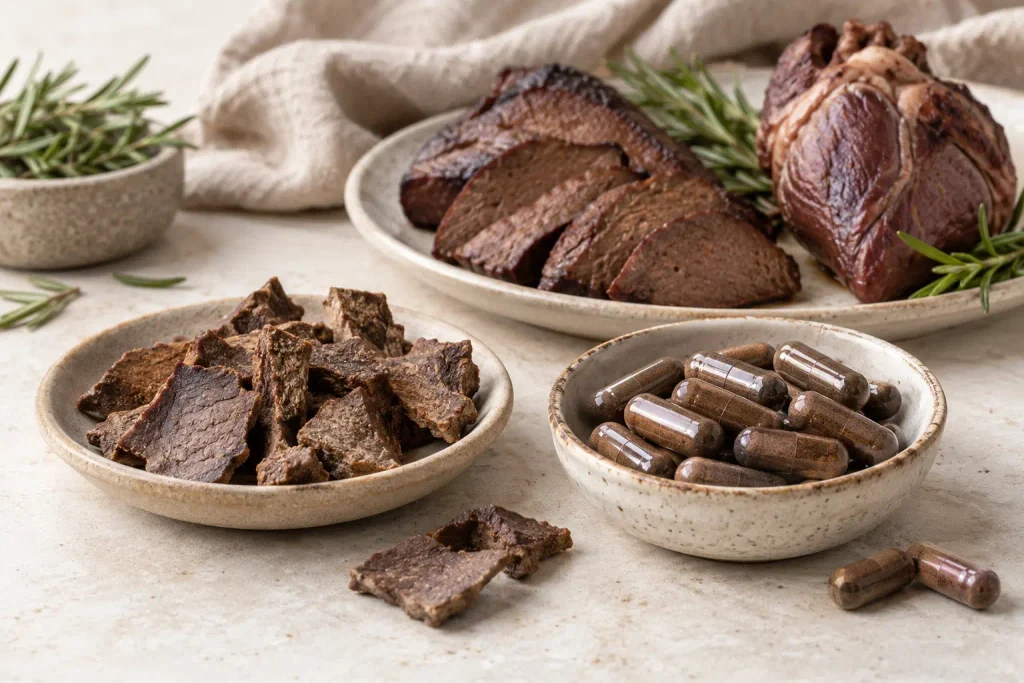
Food-derived peptides can already be present in food or be released from larger proteins during digestion, fermentation, aging, or processing.
Meat, dairy, eggs, seafood, organs, and collagen-rich tissues contain different parent proteins. When those proteins are broken apart, they can release different amino-acid sequences.
Researchers have identified thousands of these food-derived peptides. Which ones appear depends on the original protein and what happens to it before and after you eat it.
The protein source helps determine the peptide possibilities.
Colostrum Is More Than a Growth-Factor Delivery System
Colostrum is the first milk produced after birth. It’s naturally rich in proteins, immunoglobulins, lactoferrin, oligosaccharides, peptides, vitamins, minerals, and growth factors.
Grass-Fed Colostrum comes from grass-fed, pasture-raised cattle and keeps those compounds together in the food they naturally come from.
Whether specific compounds in colostrum survive intact into circulation is only one part of the story.
The digestive tract encounters them first. A 2024 meta-analysis of randomized clinical trials found improvements in pooled measures of intestinal permeability with bovine colostrum, although results varied substantially between studies.
Researchers have not established which individual peptide, growth factor, or other component explains those findings.
Food can interact with the gut without first needing to behave like an injectable drug.
Heart & Soil Animal-Based Protein
Animal-Based Protein combines whey, collagen, and colostrum.
Those are three different protein sources with three different starting protein profiles. As digestion breaks them down, they can therefore release different peptide sequences.
One scoop can contain plenty of protein. Peptide science reminds us that the grams are not the whole story.
Can Food-Derived Peptides Support Weight Management?
Food-derived peptides can participate in appetite signaling, including pathways involving CCK and GLP-1. What we do not yet have is strong human evidence that isolated food peptides produce meaningful weight loss on their own.
Protein-rich foods give us much stronger human evidence. They can increase satiety and help preserve lean mass during weight loss, while the peptides released during digestion may help explain some of the signaling behind those effects.
A 2017 review of protein-derived peptides and appetite looked at this connection, including the release of CCK and GLP-1, two hormones involved in fullness.
We see the effect more clearly when researchers look at protein as a whole. A 2020 meta-analysis of randomized trials found that protein increased fullness and satiety while reducing hunger. It also increased CCK and GLP-1 and lowered ghrelin, one of the hormones involved in hunger.
There are some interesting animal-food examples too.
A 2022 review of food-derived peptides describes experiments using proteins from beef, beef liver, pork, chicken, and egg white. After those proteins were broken into smaller pieces, some of the resulting mixtures triggered CCK release in cell studies.
That tells us protein digestion is doing more than simply handing your body a pile of amino acids. Smaller pieces of those proteins can interact with the systems involved in appetite.
But the human evidence also keeps the story grounded.
In a 2025 controlled study of whey- and casein-derived peptides, giving those peptide mixtures to 22 healthy men did not significantly reduce how much they ate compared with placebo.
What Does This Mean at the Dinner Table?
You don’t need to hunt for a special “weight-loss peptide” in food.
Meat, eggs, fish, dairy, organs, whey, and colostrum already give you high-quality protein. That protein helps make meals satisfying and gives your body the amino acids it needs to maintain muscle while body weight comes down.
Food-derived peptides may help explain some of what happens after you eat that protein.
They’re part of the biology of real food, not a natural version of a GLP-1 drug.
For weight management, start with the basics that carry the strongest evidence. Eat enough protein. Build meals around real food. Keep your muscle.
Prescription, Compounded, and Research Peptides Are Not the Same
“Peptide” describes a type of molecule. It doesn’t tell you whether you are looking at an approved medication, a compounded preparation, a research product, or something naturally present in food.
| Category | What it means |
| FDA-approved medication | Tested for a specific medical use with defined dosing, manufacturing standards, safety data, and clinical evidence |
| Compounded preparation | Made for a clinical need under compounding rules, but the finished product itself is not FDA-approved |
| Research peptide | Sold for laboratory research and not approved for human use |
| Food-derived peptide | Naturally present in food proteins or released when those proteins are digested, fermented, or processed |
This is why the term peptide can create more confusion than clarity.
Semaglutide and a peptide released from milk protein can both belong to the peptide family. That doesn’t make their dose, delivery, exposure, or biological effect remotely equivalent.
The FDA has specifically warned about unapproved GLP-1 products sold for weight loss, including concerns around dosing and product quality.
“Peptide” tells you the molecular family. It does not tell you the regulatory category, evidence, or quality of the product.
What to Look for in a Whole-Food Peptide or Growth-Factor Product

Start with the tissue and how it was handled. If the food is the point, processing is part of the product.
Before buying, ask a few simple questions:
- What food or animal tissue is actually in it?
- Where was it sourced?
- How was it processed?
- How much of each ingredient are you getting?
- Has the finished product been tested for quality and contaminants?
That processing question deserves more attention than it usually gets.
Researchers have shown that the same starting tissue can produce very different peptide profiles depending on how it is processed. In one study, porcine liver treated with four different enzymes produced 44 peptides that differed significantly between preparations, along with differences in measured antioxidant activity.
Processing can change which peptides remain intact, so the finished product may have a different peptide profile from the original tissue.
Low-temperature methods (freeze-drying) are useful because they remove water without relying on the kind of sustained high heat that can alter heat-sensitive proteins and peptides.
If a company wants you excited about the peptides but will not tell you the animal, the tissue, or the process, you are mostly buying a story.
Red Flags to Watch For
Be skeptical when a food supplement starts borrowing the language of a drug.
- “Natural Ozempic”
- “Works like a GLP-1”
- Drug-like fat-loss claims without drug-level evidence
- Proprietary blends that hide the actual food or tissue amounts
- No explanation of how the material was processed
- A product marketed as both a dietary supplement and a research chemical
- Injectable peptides sold outside appropriate medical care
Whole-food products do not need pharmaceutical cosplay.
The closer a product stays to the original food, and the more clearly the company shows you what happened between animal and bottle, the easier it is to judge what you are getting.
We Are Still Discovering What Food Contains
We spent decades talking about animal foods mostly in grams of protein, fat, vitamins, and minerals.
Peptide science adds another layer.
Digestion can reveal sequences hidden inside larger proteins. Some short peptides can survive digestion and be absorbed intact. Their amino-acid order can change their biological activity. Processing can change which sequences remain in the finished food.
There is still a lot we do not know, especially about individual organs.
A nutrition label can tell you how many grams of protein are in the food. It cannot tell you which biological sequences that protein may release after you eat it.
FAQ
What are peptides for weight loss?
Peptides for weight loss are usually medications that alter appetite and metabolic signaling. Semaglutide and tirzepatide are well-known examples. They are engineered to act on specific receptors and remain active for a controlled period, which makes them very different from peptides naturally released from food during digestion.
Do whole foods contain peptides?
Whole foods do contain peptides and proteins that can release smaller peptide fragments. Meat, organs, dairy, eggs, seafood, colostrum, and collagen-rich tissues all contribute different peptide sequences. Digestion breaks many down further, but it can also release peptides that become biologically active.
Can peptides survive digestion?
Some peptides can survive digestion. Many are broken into smaller fragments or amino acids, but selected short peptides can remain intact long enough to be absorbed. Human studies have shown intact uptake of dipeptides, while digestion can also create active peptides from larger food proteins.
Which foods naturally contain bioactive peptides?
Foods that naturally contain bioactive peptides include milk, whey, yogurt, meat, fish, eggs, organ meats, colostrum, and collagen-rich tissues. Each food contains different proteins, so digestion and processing can release different peptide sequences with different biological properties and potential effects.
Does the peptide sequence matter?
Peptide sequence does matter because the order of amino acids can change biological activity. In one egg-peptide experiment, the intact tripeptide IRW affected inflammatory signaling, while the same amino acids supplied separately did not reproduce the effect. The sequence can carry information beyond the amino acids themselves.
Are peptides in food the same as semaglutide?
Peptides in food are not the same as semaglutide. Semaglutide is engineered to activate the GLP-1 receptor and remain active far longer than native GLP-1. Food-derived peptides arrive through digestion, where their sequence, stability, absorption, and concentration vary widely from one peptide to another.
Do organ meats contain different peptide profiles?
Organ meats do contain distinct proteins that can produce different peptide profiles. Liver, heart, kidney, spleen, and pancreas are different tissues with different protein structures. Researchers are beginning to study whether some organ-derived peptides have tissue-specific biological activity, although much of this work remains experimental.
Does processing change the peptides in food?
Processing can change the peptides present in food by altering which sequences remain intact or are released from larger proteins. In one porcine-liver study, four enzyme treatments produced significantly different peptide profiles, including 44 peptides that varied between preparations, along with differences in measured antioxidant activity.
Does colostrum contain growth factors?
Colostrum does contain growth factors, including IGF-1, IGF-2, and TGF-family compounds, alongside immunoglobulins, lactoferrin, proteins, and proline-rich peptides. Digestion can alter many of these molecules. Colostrum may still exert local effects in the gut, but research has not established that those effects come from any one growth factor.
Is Heart & Soil Beef Organs a peptide supplement?
Heart & Soil Beef Organs is a whole-food organ supplement made from freeze-dried liver, heart, pancreas, spleen, and kidney. Those tissues naturally contain proteins that can yield peptides alongside vitamins, minerals, amino acids, and other compounds. the formula uses freeze-dried whole-organ material rather than an isolated peptide.
Can food-derived peptides help with weight loss?
Food-derived peptides may play a role in weight management by interacting with appetite signals such as CCK and GLP-1. Human evidence for meaningful weight-loss effects is still limited, while protein itself has stronger evidence for satiety and muscle retention. Peptides may help explain part of that biology.
Are compounded weight-loss peptides FDA-approved?
Compounded weight-loss peptides are not FDA-approved as finished drugs. Licensed pharmacies can prepare compounded medications for specific patient needs, but those products do not undergo the same FDA review for safety, effectiveness, quality, and manufacturing consistency as approved medications. That difference is important when comparing peptide products.
Want more on this? Join the Radical Health Newsletter for more straight-talk nutrition guidance, or reach out to our team if you have questions about which products fit your routine.
Subscribe to future articles like this:
