
Most iron supplements reduce the conversation to one number.
Milligrams of iron.
But iron is more than a number on a Supplement Facts panel. The form matters, the food it comes from matters, and the reason your iron is low matters too.
Animal foods provide heme iron, the form naturally found in hemoglobin and myoglobin. Whole-food sources such as liver also bring iron alongside other nutrients involved in red blood cell production and iron metabolism.
Conventional iron supplements take a different approach. They deliver a standardized amount of isolated iron, which can be useful when bloodwork confirms a need for a specific dose.
That gives us a better question than “natural or synthetic.”
What kind of iron are you getting, and what job are you asking it to do?
If you’d like help sorting through your options, talk to our Health Success Team about what fits your situation.
Table of Contents
What Is a Natural Iron Supplement?
A natural iron supplement usually gets its iron from a recognizable food or animal tissue rather than from an isolated iron salt. There is no single scientific definition, so the ingredient list matters more than the word “natural.”
For Heart & Soil, the useful question is:
Can you trace the iron back to an actual food?
Liver, spleen, blood, and multi-organ formulas contain iron because those tissues naturally contain it. In animal foods, much of that iron is heme iron, the form found in hemoglobin and myoglobin.
That makes the source biologically meaningful, not just more appealing on a label.
Before buying, look for the actual tissue used, how much is in a serving, where it came from, and whether the finished product is tested.
“Natural” is easy to print on a bottle.
Knowing exactly what part of the animal supplied the iron tells you much more.
What Does Synthetic Iron Mean?
Synthetic iron usually refers to an isolated iron compound manufactured to deliver a specific, measurable amount of iron. Ferrous sulfate, ferrous fumarate, ferrous gluconate, iron bisglycinate, and carbonyl iron are common examples.
Their strength is precision.
If someone has confirmed iron deficiency and needs a defined amount of elemental iron, an isolated form makes that dose easy to prescribe, measure, and adjust.
That is a very different job from eating an iron-rich food.
The mistake is turning “synthetic” into shorthand for poisonous or useless. These forms can raise iron status and are used precisely because the body can absorb them.
The more useful distinction is purpose.
Whole-food iron brings the tissue. Isolated iron brings the dose.
Sometimes you want one. Sometimes you want the other.
Does the Body Know Whether Iron Is Natural or Synthetic?
Your body doesn’t sort iron into “natural” and “synthetic.” It responds to the chemical form of the iron, the amount you take, and the environment it arrives in.
This is where biology gets more interesting than marketing.
Heme iron from meat and organs travels through a different digestive pathway from non-heme iron and is generally absorbed more efficiently. Non-heme iron from supplements and other foods has to remain soluble and reach the intestinal transport machinery in a usable form.
The meal around it can change the result too.
So a milligram of iron on two different labels doesn’t automatically mean your body will absorb the same amount from both.
The story on the front of the bottle is redundant. Your body cares about the form that reaches the gut and what it can do with it once it gets there.
Heme Iron vs Non-Heme Iron
Heme iron is the form of iron found inside hemoglobin and myoglobin in animal foods. Non-heme iron is the form found in most supplements, fortified foods, and plant foods. Heme iron is generally absorbed more efficiently and is less disrupted by compounds elsewhere in the meal.
Heme iron is already built into the proteins animals use to carry and store oxygen. You find it in beef, liver, spleen, blood, seafood, and other animal tissues.
Non-heme iron takes a different route. Its absorption is more sensitive to what surrounds it in the gut.
Phytates and polyphenols can reduce absorption, while vitamin C can increase it. That variability is one reason conventional iron products are formulated around clearly measured elemental doses.
| Feature | Heme iron from animal foods | Non-heme iron from supplements |
| Where it appears | Hemoglobin and myoglobin in animal tissue | Iron salts, chelates, and other isolated forms |
| Common sources | Meat, liver, spleen, blood, seafood | Ferrous sulfate, fumarate, gluconate, bisglycinate |
| Absorption | Generally higher | More variable |
| Effect of the meal | Less affected by phytates and polyphenols | More sensitive to meal composition |
| Dose | Follows the iron naturally present in the food | Usually standardized and clearly labeled |
| What comes with it | The rest of the animal tissue | Usually a defined iron compound |
| Where it shines | Regular dietary iron intake | Situations where a specific elemental dose is needed |
But for everyday nutrition, Heart & Soil has a clear preference.
If you can get iron in the form already built into the animal, that is a very different starting point from manufacturing a milligram target and working backward.
What Is the Most Bioavailable Form of Iron?
Heme iron is generally the most bioavailable dietary form of iron. Estimates commonly put heme absorption around 15 to 35 percent, compared with roughly 2 to 20 percent for non-heme iron.
A 2024 review of human stable-isotope research reported those ranges and found that heme iron is also much less affected by other foods eaten alongside it.
But absorption is not a fixed percentage.
Your iron status helps regulate how much gets through. When stores are depleted and demand rises, the body can increase iron absorption substantially. That means the same food or supplement may be handled differently by someone who is iron deficient than by someone whose stores are already sufficient.
Bioavailability tells you how readily iron can get in. Your iron status helps decide how wide the door opens.
That is more useful than declaring one product universally “best.”
Why Whole-Food Iron May Be Useful
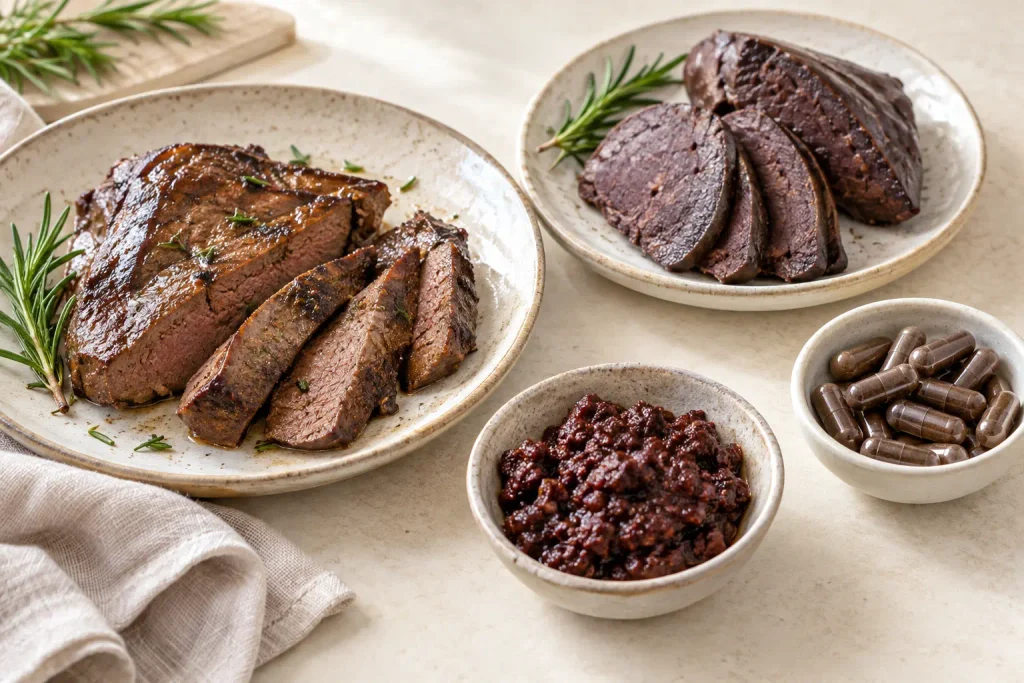
Whole-food iron lets you choose the animal tissue itself rather than reducing every organ to an iron number.
And different organs tell different nutritional stories.
Take the spleen. One of its major jobs is helping clear aging red blood cells so their iron can be recovered.
In a healthy adult, roughly 20 to 25 mg of iron is recycled from old red blood cells each day, while only about 1 to 2 mg normally enters from the diet.
Most of the iron used to build tomorrow’s red blood cells is therefore iron your body already owned yesterday.
That gives spleen’s reputation as an iron-rich organ some biological context.
Liver has a different nutrient profile. Muscle has another. That is one of the ideas behind nose-to-tail eating.
Organs are nutritionally different because they were doing different jobs inside the animal.
Heart & Soil suggests around 1 to 3 ounces of organs per day, with about 0.5 to 1 ounce coming from liver.
Fresh organs, freeze-dried organs, or a combination can all make that practical.
Why Conventional Iron May Be the Better Choice
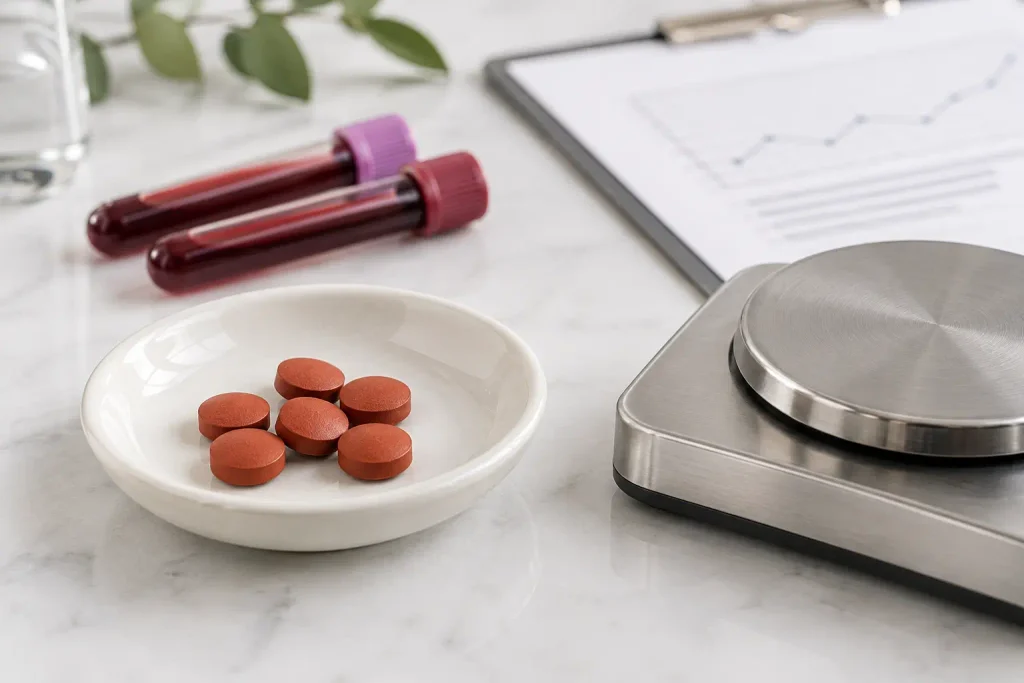
A standardized iron supplement makes sense when bloodwork shows a deficiency that requires a specific therapeutic dose.
This is a different job from using iron-rich foods or organs as part of everyday nutrition.
The American Gastroenterological Association’s 2024 guidance recommends oral iron for iron-deficiency anemia and notes that no single oral formulation has demonstrated a clear overall advantage.
It also recommends dosing no more than once daily, with every-other-day dosing potentially better tolerated for some people.
The value here is precision.
A clinician knows how much elemental iron you are taking, can follow hemoglobin and ferritin, and can change the plan if those markers do not respond. If oral iron is poorly tolerated or unlikely to be absorbed adequately, the AGA recommends considering intravenous iron.
Once iron deficiency becomes a clinical problem, guessing is the least natural thing you can do. Measure it, find the cause, and use the amount the situation actually calls for.
Is Natural Iron Better Absorbed?
Animal-derived iron can be better absorbed when it comes as heme iron, but the word “natural” by itself tells you almost nothing about absorption.
“Natural” is a marketing category. Heme and non-heme are biological categories.
A liver, spleen, or blood-based product can provide heme iron. A plant-derived product can also call itself natural while still supplying non-heme iron.
So flip the bottle around.
Ask three things.
- Where does the iron come from?
- Is it heme or non-heme?
- How much iron does the serving actually provide?
NIH classifies dietary iron as heme and non-heme. Heme iron occurs in animal foods such as meat and seafood, while non-heme iron is found in plant foods, fortified foods, and many supplements.
The front label can call it natural. The source tells you what kind of iron you are actually getting.
That avoids repeating absorption percentages, dose mechanics, or the “your body cares about chemistry” argument you’ve already made elsewhere.
Are Food-Based Iron Supplements More Effective?
They can be effective when the goal is to add more iron-rich animal foods to your routine. Treating iron-deficiency anemia is a different question.
“Effective” only means something if you define the finish line.
Are you trying to eat more liver or spleen? Maintain healthy iron intake? Raise ferritin? Correct anemia?
Those aren’t interchangeable goals.
Whole-food organ supplements are strongest at the first two. They make iron-rich animal tissues easier to use consistently, especially when fresh organs aren’t regularly on the plate.
When bloodwork shows iron-deficiency anemia, treatment is usually judged by measurable changes in hemoglobin, ferritin, and other iron markers. AGA guidance on iron-deficiency anemia is built around oral or intravenous iron for that reason.
So the useful question is not whether food-based iron is “better.”
Better for what?
For bringing liver and spleen back into the diet, whole-food supplements make a lot of sense.
For correcting a measured deficiency, the outcome needs to be measured too.
Whole-Food Iron vs Ferrous Sulfate
| Whole-Food Iron | Ferrous Sulfate | |
| Strengths | Heme-iron tissues, natural cofactors, may be better tolerated | Standardized dose, affordable, strong treatment history |
| Weaknesses | Elemental iron often undisclosed, may be too low-dose for treatment | Constipation, nausea, and adherence struggles for some |
Ferrous sulfate tends to win on predictable, therapeutic dosing. A natural iron supplement, on the other hand, tends to win on broader nutritional support for readers who prefer organ-based sourcing.
Whole-Food Iron vs Iron Bisglycinate
Iron bisglycinate is a chelated, non-heme compound with a standardized dose. Some people tolerate it better than ferrous salts, and it’s often marketed as gentle.
A whole-food option may contain heme iron and organ-derived nutrients instead. It may not disclose the elemental dose, though, and isn’t automatically effective for treating deficiency.
Bisglycinate offers dose precision with better tolerability. Whole-food iron offers a heme-containing nutrient matrix instead. Neither one makes the other obsolete.
Is Synthetic Iron Bad for You?
No. Conventional iron can cause side effects, especially at high doses, but that’s not because it was manufactured.
Problems usually trace back to excessive dose, unabsorbed iron, medication interactions, or inappropriate use, not the compound’s origin. The same is true in reverse: too much whole-food or organ-based iron can be inappropriate for someone with an iron-loading disorder.
Natural products can be unsuitable. Manufactured products can be medically useful. The dose and the context are the grown-ups in the room.
Meet Heart & Soil’s Organ-Based Iron Options
If iron is the main focus, Lifeblood is the most targeted option. Beef Organs brings broader nose-to-tail variety, while Pure American Liver keeps things centered on one exceptionally nutrient-dense organ.
The difference comes down to the tissues inside each bottle.
Lifeblood
Lifeblood combines whole blood extract, spleen, and liver from grass-fed, grass-finished cattle.
That combination is deliberate.
Blood carries iron. Spleen helps recycle old red blood cells and is naturally rich in heme iron. Liver brings iron alongside copper, B12, folate, riboflavin, and other nutrients involved in normal red blood cell biology.
If your interest is specifically iron, blood, and oxygen-carrying capacity, Lifeblood is the most focused formula in the lineup.
Beef Organs
Beef Organs takes the wider nose-to-tail route.
It combines liver, heart, pancreas, spleen, and kidney, giving you five different tissues with five different nutritional profiles.
Liver and spleen make it relevant to iron, but iron is only part of the story here.
Choose Beef Organs when you want more of the animal, not just more of one nutrient.
Pure American Liver
Pure American Liver keeps the formula as simple as it gets.
Liver only.
That means naturally occurring heme iron alongside vitamin A, B12, folate, riboflavin, vitamin B6, copper, and the rest of liver’s nutrient profile.
For someone who wants to make liver a more regular part of the diet without cooking it every day, this is the most direct option.
Pure American Liver goes deeper on liver. Beef Organs goes broader across the animal. Lifeblood goes deeper on blood-building tissues.
| Product | Animal tissues | Best fit |
| Lifeblood | Whole blood extract, spleen, liver | Focused iron and blood-related nutrition |
| Beef Organs | Liver, heart, pancreas, spleen, kidney | Broad nose-to-tail nutrition |
| Pure American Liver | Liver | Focused liver-derived nutrition |
These formulas can also be used together. Overlap is part of the design when you intentionally want more of a particular organ or tissue.
The one place to slow down is when a clinician has already prescribed a specific iron dose. That is when total iron intake becomes something worth tracking rather than guessing.
The question is not which bottle is best. It is which part of the animal you want more of.
Does Whole-Food Iron Cause Less Constipation?
It may cause fewer symptoms for some people, though that hasn’t been established for every whole-food product. Lower isolated elemental-iron exposure could explain some of the difference.
A lower side-effect risk may simply reflect a lower iron dose, not a superior formula. A gentler product may not be strong enough to treat a real deficiency. No iron supplement can guarantee zero constipation.
Can Whole-Food Iron Raise Ferritin?
It may contribute to overall iron intake. Whether it actually raises ferritin depends on the dose, your absorption, starting ferritin, ongoing blood loss, inflammation, and menstrual bleeding.
Don’t expect a ferritin improvement without product-specific evidence and a disclosed iron dose. Customer reports aren’t proof of expected results, no matter how convincing they sound.
When Each Approach Makes Sense
A whole-food, natural iron supplement tends to fit best when you:
- Want general dietary iron support, not deficiency treatment
- Don’t regularly eat organ meat
- Prefer animal-based, whole-food products
- Understand the elemental dose may be low or undisclosed
- Have already talked to a healthcare professional about it
Conventional iron tends to fit best when:
- Deficiency is laboratory-confirmed
- Ferritin or hemoglobin is significantly low
- Pregnancy has increased your iron requirement
- Blood loss is ongoing
- A known elemental dose and follow-up testing matter
Neither list replaces individualized medical guidance for your specific situation.
Can Food Alone Correct Iron Deficiency?
Sometimes. If low iron is mainly coming from inadequate intake, iron-rich animal foods can help rebuild iron status over time. If you are losing iron faster than you can replace it, food may not be enough.
That second situation is the one people miss.
Beef, lamb, liver, spleen, shellfish, sardines, poultry, and blood-based foods all provide highly bioavailable heme iron.
Our beef liver for iron guide goes deeper on the best food sources, while our organ meat benefits guide explains what those tissues bring beyond iron alone.
Within an Animal-Based diet, fruit can bring vitamin C alongside those meals and help support non-heme iron absorption from the rest of the diet.
But iron status is a balance between what comes in and what goes out.
Heavy menstrual bleeding, gastrointestinal blood loss, pregnancy, poor absorption, repeated blood donation, and other causes can push demand beyond what food alone can reasonably replace. That’s when bloodwork and a known therapeutic dose become useful.
You cannot out-eat an iron leak. Find the leak, then decide how aggressively the iron needs to be replaced.
What to Look for in a Natural Iron Supplement
A few things worth checking before you buy:
- Clearly identified source: spleen, liver, whole blood extract, heme iron, plant concentrate, or an added iron compound.
- Elemental-iron disclosure: a therapeutic product should state how much iron it provides. Treat anything vaguer as general nutritional support.
- Transparent serving size: milligrams per capsule, capsules per serving, and servings per bottle.
- Supporting nutrients: vitamin B12, folate, riboflavin, vitamin B6, copper, and vitamin C can help. More isn’t automatically better once you factor in overlap and excess.
- Third-party testing: identity, purity, heavy metals, microbial safety, and label accuracy.
- Realistic claims: be skeptical of anything promising instant absorption, guaranteed ferritin increases, anemia reversal, or zero constipation.
Who Should Not Take Iron Without Medical Guidance?
Some situations call for a clinician before trying any natural iron supplement or conventional one:
- People with hemochromatosis or another iron-loading disorder
- Men or postmenopausal women without confirmed deficiency
- Pregnant or breastfeeding people, and children
- People with gastrointestinal bleeding or liver disease
- People with unexplained or recurring anemia
- People taking medications that interact with iron
A whole-food origin doesn’t remove the risk of taking iron inappropriately.
Iron Safety Around Children
Iron overdose can be fatal in young children, whether it comes from a conventional tablet or a whole-food organ product. Store every iron-containing product securely and out of reach.
Common Myths About Natural and Synthetic Iron
| Myth | Reality |
| The body rejects synthetic iron | The body absorbs conventional iron compounds; effectiveness depends on form, dose, and the individual |
| Natural iron is always better absorbed | Heme iron absorbs well, but some “natural” products contain non-heme iron or very little iron at all |
| Whole-food iron can’t cause side effects | It can still cause digestive symptoms, interactions, or excess intake |
| Synthetic iron is toxic | Appropriately used conventional iron treats deficiency effectively; excess from any source can be harmful |
| Food-based iron always corrects anemia | Significant iron-deficiency anemia may need a standardized oral or intravenous treatment |
| More cofactors always mean better results | Extra vitamins and minerals help only when present in suitable, appropriate amounts |
The Better Question Is Why You Need More Iron
Most iron conversations start with the product. Start with the reason.
If your iron is low because intake is poor, iron-rich animal foods may solve a very different problem than low iron caused by blood loss, pregnancy, malabsorption, or disease.
The smartest iron choice starts upstream.
Figure out why your iron is low. Then choose the food, organ supplement, or clinical dose that actually matches the job.
Still deciding what fits? Talk with Heart & Soil’s Health Success Team.
Frequently Asked Questions
Is natural iron better than synthetic iron?
Animal-derived heme iron has a real advantage for everyday nutrition because it is generally absorbed more efficiently than non-heme iron. “Natural” alone is not enough, though. Look at where the iron comes from, whether it is heme or non-heme, and how the product fits the job you are trying to accomplish.
Does the body recognize natural iron better?
The body handles different forms of iron differently. Heme iron from animal tissue has its own absorption pathway and is generally absorbed more efficiently than non-heme iron. That is the biological advantage worth paying attention to rather than whether a manufacturer simply puts the word “natural” on the bottle.
What is the most bioavailable form of iron?
Heme iron from animal foods is generally the most bioavailable dietary form. It is found in meat, liver, spleen, blood, poultry, and seafood and is less affected by other foods in the meal than non-heme iron.
What is a whole-food iron supplement?
A whole-food iron supplement uses naturally iron-rich foods or animal tissues such as liver, spleen, or whole blood extract. Instead of starting with an isolated iron salt, it starts with the tissue itself and brings along the naturally occurring nutrients found within that food.
Are food-based iron supplements more effective?
They can be very effective for consistently adding iron-rich animal tissues to your diet. The right measure of success depends on the goal. Maintaining healthy iron intake, supporting iron stores, and treating diagnosed iron-deficiency anemia are different jobs and should not all be judged by the same standard.
Is synthetic iron bad for you?
Isolated iron is not inherently bad. Its main advantage is that it can deliver a precise amount when a measured deficiency calls for one. Higher-dose iron can also be harder on the gut, so form, amount, timing, and individual tolerance all deserve attention.
Is heme iron natural?
Yes. Heme iron occurs naturally in hemoglobin and myoglobin in animal tissues. Beef, liver, spleen, blood, poultry, seafood, and other animal foods provide it. It is generally absorbed more efficiently than non-heme iron and is less affected by other compounds in the meal.
Is iron bisglycinate natural or synthetic?
Iron bisglycinate is a manufactured chelated form of iron bound to glycine. It is not a whole-food source of iron. Its value is precision and often good gastrointestinal tolerance, which can make it useful when someone needs a standardized iron dose.
Does whole-food iron cause less constipation?
Some people may find whole-food organ products easier on the gut, but tolerance depends heavily on how much iron the product actually delivers. Constipation is especially common with larger doses of isolated oral iron, so comparing products only by the words “whole food” or “natural” can be misleading.
Can natural iron raise ferritin?
Yes, absorbed iron from food contributes to the body’s iron stores and can influence ferritin over time. The response depends on intake, absorption, current iron status, menstrual or gastrointestinal blood loss, inflammation, and other factors. Persistently low ferritin deserves a look at the reason it keeps staying low.
Can a liver supplement help with low iron?
Liver naturally provides heme iron alongside B12, folate, copper, riboflavin, and other nutrients involved in normal red blood cell biology. It can be a useful way to bring more iron-rich animal food into the diet. How aggressively low iron needs to be corrected depends on the cause and bloodwork.
What is Heart & Soil Lifeblood?
Lifeblood combines whole blood extract, spleen, and liver from grass-fed, grass-finished cattle. It is Heart & Soil’s most focused formula for people interested in healthy iron stores, normal red blood cell formation, oxygen use, stamina, and blood-related nutrition.
Is Lifeblood a heme-iron supplement?
Lifeblood contains whole blood, spleen, and liver, animal tissues that naturally contain heme iron. Heart & Soil formulates it as a whole-food organ product rather than an isolated heme-iron compound, so the focus stays on the tissues and their naturally occurring nutritional profile.
How much elemental iron is in Lifeblood?
Lifeblood is built around whole blood, spleen, and liver rather than a standardized isolated iron dose measured like a conventional iron tablet. If you need a specific therapeutic amount of elemental iron, that dose should be determined and monitored separately rather than estimated from an organ formula.
Does Lifeblood support low ferritin?
Lifeblood is designed to support healthy iron stores through naturally iron-rich blood, spleen, and liver. Low ferritin can have several causes, including low intake, blood loss, increased demand, or poor absorption, so recurring low results deserve more than simply adding another source of iron.
Who should be careful with iron supplements?
People with hemochromatosis or another iron-overload disorder should be especially cautious with additional iron. Pregnancy, recurrent anemia, unexplained low ferritin, gastrointestinal bleeding, and clinician-directed iron therapy also deserve individualized guidance so total intake matches the actual need rather than guesswork.
Subscribe to future articles like this:
