

The organs have largely disappeared from the plate. Somewhere along the way, eating the whole animal was reduced to eating a handful of familiar cuts.
Beef organ supplements make that lost variety easier to bring back.
Heart & Soil Beef Organs combines freeze-dried organs in one formula. This gives people a practical way to eat more of the animal without keeping different organs in the fridge.
But the animal was never nutritionally uniform. Liver, heart, kidney, spleen, and pancreas are different tissues with different functions, so they bring different things to the table.
With this in mind, let’s break down the benefits of beef organ supplements and how they fit into a nose-to-tail approach.
Table of Contents
What Is a Beef Organ Supplement?
A beef organ supplement is made from real bovine organs that are freeze-dried or desiccated and turned into capsules or powder. Some formulas use one organ, while others combine several to bring more nose-to-tail variety into one serving.
Our founder, Dr. Paul Saladino prefers fresh organs. But he also recognizes that many people won’t eat them or struggle to get them. That gap is one of the reasons Heart & Soil exists.

A good organ supplement should be easy to understand:
- Clearly named organs
- Transparent sourcing
- Simple ingredients
- Sensible serving information
- Real quality testing
Most importantly, those organs must go from fresh tissue to a shelf-stable capsule without unnecessary processing.
This is why freeze-drying is key. The process starts by freezing the organs, then removing the ice as vapor under vacuum. Unlike conventional hot-air drying, this approach helps preserve more of the tissue’s original structure, proteins, nutrients, and some bioactive compounds.
What Does Nose-to-Tail Nutrition Mean?
Nose-to-tail nutrition means eating across more of the animal, including muscle meat, organs, connective tissue, marrow, and other edible parts. It broadens the diet beyond the familiar cuts.
Dr. Paul Saladino takes that idea a step further. He talks about nutrients in relationships, rather than as isolated numbers on a label.

Muscle meat, for example, is relatively rich in methionine. Connective tissue brings considerably more glycine. Muscle meat is a strong source of zinc, while liver is unusually rich in copper. So a diet built around choice cuts alone misses part of the nutritional picture.
This is where nose-to-tail nutrition becomes more useful than another checklist of vitamins and minerals.
A well-constructed animal-based diet is intentional, yet also surprisingly simple once you stop trying to engineer every nutrient separately. Eating a greater variety of animal tissues puts many of those relationships back into the food itself.
What Are the Main Benefits of Beef Organ Supplements?
| Where these nutrients are used | Relevant nutrients | Role in the body |
| Energy metabolism and blood formation | B12, riboflavin, B6, biotin, copper, iron, iodine | Help release energy from food and contribute to red blood cell production and thyroid function |
| Immune function | Vitamin A, B6, B12, iron, copper, zinc, selenium | Participate in immune-cell development, antioxidant defenses, and normal immune responses |
| Exercise physiology | Iron, B12, riboflavin, copper, selenium, amino acids | Contribute to oxygen transport, red blood cell formation, muscle function, and energy metabolism |
| Cellular metabolism | B vitamins, copper, iodine, iron, selenium, CoQ10 | Serve as cofactors or components of pathways involved in cellular energy production and enzyme activity |
Nutrient gaps are hardly rare. A 2024 Lancet Global Health analysis covering 185 countries estimated inadequate intake in 68% of the global population for iodine, 65% for iron, 55% for riboflavin, 51% for vitamin B6, 48% for vitamin A, 46% for zinc, 39% for B12, and 38% for selenium.
The takeaway is that micronutrient adequacy needs a better solution, even in modern diets. Organs happen to concentrate many of the nutrients people commonly fall short on.
Can Beef Organs Support Energy, Immune Function, and Workout Recovery?
Yes, when they improve nutrient adequacy. Beef organs supply nutrients involved in energy metabolism, oxygen transport, immune function, and the physiology that supports exercise and recovery.
Iron is a good example. Your body needs it to make hemoglobin and myoglobin, which carry oxygen through the blood and into muscle.
In a recent meta-analysis of 17,519 collegiate athletes across 62 sports, about 23% had absolute iron deficiency (ferritin concentration below 20 mcg/L). That’s a meaningful number in a population asking a lot from their bodies.
Then look at liver. You’re getting B12 for red blood cell formation, preformed vitamin A for normal immune function, along with iron, copper, riboflavin, and other nutrients working in the same food.
More only helps when there’s something to add. For instance, NIH data show that extra B12 doesn’t improve energy or endurance in people who already get enough.
That’s why we keep coming back to the nutritional foundation: figure out what your diet actually provides, then build from there.
Our two cents is that organs are an obvious place to start when there are gaps that need filling.
The Nose-to-Tail Breakdown: What Each Organ Provides
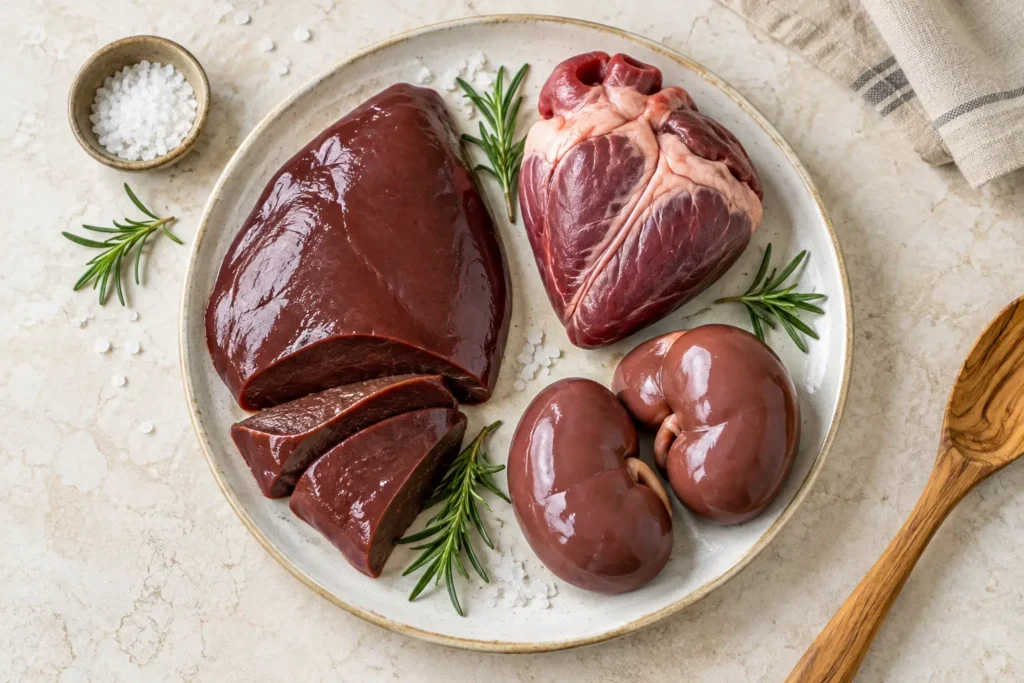
Liver is especially rich in vitamin A, B12, copper, and iron. Heart stands out for CoQ10, spleen for heme iron, and kidney for riboflavin, B12, and selenium. Pancreas adds another distinct mix of proteins, minerals, and organ-specific compounds, giving a multi-organ formula a broader profile than liver alone.
Liver: Vitamin A, B Vitamins, Copper, and Iron
Liver earns its reputation.
It’s exceptionally concentrated in preformed vitamin A, B12, riboflavin, copper, folate, and heme iron. A 2024 U.S. analysis of beef offal found liver qualified as an excellent source of several of these nutrients.
Look at the biology and the profile makes sense. The liver spends its life processing, storing, and managing nutrients. When you eat liver, you’re eating that nutrient-rich tissue.
Heart: CoQ10, B Vitamins, Taurine, and Carnitine
The heart tells a different story.
In one direct analysis of beef tissues, heart contained about 110 μg of CoQ10 per gram, compared with 33 μg/g in liver and 23 μg/g in loin muscle.
The heart is working every second of the animal’s life and has enormous energy demands. Its high concentration of CoQ10 fits the metabolic job that tissue performs.
Spleen: Heme Iron, B12, and Selenium
And spleen may be one of the most overlooked.
A direct bovine analysis measured 31.2 mg of iron per 100 g of spleen, compared with 6.0 mg in liver and 3.2 mg in heart. About 73% of the spleen’s iron was heme iron in that study.
The study was small, so those numbers shouldn’t be treated as universal values, but the difference between tissues was striking.
Kidney: Riboflavin, Selenium, B12, and Other Micronutrients
Beef kidney is especially rich in selenium and riboflavin, while also providing complete protein, B12, iron, copper, phosphorus, and zinc.
That variety is one of the strongest arguments for eating more than one type of organ instead of relying on liver alone.
Pancreas: Enzymes, B Vitamins, and Selenium
Pancreas stands apart because much of the organ is built around digestion.
About 90% of pancreatic tissue is exocrine tissue, which produces amylase to break down carbohydrates, lipase to break down fats, and proteases to break down proteins.
Heart & Soil takes an ancestral “like supports like” view here. Desiccated pancreas naturally contains pancreatic peptides, enzymes, and cofactors as part of the original tissue, which is why pancreas earns a place alongside liver, heart, kidney, and spleen in Beef Organs.
What Nutrients Are in a Beef Organ Complex?
| Nutrient | Common organ sources | Normal physiological role |
| Vitamin A | Liver | Vision, immune function, skin and cellular growth |
| Vitamin B12 | Liver, kidney, spleen | Red blood cells, nervous system, DNA synthesis |
| Riboflavin | Liver, kidney | Energy metabolism, antioxidant systems |
| Vitamin B6 | Liver and other organs | Amino-acid metabolism, nervous-system function |
| Folate | Liver | DNA synthesis, red blood cell formation |
| Heme iron | Spleen, liver, kidney | Hemoglobin production, oxygen transport |
| Copper | Liver | Iron metabolism, connective tissue, nervous-system function |
| Selenium | Kidney, pancreas, spleen | Antioxidant systems, thyroid-related processes |
| Iodine | Varies by organ and source | Thyroid hormone production |
| CoQ10 | Heart | Cellular energy production, antioxidant activity |
| Choline | Liver | Cell membranes, acetylcholine production, lipid metabolism |
| Taurine | Heart and other tissues | Nervous-system and muscle function |
| Carnitine | Heart and muscle tissue | Fatty-acid transport, cellular energy metabolism |
Exact quantities depend on organ ratios, the animal’s diet, serving size, processing, and batch variation. Not every beef organ complex contains a clinically meaningful amount of everything on this list.
For baseline nutrient values in fresh beef liver, kidney, heart, or spleen, USDA FoodData Central is a useful reference, though fresh-food values don’t translate directly into exact amounts in a finished supplement.
Heart & Soil Beef Organs
Beef Organs brings five organs together in one formula. Liver, heart, pancreas, spleen, and kidney are sourced from grass-fed, grass-finished cattle, then freeze-dried and packed into capsules. Each bottle contains 180 capsules, with six capsules per full serving.
The ingredient list stays simple.
The formula is freeze-dried and made without preservatives, added hormones, pesticides, or GMOs. It’s also Informed Sport Certified, with every batch screened for more than 200 prohibited substances.
You shouldn’t need to take a brand’s word for quality. Sourcing, ingredients, processing, and testing should all be easy to see. That fits Heart & Soil’s wider approach of giving people clarity and enough information to make their own call.
Do Beef Organ Supplements Actually Work?
Yes, in the sense that they can change what your diet consistently provides. Whether you notice a meaningful difference depends heavily on what you were eating beforehand.
Paul Saladino talks a lot about separating signal from noise. That applies here.
If your diet already covers your nutritional bases, adding an organ supplement may feel completely uneventful. If your diet has been narrow for years, changing the foods you regularly consume can have a much bigger effect.
That also makes “How do I feel after a week?” a pretty poor test.
Some nutrients influence things you can feel. Others are doing quieter work in red blood cell production, enzyme systems, immune function, or normal cellular metabolism. And if you are trying to correct something measurable such as low iron or B12, the useful feedback comes from bloodwork over time rather than waiting for a dramatic sensation.
Our broader philosophy is useful here too. A good diet is intentional without becoming unnecessarily complicated. An organ supplement fits when it helps you build a better diet and then get on with your life.
Are Beef Organ Supplements Worth It?
That depends less on how impressive the supplement sounds and more on what it actually changes in your diet.
If taking Beef Organs means you regularly consume foods that otherwise never make it onto your plate, there is a clear nutritional purpose behind it. If your diet already includes those foods frequently, the case is naturally smaller.
A useful supplement should solve a real problem in the diet. Otherwise, it is just another bottle on the shelf.
How Long Do Beef Organ Supplements Take to Work?
There is no established clinical timeline for beef organ supplements. When adding organs corrects a genuine nutrient gap, measurable changes are more likely to unfold over weeks or months.
Iron gives us one of the clearest examples. In people being treated for iron-deficiency anemia, changes in new red blood cells can appear within days, and a rise in hemoglobin of about 1 g/dL within two weeks is considered a strong response to oral iron therapy. Rebuilding depleted iron stores can take several months.
That gives us a more useful way to judge an organ supplement.
A rush of energy on day three tells you very little. If you are using organs to broaden a diet that has been missing them, consistency over time is the relevant test. If you are correcting a known deficiency, bloodwork gives you a much clearer answer than waiting to “feel” something.
Nutrition usually leaves fingerprints in physiology before it puts on a show.
Beef Organ Supplements vs Eating Fresh Organ Meat
| Feature | Fresh organ meat | Beef organ supplement |
| Form | Whole cooked food | Freeze-dried capsules or powder |
| Protein and calories | Meaningful amounts | Usually small amounts per serving |
| Nutrient concentration | Depends on portion and cooking | Concentrated, but serving is typically smaller |
| Taste | Strong for some people | Little or no organ taste |
| Convenience | Requires sourcing and preparation | Easy to store and take |
| Culinary value | Can form part of a meal | Doesn’t replace a meal |
| Processing | Cooking may affect some nutrients | Freeze-drying may preserve some heat-sensitive components better |
Beef Organ Supplements vs Multivitamins
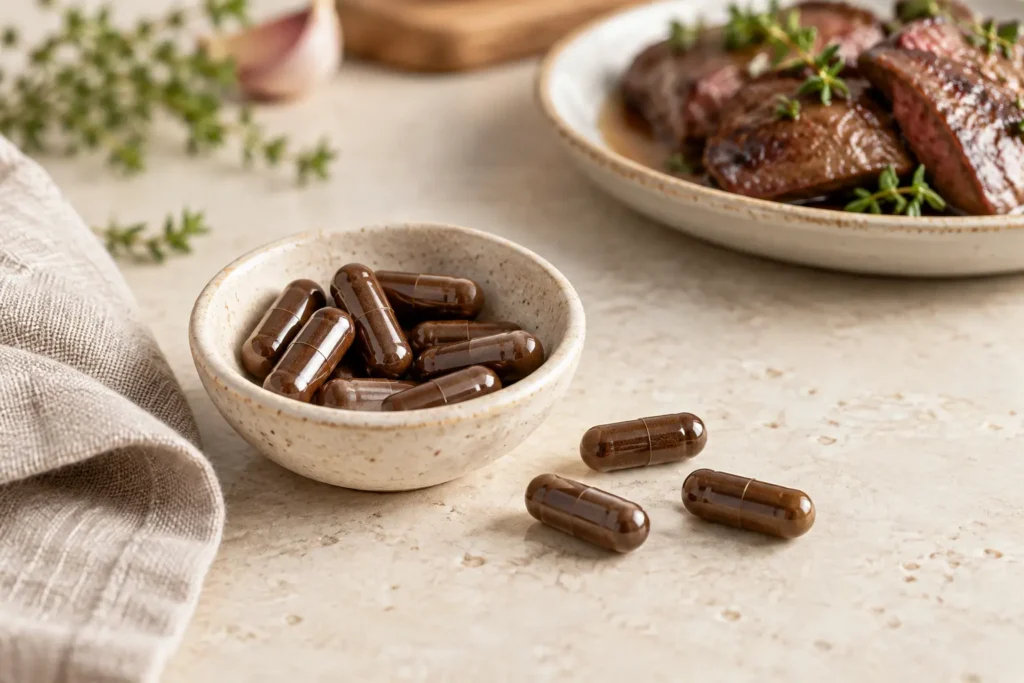
A multivitamin builds a nutrient profile by selecting individual vitamins and minerals in predetermined amounts. A beef organ supplement starts with the organ tissue itself, so the nutrients remain part of the food they naturally occur in.
We identify vitamin A, B12, copper, riboflavin, iron, and dozens of other compounds, then try to assemble nutrition again one ingredient at a time.
But why should food be the second place we look?
Beef liver already contains thousands of compounds alongside the familiar vitamins and minerals printed on nutrition labels. Heart, kidney, spleen, and other tissues have their own biochemical makeup. A supplement made from those tissues carries more of that original food matrix than a formula assembled from a list of isolated nutrients.
That doesn’t make individual vitamins useless. Paul himself has used targeted B vitamins for a specific reason. There are situations where knowing the nutrient and controlling the dose is exactly what you want.
The Heart & Soil approach starts one step earlier. Before building nutrition ingredient by ingredient, look at what real food can provide.
Who Should Speak With a Healthcare Professional First?
If you have a condition that changes how your body handles iron, copper, vitamin A, or uric acid, talk with your healthcare professional before adding a concentrated organ supplement. The same applies when you are already taking supplements or medications that affect those nutrients.
Nutrition is more about finding balance rather than assuming more is always better. Nutrient-dense foods still exist inside a larger diet, and what you already eat or supplement counts.
A few situations deserve more attention.
- Hemochromatosis or another iron-storage disorder. NIDDK specifically advises people with hemochromatosis to avoid iron-containing supplements unless directed otherwise and to discuss supplements with their doctor.
- Wilson disease. This condition prevents the body from clearing copper normally. NIDDK specifically lists liver among the high-copper foods that doctors may recommend limiting during treatment.
- Pregnancy or trying to conceive. Liver contains preformed vitamin A. NIH sets the adult pregnancy upper limit at 3,000 mcg RAE per day for ages 19 to 50 because excessive preformed vitamin A can harm fetal development.
- Gout or high uric acid. Organ meats are particularly high in purines and can contribute to gout flares in susceptible people.
- A crowded supplement stack. Liver capsules, cod liver oil, multivitamins, iron, copper, and other organ formulas can start covering the same nutritional ground.
Can You Take Too Much Beef Organ Supplement?
Yes. The easiest way to overdo an organ supplement is to stack it with several other concentrated sources of the same nutrients.
Fresh liver, liver capsules, cod liver oil, a multivitamin, and separate vitamin A, iron, or copper can all start covering the same ground. Look at the whole diet before adding another concentrated source.
Sourcing deserves the same attention. Liver is a highly active tissue, and a concentrated organ product should come from animals you trust and be tested for contaminants.Heart & Soil’s review of liver safety discusses concerns including heavy metals, pesticide residues, pharmaceuticals, bacteria, and mycotoxins.
You do not need huge amounts of liver. You need good liver, in a sensible amount, from a source you trust.
How to Choose a High-Quality Beef Organ Supplement
A beef organ supplement should make it easy to see exactly what you are getting.
Because theFDA does not approve dietary supplements for safety and effectiveness before they are sold, the quality of the product comes down to sourcing, processing, labeling, and testing.
What to Look For
- Clearly listed organs. You should be able to see which organs are included and how much you get per serving.
- Transparent sourcing. Look for clear information on where the cattle come from and how they were raised, such as grass-fed and grass-finished sourcing.
- Freeze-drying. This is a practical way to preserve organ tissue without relying on aggressive high-heat processing.
- Simple ingredients. A good organ supplement does not need a long list of fillers, binders, or unnecessary additives.
- Third-party testing. Look for testing that covers contaminants and product quality. For athletes, certification for prohibited substances is an added advantage.
How to Take Heart & Soil Beef Organs
The full serving is six capsules once a day, with or without food. If organs are new to you, Heart & Soil recommends starting with one capsule daily and adding one each week until you reach the full serving.
There is no special window when Beef Organs suddenly works better. Take it at a time you can stick with. Breakfast, lunch, or dinner is fine.
Starting slowly also gives you a chance to see how you respond instead of jumping straight into six capsules on day one. Add something deliberately, give it time, and pay attention to what changes.
Can Beef Organs Be Taken With Other Heart & Soil Products?
Yes. Heart & Soil intentionally combines Beef Organs with other formulas, and some of those combinations contain the same organs more than once. The overlap is deliberate when each product has a different job.
Take the Energy Stack, for example. It combines Beef Organs with Pure American Liver and Firestarter. Beef Organs already contains liver, so adding Pure American Liver gives liver a larger role in a stack built around foundational nutrition and energy. Firestarter contributes beef suet rather than another organ blend.
The Thyroid Health Stack is another good example. Thyroid+ adds thyroid tissue, which is absent from Beef Organs. Gut & Digestion adds stomach and intestinal tissue. There is some overlap in liver, kidney, pancreas, and spleen, but the reason for combining the formulas is the new tissues they bring in, not simply a larger dose of the same five organs.
Her Package makes the distinction even clearer. Beef Organs gives you the broader organ base. Her Package adds ovary, uterus, and fallopian tube. Whole Package moves in a different direction with testicle and whole blood.
That gives you a much better way to think about stacking.
Start with what Beef Organs already contains. Then ask whether the next product brings in a part of the animal you are not already getting.
Final Takeaway
Beef organ supplements are ultimately a practical expression of a bigger idea.
We waste a remarkable amount of the animal today. Liver, heart, kidney, connective tissue, fat, and other edible parts often have little place in the modern diet, even though they represent real food and real nutrition.
Using more of them means getting more from the animal that was already raised to feed us.
That gives nose-to-tail eating a purpose beyond micronutrients. It asks us to be more intentional about the animals we eat and less casual about what we throw away.
Heart & Soil Beef Organs makes five of those tissues easier to use when fresh organs aren’t part of everyday life.
Honor the animal. Use more of what it gives us.
FAQ
What are the benefits of beef organ supplements?
Beef organ supplement benefits come from adding nutrients that are naturally concentrated in organ tissues. These include vitamin A, B vitamins, heme iron, copper, selenium, CoQ10, taurine, and carnitine. They are most useful when fresh organs rarely appear in your regular diet.
Are beef organ supplements good for you?
Beef organ supplements can be useful when they add organ foods and nutrients that your diet does not already provide consistently. They make the strongest case for people who rarely eat liver, heart, spleen, kidney, or other nutrient-dense animal foods.
What nutrients are in a beef organ complex?
A beef organ complex can provide vitamin A, B12, folate, copper, iron, selenium, CoQ10, taurine, and carnitine. Liver is especially rich in vitamin A and B12, heart stands out for CoQ10, spleen for heme iron, and kidney for B vitamins and selenium.
Do beef organ supplements actually work?
Beef organ supplements work by changing what your diet consistently provides. They deliver freeze-dried organ tissue and the nutrients naturally concentrated in those tissues. Their value is highest when they add foods or nutrients that were previously missing or rarely consumed.
Do beef organ supplements increase energy?
Beef organ supplements can support normal energy production when they improve intake of nutrients such as iron, B vitamins, copper, and CoQ10. These nutrients are involved in oxygen transport and energy metabolism. They should not be expected to create a stimulant-like energy boost.
Are beef organ supplements the same as eating organ meat?
Beef organ supplements are concentrated, freeze-dried versions of real organ tissue. They preserve much of the original food matrix, but a capsule serving is much smaller than a full portion of fresh liver, heart, or kidney and provides less total protein and energy.
Are beef organ supplements better than multivitamins?
Beef organ supplements and multivitamins take different approaches to nutrition. Organ supplements provide nutrients as part of real dried tissue, while multivitamins provide selected vitamins and minerals in standardized amounts. Organ supplements fit best when the goal is to bring organ foods and their benefits back into the diet.
How long do beef organ supplements take to work?
Beef organ supplements do not have a clinically established timeline. When they correct a real nutrient gap, measurable changes are more likely to unfold over weeks or months than within hours or days. For a diagnosed deficiency, bloodwork gives a clearer answer than subjective feelings alone.
Can I take beef organ supplements every day?
Beef organ supplements can be taken daily when the product is designed for daily use and the labeled serving is followed. Daily intake should also account for fresh liver, cod liver oil, multivitamins, iron, copper, or other organ supplements that may overlap nutritionally.
Who should not take beef organ supplements?
People with iron-storage disorders, copper-metabolism disorders, gout, or other conditions that affect nutrient handling should speak with a healthcare professional before taking beef organ supplements. Pregnancy also deserves extra attention because liver is naturally high in preformed vitamin A.
What are the benefits of beef organ supplements?
Beef organ supplement benefits come from adding nutrients that are naturally concentrated in organ tissues. These include vitamin A, B vitamins, heme iron, copper, selenium, CoQ10, taurine, and carnitine. They are most useful when fresh organs rarely appear in your regular diet.
Are beef organ supplements good for you?
Beef organ supplements can be useful when they add organ foods and nutrients that your diet does not already provide consistently. They make the strongest case for people who rarely eat liver, heart, spleen, kidney, or other nutrient-dense animal foods.
What nutrients are in a beef organ complex?
A beef organ complex can provide vitamin A, B12, folate, copper, iron, selenium, CoQ10, taurine, and carnitine. Liver is especially rich in vitamin A and B12, heart stands out for CoQ10, spleen for heme iron, and kidney for B vitamins and selenium.
Do beef organ supplements actually work?
Beef organ supplements work by changing what your diet consistently provides. They deliver freeze-dried organ tissue and the nutrients naturally concentrated in those tissues. Their value is highest when they add foods or nutrients that were previously missing or rarely consumed.
Do beef organ supplements increase energy?
Beef organ supplements can support normal energy production when they improve intake of nutrients such as iron, B vitamins, copper, and CoQ10. These nutrients are involved in oxygen transport and energy metabolism. They should not be expected to create a stimulant-like energy boost.
Are beef organ supplements the same as eating organ meat?
Beef organ supplements are concentrated, freeze-dried versions of real organ tissue. They preserve much of the original food matrix, but a capsule serving is much smaller than a full portion of fresh liver, heart, or kidney and provides less total protein and energy.
Are beef organ supplements better than multivitamins?
Beef organ supplements and multivitamins take different approaches to nutrition. Organ supplements provide nutrients as part of real dried tissue, while multivitamins provide selected vitamins and minerals in standardized amounts. Organ supplements fit best when the goal is to bring organ foods and their benefits back into the diet.
How long do beef organ supplements take to work?
Beef organ supplements do not have a clinically established timeline. When they correct a real nutrient gap, measurable changes are more likely to unfold over weeks or months than within hours or days. For a diagnosed deficiency, bloodwork gives a clearer answer than subjective feelings alone.
Can I take beef organ supplements every day?
Beef organ supplements can be taken daily when the product is designed for daily use and the labeled serving is followed. Daily intake should also account for fresh liver, cod liver oil, multivitamins, iron, copper, or other organ supplements that may overlap nutritionally.
Who should not take beef organ supplements?
People with iron-storage disorders, copper-metabolism disorders, gout, or other conditions that affect nutrient handling should speak with a healthcare professional before taking beef organ supplements. Pregnancy also deserves extra attention because liver is naturally high in preformed vitamin A.
What organs are in Heart & Soil Beef Organs?
Heart & Soil Beef Organs contains freeze-dried liver, heart, pancreas, spleen, and kidney from grass-fed, grass-finished cattle. The five-organ formula gives you broader nose-to-tail variety than a liver-only product without requiring you to source, prepare, and cook each organ separately.
How many Heart & Soil Beef Organs capsules should I take?
Heart & Soil Beef Organs has a full serving of six capsules once daily. Heart & Soil recommends starting with one capsule daily if organs are new to you, then gradually increasing toward the full serving. The capsules can be taken with or without food.
Is Heart & Soil Beef Organs third-party tested?
Heart & Soil Beef Organs is third-party tested through Informed Sport. Each batch is screened for more than 200 prohibited substances, and Heart & Soil also conducts quality and contaminant testing to verify the purity and safety of the finished product.
Want more on this? Join the Radical Health Newsletter for more straight-talk nutrition guidance, or reach out to our team if you have questions about which products fit your routine.
Subscribe to future articles like this:
