

The bones, skin and connective tissue left after carving the Thanksgiving turkey can make a deeply savory broth. Simmering them gives you a useful base for soup, gravy and rice, so more of the bird ends up on the table.
Using the whole bird this way is part of the nose-to-tail approach we value at Heart & Soil. The method works on the stove, in a slow cooker or under pressure, so you can choose what fits your kitchen. Or jump straight to the stovetop recipe for the measurements.
Table of Contents
What You Need for Turkey Bone Broth
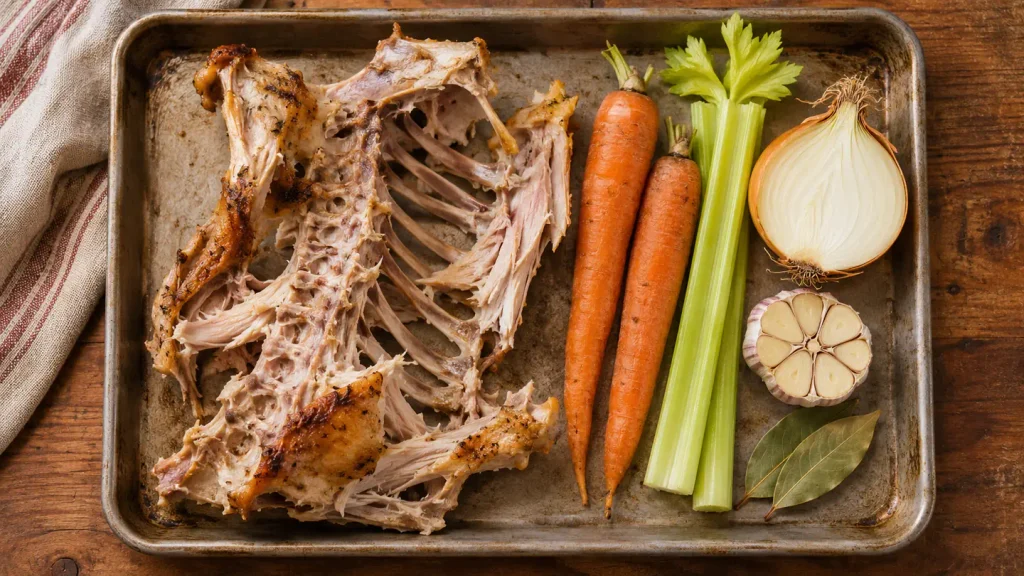
Start with the roasted turkey bones, especially the wing tips and joints, and include any skin you saved. These parts give the broth body as they simmer, while onion, celery and other aromatics round out the flavor.
- Bones and skin from one roasted 12- to 16-pound turkey: Include the back, wing tips and joints, along with the neck if you saved it. Break larger pieces up to fit the pot.
- Saved neck, heart or gizzard, if available: These can join the pot. Leave out the liver because its strong flavor can overwhelm the broth. Our turkey giblets guide explains what each piece is.
- 3 to 4 quarts water, or enough to cover the bones by about an inch in a suitable pot. The exact amount depends on how many bones you have and the size of your pot.
- 1 to 2 tablespoons apple cider vinegar: This is a traditional addition that brings a little acidity, although it isn’t necessary for a successful broth and shouldn’t be treated as a guarantee of mineral extraction.
- Aromatics: one onion, two carrots, two celery stalks, one head of garlic halved across the middle, two bay leaves and a few black peppercorns.
- Salt, added at the end so the broth doesn’t become too salty as it reduces.
How to Make Turkey Bone Broth on the Stovetop
For stovetop broth, keep the liquid at a low simmer for 8 to 12 hours. That gives the bones and connective tissue time to release flavor without reducing the pot too quickly. Add water whenever the bones start to show.

- Load the pot: Break any large bones into pieces that fit your pot. Add the bones, skin, neck and any saved heart or gizzard, then pour in enough water to cover by about an inch. Stir in the apple cider vinegar, if using, and let the mixture sit for 20 to 30 minutes before heating.
- Heat and skim: Bring the liquid up toward a boil, skim away any foam that rises and turn the heat down. You’re looking for a gentle simmer with only a few bubbles at the surface.
- Simmer for 8 to 12 hours: Keep an eye on the level and add hot water as needed to keep the bones submerged. A hard rolling boil can make the liquid cloudy and reduce it too aggressively.
- Add vegetables near the end: Add the onion, carrots, celery, garlic, bay leaves and peppercorns during the last 1 to 2 hours. This keeps the aromatics from becoming dull over a very long simmer.
- Strain and season: Pour the finished broth through a fine-mesh strainer into a heat-safe container, discard the spent solids and add salt to taste.
Turkey Bone Broth in a Slow Cooker
A slow cooker can keep the broth at a gentle heat for 12 to 24 hours without the attention a stockpot needs. Use the same ingredients, but follow your cooker’s fill limit and add only enough water to cover the bones.
- Put the turkey bones, saved neck or giblets, water and optional vinegar into the slow cooker.
- Cover and cook on low for 12 to 24 hours. Use enough water to keep the bones covered without exceeding the cooker’s fill guidance.
- Add the vegetables, garlic, bay leaves and peppercorns for the last 2 hours.
- Strain the broth, season with salt and divide it into shallow containers for prompt chilling.
Turkey Bone Broth in an Instant Pot
An Instant Pot cuts the cooking time to 2 hours at high pressure, plus the time needed for a natural release. Keep the ingredients below the fill line, and break the bones into smaller sections or cook in batches if needed.
- Place the turkey bones, saved giblets, vegetables, garlic, bay leaves and peppercorns in the pot. Add the optional vinegar and enough water to cover where possible, without crossing the manufacturer’s maximum-fill line.
- Lock the lid and set the cooker to high pressure for 2 hours.
- Allow the pressure to release naturally, following your appliance’s safety instructions.
- Carefully strain the broth, season it and transfer it into shallow containers for prompt refrigeration.
How to Tell if Your Turkey Bone Broth Is Good: The Gel Test
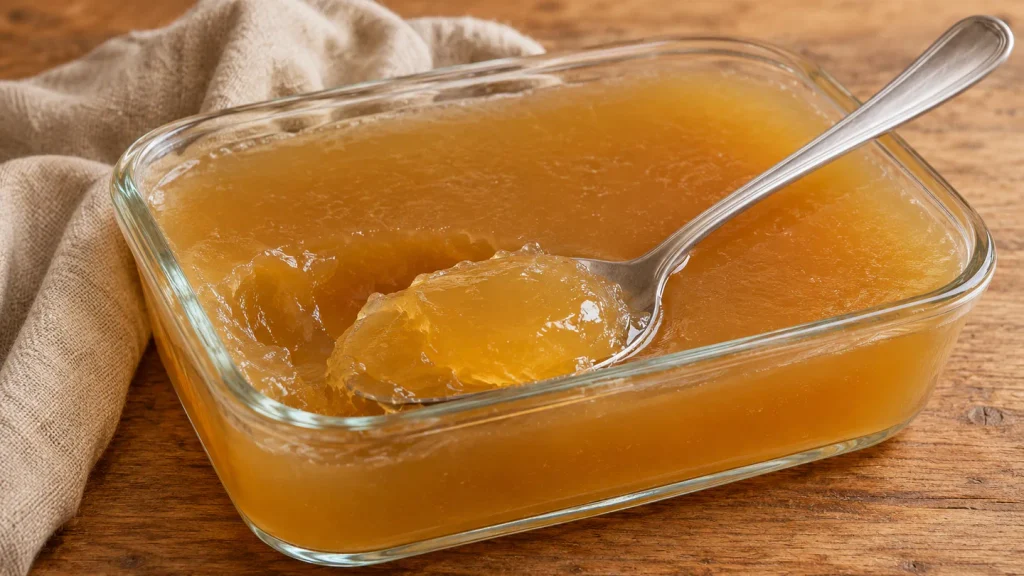
If chilled broth turns to a loose jelly, it contains enough gelatin to set. That happens when collagen from skin and connective tissue breaks down during cooking, and it tells you something about texture rather than an exact protein amount.
Leave a small container in the refrigerator overnight. If the broth sets, it’ll turn back to liquid when warmed.
Don’t worry if it stays liquid. It’ll still flavor soup, gravy or rice. For a thicker gel next time, use less water or add more joints, neck or skin.
How to Cool and Store Turkey Bone Broth Safely
Strained broth needs to be chilled promptly. Leaving a full pot on the stove to cool takes too long, so divide it among shallow containers and refrigerate it without delay.
- Cool promptly: Refrigerate the strained broth within 2 hours of cooking. Shallow containers help it cool more quickly, as advised by USDA FSIS.
- Refrigerate: Use within 3 to 4 days when kept at 40°F or below.
- Freeze: For soups and stews, FoodSafety.gov’s cold-storage chart gives 2 to 3 months as a freezer quality guideline. Broth may remain safe longer when continuously frozen at 0°F, but quality can change.
- Reheat: When reheating refrigerated broth, bring soups and sauces to a rolling boil, following USDA reheating guidance.
Cooling the broth also makes it easy to remove the layer of fat that hardens on top. You can save it for roasting vegetables or making gravy as long as it’s stored safely, and our guide to cooking-fat alternatives has more ways to use it.
Turkey Bone Broth vs. Turkey Stock: Is There a Difference?
There isn’t a strict dividing line between turkey stock and turkey bone broth. Stock often simmers for a few hours as a cooking base, while bone broth usually cooks longer to draw out more gelatin and may be seasoned for sipping.
In practice, both depend on the same things: which bones you use, how much water you add and how long you cook them.
What Is Actually in Turkey Bone Broth?
Homemade bone broth varies from pot to pot. The bones and connective tissue contribute flavor and gelatin, but the final protein and mineral amounts depend on the ingredients, water and cooking time. A broth that gels isn’t automatically a concentrated source of every nutrient in the bones.
Gelatin, Protein and Amino Acids
As connective tissue cooks, some collagen turns into gelatin, which is why a well-set broth feels richer on the spoon. Gelatin includes amino acids such as glycine and proline, although the amount per cup varies with the batch.
You can’t tell exactly how much protein is in your broth from how firmly it gels. For perspective, one USDA FoodData Central entry for homemade chicken stock reports about 6 grams per cup, but that’s a chicken recipe, so it isn’t a number you can assign to a homemade turkey batch.
What Collagen Research Can and Can’t Tell Us
That variability matters when people compare homemade broth with measured collagen products. A 2019 analysis in the International Journal of Sport Nutrition and Exercise Metabolism found that bone-broth amino acid concentrations varied widely and didn’t reliably match the amounts studied in collagen supplement research.
Broth is still worth making for its flavor and the food it helps you cook. Just don’t assume every homemade cup contains a standardized dose of collagen-related amino acids.
What About Minerals?
Having bones in the pot doesn’t automatically make broth a major source of calcium. The amount that reaches the liquid depends on the recipe, and you’d need actual measurements to make a specific mineral claim.
Is There a Downside to Drinking Bone Broth?
Because a long simmer draws substances from bones into the liquid, it’s reasonable to ask what else might come along with the gelatin. A small 2013 report in Medical Hypotheses measured more lead in a handful of chicken bone broth samples than in the water used to prepare them.
However, the report examined only a few chicken-broth samples, so its findings can’t tell us what to expect from homemade turkey broth. A 2017 analysis of commercial bone-broth dishes in Taiwan found lead at a few micrograms per serving, which the authors considered a minimal risk, though neither study measures what’s in your own pot.
For everyday cooking, salt is a more immediate consideration. Commercial broths can have a lot of sodium, while homemade broth lets you season after straining and adjust the flavor to suit the dish.
Turkey Bone Broth vs. Beef Bone Broth
Turkey broth usually has a milder flavor than beef broth, which makes it easy to use for poultry soup and gravy. Beef knuckles and joints can create a deeper-tasting broth and sometimes a firmer gel because of their connective tissue.
That doesn’t make one broth inherently healthier. Choose the flavor you want, or combine bones if you have them.
Ways to Use Leftover Turkey Bone Broth
Once you’ve made a batch, keep what you’ll use in the next few days and freeze the rest. It’s a useful ingredient for several dishes, especially after a holiday meal.
- Drink it warm: Heat a mugful, season it with salt and black pepper, and sip it as a simple savory drink.
- Make leftover turkey soup: Soften chopped onion, carrot and celery in a pot, pour in the broth and bring it to a simmer. Add leftover cooked turkey near the end, along with rice or another ingredient you enjoy, then heat everything thoroughly. It’s a good way to use the final bits of meat.
- Cook rice in it: Replace some or all of the cooking water for a richer, more savory result.
- Build gravy or pan sauce: Use the strained broth where a recipe calls for stock, then reduce it if you want a deeper flavor.
- Freeze small portions: One-cup containers and ice cube trays are useful when you only need a splash to loosen a skillet sauce.
No Time for a Twelve-Hour Pot?
If a long stovetop simmer won’t fit your schedule, the pressure cooker method takes 2 hours at high pressure, followed by a natural release. And if you’re weighing broth against other protein foods, our guides to bone broth and complete protein and bone broth protein versus whey explain the differences.
Making broth is one way to use more of the animal, and you can explore other nose-to-tail ingredients in different formats. Our Bone Matrix uses freeze-dried whole cattle bone, while Animal-Based Protein combines whey, colostrum and cartilage collagen. They’re distinct from homemade turkey broth, which is worth making for the meals it helps you cook.
Turkey Bone Broth From Leftover Turkey Bones
This stovetop method makes about 2 to 3 quarts, depending on how many bones you use and how much liquid cooks off.
Prep: 15 minutesCook: 8 to 12 hoursYield: About 2 to 3 quarts
Ingredients
- Bones, back, wing tips and skin from one roasted 12- to 16-pound turkey
- Turkey neck, heart or gizzard, optional, excluding liver
- 3 to 4 quarts water, enough to cover bones by about 1 inch
- 1 to 2 tablespoons apple cider vinegar, optional
- 1 onion, roughly chopped
- 2 carrots, roughly chopped
- 2 celery stalks, roughly chopped
- 1 head garlic, halved
- 2 bay leaves and a few black peppercorns
- Salt, to taste, added after straining
Instructions
- Place the leftover turkey bones and optional saved neck, heart and gizzard in a large stockpot with the water and optional vinegar. Let stand 20 to 30 minutes.
- Bring toward a boil, skim any foam and reduce to a very gentle simmer.
- Simmer for 8 to 12 hours, adding hot water when necessary to keep the bones covered.
- Add the onion, carrots, celery, garlic, bay and peppercorns during the final 1 to 2 hours.
- Strain, season with salt and divide into shallow containers. Refrigerate within 2 hours.
Slow cooker: Cook bones, water and optional vinegar on low for 12 to 24 hours. Add vegetables for the final 2 hours. Strain and store safely.
Instant Pot: Place all ingredients except salt in the cooker without exceeding the max-fill line. Cook at high pressure for 2 hours, allow a natural release, then strain, season and store safely.
Frequently Asked Questions
How long does turkey bone broth last in the fridge?
Use refrigerated broth within 3 to 4 days. Freeze extra portions for longer storage, following FoodSafety.gov’s quality guidance for soups and stews.
Is turkey bone broth the same as turkey stock?
The names overlap. Bone broth usually refers to a longer simmer, while stock is often made with a shorter cook and less seasoning.
How long should I simmer turkey bones for broth?
Use 8 to 12 hours on the stovetop, 12 to 24 hours on low in a slow cooker, or 2 hours at high pressure in an Instant Pot followed by a natural pressure release.
Why didn’t my turkey broth gel?
It may have contained too much water or too few joints, skin and other collagen-rich parts. A liquid broth can still be delicious and useful.
Is turkey bone broth healthy?
It can be a nourishing part of a meal and a practical way to use bones, skin and leftover meat. Gelatin and protein content vary considerably, so don’t assume every homemade cup provides the same amount.
Turn One Thanksgiving Bird Into More Good Food
The bones you save after Thanksgiving still have a useful place in the kitchen. Simmer them with the neck, wing tips and a few aromatics, and you’ll have broth for soup, pan sauces or cooking rice. Freeze what you won’t use right away, and you’ve got a flavorful ingredient ready for another meal instead of starting from scratch.
It doesn’t matter whether every batch sets into a firm gel. A thicker broth tells you that more gelatin made it into the liquid, while a lighter one can still taste excellent. Homemade broth varies with the bones, water and cooking time, so it’s best appreciated as good food rather than a promise of a particular amount of collagen or protein.
At Heart & Soil, this is why we care about nose-to-tail cooking. Using more of the animal you’ve already prepared is a practical way to respect the food and bring real nourishment into the next meal. And if you saved the heart, gizzard or neck as well, our guide to turkey giblets will help you make use of those parts before the broth pot goes on.
Subscribe to future articles like this:
