

We have been taught to think about nutrition like a checklist.
Get enough boxes ticked on the Supplement Facts panel and you’re supposedly covered.
Heart & Soil sees nutrition differently.
Food doesn’t arrive as a spreadsheet of isolated nutrients. It arrives as a package.
Liver brings vitamin A with copper, B12, riboflavin, folate, heme iron, choline, protein, and the rest of the liver tissue. Dairy brings calcium alongside protein, phosphorus, lactose, and other compounds. Eggs, seafood, meat, and fruit each bring their own combinations.
That is the more useful way to think about a whole-food multivitamin.
Instead of asking which bottle has the longest vitamin list, ask how much real nutrition can come from recognizable foods that already carry those nutrients together?
Table of Contents
What Is a Whole-Food Multivitamin?
A whole-food multivitamin gets its nutrients from actual foods such as liver and other organs rather than building the formula one isolated vitamin at a time.
The whole idea of a multivitamin is nutritional insurance. Take one pill, tick the boxes, and assume your bases are covered.
Heart & Soil would rather put that insurance policy in your fridge.
Food is complex. That’s what makes it so powerful.
When you eat liver, you’re getting vitamin A, B12, riboflavin, folate, copper, heme iron, choline, protein, and a whole matrix of naturally occurring compounds in the same food. The same goes for meat, eggs, dairy, seafood, and fruit. Each brings its own package.
A good whole-food multivitamin takes that logic and makes it more convenient. Turn the bottle around and you should recognize the food.
That is very different from taking a conventional vitamin formula and sprinkling a little food powder into it so “whole food” can go on the front label.
The answer starts in your fridge. A whole-food supplement simply makes some of those foods easier to take with you.
What Is a Regular Multivitamin?
A regular multivitamin combines standardized amounts of selected vitamins and minerals into one daily product.
The promise is convenience. Take one pill and cover your bases.
That idea is powerful because it turns nutrition into something easy to measure. Vitamin A at one percentage. B12 at another. Magnesium, zinc, iron, and the rest lined up on a label.
But the numbers can create a false sense of security.
A multivitamin can tell you exactly how much of a nutrient is in the pill. It cannot tell you whether your diet is actually nourishing you well, whether you need that nutrient in the first place, or whether taking more of it will improve anything.
That is the trap in the “nutritional insurance” idea. A complete-looking label can make an incomplete diet feel covered.
Multivitamins can still be useful when you have a clear reason for taking them. The mistake is treating the bottle like proof that the rest of your nutrition no longer matters.
Best Whole-Food Multivitamin vs. Regular Multivitamin
Whole-food and conventional multivitamins approach the same problem from opposite directions. One starts with food. The other starts with a list of nutrients.
| What you’re comparing | Whole-food multivitamin | Regular multivitamin |
| Starting point | Recognizable foods such as liver and other organs | Individual vitamins and minerals |
| What the formula contains | Food tissue with its naturally occurring nutrient profile | Selected nutrients added in measured amounts |
| What the label emphasizes | The foods and tissues included | Milligrams, micrograms, and Daily Values |
| Nutrient amounts | Follow the natural composition of the ingredients | Usually standardized |
| Main advantage | Several nutrients arrive together in the same food | Precise amounts are easy to see and compare |
| Best use | Adding more nutrient-dense foods to your routine | Delivering defined amounts when precision is useful |
| What to watch | Ingredient quality, serving size, sourcing, and testing | Overlap, unnecessary high doses, and the false comfort of a “complete” label |
The regular multivitamin has a very convincing promise. Take one pill and cover your bases.
The problem is that a complete-looking Supplement Facts panel can make nutrition look more solved than it really is.
Heart & Soil cares about the question behind the numbers. Where did those nutrients come from?
With an organ-based whole-food formula, vitamin A, B12, copper, heme iron, riboflavin, folate, amino acids, and other compounds arrive because the liver, spleen, heart, kidney, or pancreas naturally contains them.
A regular multivitamin works in the other direction. Decide which nutrients belong in the formula, measure them out, and put them together in a pill.
There are times when that precision is exactly what you want.
But 100% Daily Value on a label and a deeply nourishing diet are two very different things.
What Makes a Good Whole-Food Multivitamin?
Ignore the marketing language for a minute and look at what’s actually in the bottle.
A good whole-food multivitamin should make a few things easy to verify:
- Clearly named food ingredients. You should know exactly which foods or organs are included.
- A real serving amount. Look for grams or milligrams of actual food material, not just a vague “proprietary blend.”
- Transparent sourcing. Where did the ingredients come from, and how were the animals raised?
- Clear processing. Freeze-dried, dehydrated, or something else? The brand should tell you.
- Finished-product testing. Look for testing around identity, purity, heavy metals, and microbes.
- Reasonable claims. No single supplement replaces every nutrient or every food group.
- Overlap guidance. Especially for nutrients like vitamin A, iron, and copper, which can add up across products.
Be wary of products that call themselves “food-based” but are mostly isolated vitamins with a little food powder added. The same goes for formulas that hide amounts behind a proprietary matrix or promise to fix deficiencies without testing.
Why Organ Meats Show Up in Whole-Food Multivitamins
This is the idea behind nose-to-tail nourishment. Muscle meat is an excellent source of protein and several key nutrients, but organs bring things to the table that muscle meat doesn’t provide in the same concentrations.
A 2024 review of edible offal found clear nutritional differences between organs and skeletal muscle.
Liver is especially rich in vitamin A, B12, riboflavin, folate, copper, and heme iron. Heart brings CoQ10, riboflavin, and iron. Spleen stands out for heme iron. Kidney contributes B12, riboflavin, and selenium. Pancreas adds its own mix of proteins, peptides, enzymes, and micronutrients.
That variety is the point. Different organs bring different nutrients, which is why a multi-organ formula can offer more nutritional breadth than liver alone.
Why Liver Is the Foundation of Many Whole-Food Multivitamins
Liver earns the nickname “nature’s multivitamin” because few whole foods match its concentration of vitamin A, B12, riboflavin, folate, copper, heme iron, choline, and other naturally occurring nutrients.
Heart & Soil breaks that down further in its guide to beef liver vs a multivitamin.
USDA FoodData Central shows just how concentrated that nutrition can be in a relatively small serving.
Liver is not supposed to do every nutritional job by itself. Its strength is delivering exceptional depth in a select group of nutrients as part of a broader Animal-Based diet that supplies calcium, magnesium, vitamin C, omega-3 fats, and other nutrients from complementary foods.
For a closer look at one of its standout nutrients, see our beef liver for iron guide.
Is a Multi-Organ Formula Better Than Liver Alone?
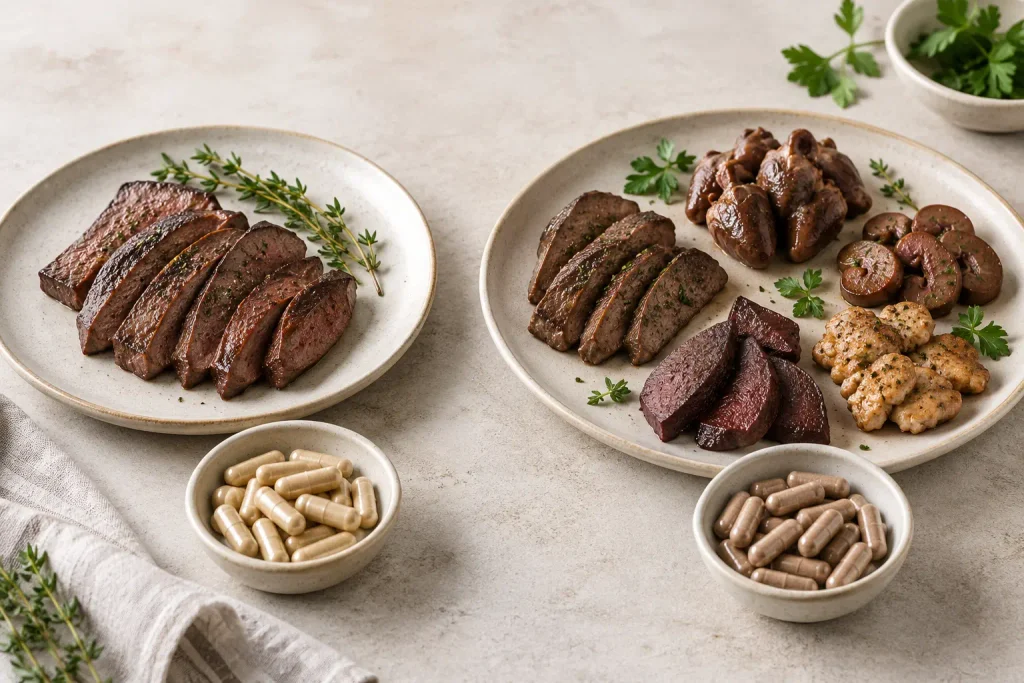
A multi-organ formula makes sense when the goal is broader nose-to-tail nutrition in one product or when fresh organs rarely make it onto the plate.
Liver alone offers focused nutrient density. Adding heart, kidney, spleen, and pancreas brings a wider range of tissues and naturally occurring compounds into the routine.
Neither approach is about finding one product that does everything. Liver provides focus. A multi-organ formula provides greater nose-to-tail variety.
Are Whole-Food Multivitamins More Bioavailable?
Often, whole foods provide nutrients in forms the body is already well equipped to use.
Preformed vitamin A from liver is readily available, and heme iron is generally more bioavailable than non-heme iron. Whole foods also deliver those nutrients alongside proteins, amino acids, fats, and other naturally occurring compounds rather than in isolation.
That does not mean every food-derived nutrient is automatically absorbed better than every isolated form. Vitamin B12 absorption, for example, depends on source and form, and supplemental B12 can be absorbed very effectively.
Heart & Soil’s priority is still real food first. Whole-food sources provide the nutritional foundation, whereas isolated nutrients are useful when there is a clear reason for precise, targeted supplementation.
What Does Nutrient Density Mean?
Nutrient density is simply how much useful nutrition you get from a relatively small amount of food.
Liver is a good example. A small serving can deliver large amounts of vitamin A, B12, copper, riboflavin, folate, and iron.
But nutrient-dense doesn’t mean nutritionally complete. A food can be exceptional in some nutrients and low in others.
That’s why Heart & Soil’s approach isn’t built around one “perfect” food. It’s built around variety across meat, organs, eggs, dairy, seafood, fruit, and other nutrient-dense Animal-Based foods.
Which Nutrients Should a Whole-Food Multivitamin Provide?
A strong organ-based formula may contribute vitamin A, B vitamins, iron, copper, selenium, zinc, choline, and other naturally occurring nutrients. But it doesn’t need to cover everything on its own.
That’s where the rest of the animal-based diet comes in.
Fruit helps with vitamin C and fiber. Dairy and bone-based foods can add calcium. Eggs and fatty fish contribute vitamin D. Seafood is one of the best sources of long-chain omega-3 fats.
Heart & Soil’s animal-based grocery list shows how those foods fit together.
The goal isn’t to get every nutrient from one bottle. It’s to build a nutrient-dense diet, then use supplements to make that easier.
Meet Heart & Soil Beef Organs
Heart & Soil Beef Organs is the broadest foundational option if you want several organs in one formula.
It combines grass-fed and grass-finished liver, heart, pancreas, spleen, and kidney. Each capsule contains 500 mg, with six capsules making up the daily serving.
The product provides naturally occurring nutrients such as vitamin A, B12, riboflavin, B6, B5, biotin, copper, heme iron, iodine, and CoQ10.
It’s also freeze-dried and Informed Sport certified, with batch testing through the certification program.
Beef Organs is best understood as a whole-food alternative to a conventional multivitamin, not a one-for-one copy of one. It isn’t formulated to provide standardized Daily Values across every vitamin and mineral.
For more on what those organs bring to the table, see our guide to organ meat benefits.
Heart & Soil Pure American Liver
Heart & Soil Pure American Liver is the simpler option.
It contains 100% American beef liver from grass-fed, pasture-raised cattle, freeze-dried into 500 mg capsules.
Liver naturally provides nutrients such as vitamin A, B12, riboflavin, B6, biotin, folate, copper, iron, selenium, and choline.
Choose Pure American Liver if you specifically want liver. Choose Beef Organs if you want a wider mix of organs in one product.
That’s really the difference: focus versus variety.
Beef Organs vs. Pure American Liver
| Feature | Beef Organs | Pure American Liver |
| Ingredients | Liver, heart, pancreas, spleen, kidney | Liver only |
| Main goal | Broad organ variety | Focused liver nutrition |
| Sourcing | Grass-fed, grass-finished | Grass-fed, pasture-raised American |
| Processing | Freeze-dried | Freeze-dried |
| Best for | Foundational nose-to-tail support | Single-organ simplicity |
Choose Beef Organs if you want the broadest whole-food foundation. Choose Pure American Liver if you specifically want liver and prefer a simpler formula.
You don’t automatically need both. Since each contains liver, check the overlap before stacking them.
For a wider comparison, see our guide to the 7 best beef organ supplements.
Best Whole-Food Multivitamin vs. Prenatal Multivitamin
A prenatal is built for a very different job.
Most prenatal formulas use standardized amounts of nutrients like folic acid, iron, iodine, and vitamin D. Choline is often missing or included in smaller amounts, so it may need separate attention depending on the product.
Prenatal supplements are designed around pregnancy-specific nutrient needs. An organ supplement isn’t built to standardize those nutrients in the same way.
That doesn’t make organs less valuable during pregnancy. It just means they shouldn’t automatically replace a prenatal.
Preformed vitamin A deserves extra attention here. The adult upper limit is 3,000 mcg RAE per day, and excessive intake during pregnancy can be harmful.
Heart & Soil still sees liver and other organs as valuable foods during pregnancy, but total vitamin A, iron, folate, and other nutrient intake needs to be considered as part of the bigger picture.
Our guide to pregnancy and organ supplements goes deeper on that food-first approach.
For people looking for a formula built specifically around pregnancy, the Prenatal Health Stack is the more relevant place to start than trying to make a general organ formula do the same job.
Can a Whole-Food Multivitamin Correct a Deficiency?
Sometimes, but it depends on what you’re actually low in.
A mild dietary gap is very different from a diagnosed deficiency. Significant iron deficiency may need a standardized dose of elemental iron. B12 deficiency may require high-dose oral B12 or injections. Calcium and magnesium usually aren’t meaningfully covered by organ formulas at all.
That’s why bloodwork matters.
A broad whole-food formula can improve overall nutrient intake, but it isn’t the same thing as treating a specific deficiency with a clinically appropriate dose.
Are Multivitamins Worth Taking?
Multivitamins can be useful when there is a clear reason for them. Poor appetite, restricted diets, pregnancy, certain medical conditions, or a known nutrient gap can all make targeted supplementation practical.
What Heart & Soil pushes back on is the idea of a multivitamin as automatic daily insurance.
That mindset makes it easy to treat the pill as the solution while the food stays mediocre.
The better order is simple. Build a diet that does most of the work, then use supplements for the parts that still need help.
For Heart & Soil, that means meat, organs, eggs, dairy, seafood, fruit, and other Animal-Based foods forming the base.
A multivitamin can still earn a place.
It just works better as a tool with a job than as a permission slip to ignore the plate.
How to Compare Nutrient Amounts
For conventional multivitamins, check the Daily Value percentages and the amount of each nutrient per full serving.
For whole-food formulas, also look at how much actual food material you’re getting. A product may use one tablet, while another takes six capsules to reach a full serving.
And don’t assume that a certain amount of liver powder automatically equals a specific dose of vitamin A, B12, or iron unless the product has tested and disclosed those amounts.
Cost matters too. Compare price per full daily serving, not just price per bottle.
Does Freeze-Drying Matter?
Freeze-drying removes water from frozen tissue under reduced pressure, which helps avoid the prolonged high heat used in some other drying methods.
Research on freeze-drying supports its ability to preserve structure, quality, and some heat-sensitive compounds.
That makes it a useful way to turn organs into a shelf-stable supplement without cooking them into oblivion.
It doesn’t mean every nutrient, enzyme, or peptide stays perfectly unchanged, and it doesn’t automatically make the final product more bioavailable.
The advantage is preservation and convenience, not nutritional immortality.
Can You Take a Whole-Food Multivitamin With a Regular Multivitamin?
Possibly, but check the overlap first. Vitamin A, iron, copper, selenium, B12, folate, and iodine can all show up in more than one product. Cod liver oil, prenatals, liver capsules, organ blends, and conventional multivitamins can stack quickly.
“Whole food” doesn’t make those nutrients disappear from the math.
For example, the adult upper limit for preformed vitamin A is 3,000 mcg RAE per day, no matter whether that vitamin A comes from liver, cod liver oil, or a capsule.
If you’re combining products, look at the total routine rather than judging each bottle in isolation.
Who Should Seek Professional Guidance First?
Talk with a healthcare professional before adding or stacking these products if you’re:
- Pregnant, trying to conceive, or breastfeeding
- Giving supplements to a child
- Managing hereditary hemochromatosis or iron overload
- Managing Wilson disease or another copper-metabolism disorder
- Living with gout, liver disease, or kidney disease
- Taking medications that may interact with nutrients or supplements
- Treating a diagnosed deficiency
- Already using several organ-based products with overlapping ingredients
The more concentrated your supplement routine gets, the more important it is to look at the whole picture rather than one product at a time.
How to Choose the Best Whole-Food Multivitamin
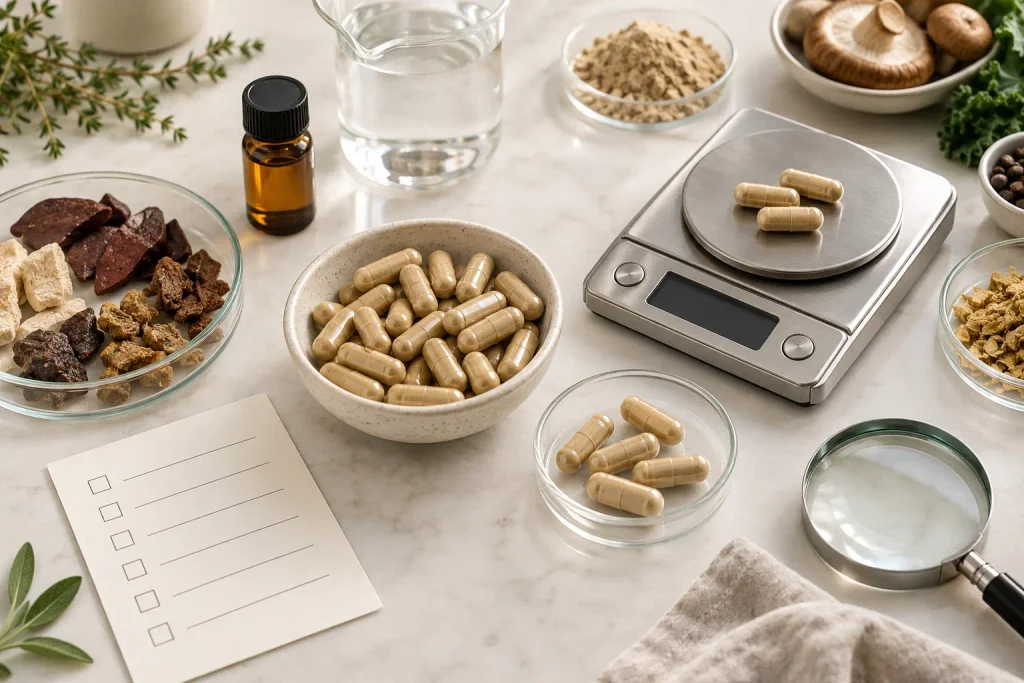
Start with what you already eat. How often are liver, other organs, seafood, dairy, fruit, and other nutrient-dense foods actually on your plate?
From there, decide what you’re trying to add.
If you want a broad Animal-Based foundation, a multi-organ formula makes sense. If you specifically want liver, choose a liver-focused product. If bloodwork shows a specific deficiency, a standardized nutrient may be the better tool.
Then check the basics:
- Are the food ingredients clearly named?
- How much are you getting in a full serving?
- What nutrients does the formula actually provide?
- What still needs to come from food?
- Does it overlap with anything else you take?
- Is the finished product independently tested?
An organ formula doesn’t need to provide every nutrient to be useful. Its job is to bring concentrated, nutrient-dense animal foods into the diet in a form that’s easy to use consistently.
Vitamin C, calcium, magnesium, omega-3 fats, and other nutrients can come from the complementary foods that make up the rest of an animal-based diet.
Is Heart & Soil Beef Organs the Best Whole-Food Multivitamin?
For someone looking for a broad, animal-based whole-food alternative to a conventional multivitamin, Beef Organs is Heart & Soil’s strongest starting point.
It combines liver, heart, pancreas, spleen, and kidney, bringing more nose-to-tail variety into the diet than a liver-only product and making regular organ intake practical for people who don’t often eat fresh organs.
Beef Organs is not a conventional multivitamin with standardized Daily Values, and it isn’t designed as a clinical treatment for a diagnosed deficiency. Those are different jobs. If focused liver nutrition is the goal, Pure American Liver is the more targeted option.
For more on sourcing, testing, and safety, see our organ supplement safety guide.
Frequently Asked Questions
What is the best whole-food multivitamin?
Heart & Soil Beef Organs is the strongest whole-food multivitamin option in the current lineup for broad, foundational support. It combines freeze-dried liver, heart, pancreas, spleen, and kidney from grass-fed, grass-finished cattle, providing a wider range of organ-derived nutrients than liver alone. It is also Informed Sport certified and independently tested.
What is a food-based multivitamin?
A food-based multivitamin is a supplement that derives some or most of its nutrients from identifiable food ingredients, like organ meats, fruits, vegetables, or algae, rather than relying entirely on isolated vitamin and mineral compounds. Many products blend both approaches, so reading the ingredient list matters more than the front-of-label claim.
Is a whole-food multivitamin better than a regular multivitamin?
Not automatically. Whole-food products offer a natural nutrient matrix and food-based compounds, while conventional multivitamins offer standardized, precisely dosed amounts you can compare against the Daily Value. Which one fits better depends on whether you’re trying to round out your diet or close a specific, confirmed nutrient gap.
Are whole-food vitamins better absorbed?
Some are, but absorption depends on the individual nutrient and its chemical form, not on whether the source is labeled whole-food. Preformed vitamin A and heme iron from liver absorb well, but several isolated nutrients, including some forms of B12, absorb just as effectively without needing to be freed from a food matrix first.
What is the most bioavailable multivitamin option?
There isn’t one universal answer, since each nutrient has different absorption requirements whether it comes from food or an isolated form. Heme iron and preformed vitamin A from liver tend to absorb well, while other nutrients like B12 can be just as bioavailable from a well-formulated isolated supplement.
Is liver better than a multivitamin?
Liver is exceptionally nutrient-dense for select vitamins and minerals, including vitamin A, B12, riboflavin, folate, and copper. It doesn’t meaningfully provide vitamin C, calcium, magnesium, vitamin D, or fiber. A conventional multivitamin can provide more standardized coverage of some of those vitamins and minerals, while neither replaces a varied diet.
Can organ supplements replace a multivitamin?
Organ supplements can provide meaningful amounts of nutrients like vitamin A, B12, iron, and copper, potentially reducing the need to supplement those nutrients separately. They don’t reliably provide vitamin C, calcium, magnesium, fiber, or omega-3 fats. A varied Animal-Based diet, not a single organ formula, is what closes the remaining nutritional gaps.
Is a multi-organ supplement better than liver alone?
Neither is universally better. A multi-organ product like Beef Organs offers broader organ variety across liver, heart, pancreas, spleen, and kidney, while a liver-only product offers a simpler, more focused nutrient source. The right choice depends on whether you want breadth or a specific liver-derived nutrient profile.
What should I look for in a whole-food multivitamin?
Look for identified food sources rather than a vague proprietary blend, a transparent serving amount in grams or milligrams, third-party testing, clear sourcing information, and realistic claims. A trustworthy product also tells you plainly what nutrients it doesn’t cover, rather than implying it replaces your entire diet.
Does a whole-food multivitamin need a Supplement Facts panel?
Yes. Most dietary supplements sold in the U.S. must carry a Supplement Facts labeling panel, subject to limited exemptions. It identifies serving size and dietary ingredients and generally discloses their amounts per serving, making it easier to compare products and spot nutrient overlap.
Can whole-food multivitamins correct a deficiency?
They may contribute relevant nutrients, but a significant, confirmed deficiency often needs a standardized dose, an investigation into the underlying cause, and follow-up bloodwork. Iron and B12 deficiencies in particular are usually better addressed with a clinically dosed treatment plan than with a broad food-based formula alone.
Are conventional multivitamins bad for you?
No. A well-formulated conventional multivitamin can help fill dietary gaps when your diet, appetite, or health status makes that difficult. Risk generally comes down to dose, ingredient choice, and unnecessary overlap with other supplements, rather than something inherently wrong with standardized, isolated nutrients themselves.
Can I take organ supplements with a regular multivitamin?
Possibly, but compare preformed vitamin A, iron, copper, selenium, B12, folate, and iodine across every product first, since these can stack up quickly. The adult upper limit for preformed vitamin A stays fixed at 3,000 mcg RAE per day no matter how many sources contribute to your total.
What is Heart & Soil Beef Organs?
Heart & Soil Beef Organs is a freeze-dried, five-organ supplement containing liver, heart, pancreas, spleen, and kidney from grass-fed and grass-finished cattle. It’s positioned as a broad Animal-Based nutritional foundation for people who don’t regularly cook or eat organ meat themselves, not as a complete multivitamin replacement.
Is Beef Organs a complete multivitamin?
No. Beef Organs provides broad organ-derived nutrition, including vitamin A, B12, copper, and heme iron, but it doesn’t standardize or meaningfully supply every essential vitamin and mineral, like vitamin C, calcium, or magnesium. It’s built to be a nutritional foundation, not a stand-alone replacement for every nutrient your diet provides.
What is the difference between Beef Organs and Pure American Liver?
Beef Organs combines five organs, liver, heart, pancreas, spleen, and kidney, for broader nose-to-tail variety, while Pure American Liver contains only liver for a more focused, simpler formula. Choose Beef Organs for breadth, and Pure American Liver if you specifically want concentrated liver-derived nutrients without the other four organs.
Can pregnant people take organ supplements?
They should seek prenatal-care guidance first. Liver contains concentrated preformed vitamin A, and organ supplements don’t provide the standardized folic acid, iron, iodine, and vitamin D a prenatal formula does. Heart & Soil still views organ foods as valuable during pregnancy, but total vitamin A exposure needs individual attention.
Who should avoid organ-based multivitamins?
People with iron- or copper-storage disorders, gout, or liver or kidney disease should seek guidance first, since organ meats concentrate the exact nutrients that can become risky in those conditions. So should anyone with pregnancy-related concerns, a diagnosed deficiency, or several overlapping vitamin A, iron, or copper supplements already in their routine.
Subscribe to future articles like this:
